Terry Pratchett [1948-2015]
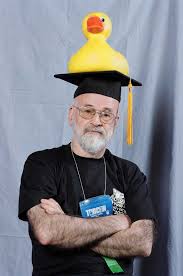 I have been reading Terry Pratchett since I lived in Boston (circa 1993). I “discovered” him from the book Good Omens, which he co-wrote with Neil Gaiman (who I had also recently discovered). I recently learned that even though I purchased Good Omens, I had never actually read it. Duh. Perhaps I was planning to read it in order after reading his Discworld books.
My fondest memory of reading Discworld is that when I first bought the Discworld books (not easy to get in the States back in 1993), the only versions I could find were these tiny editions (which now I can’t even find evidence of online–perhaps I am the only one who owns them). I have no idea why they were printed in this preposterous format (the couldn’t have been more than 5 inches square with stupid tiny print). And I remember diligently reading them at lunch at work. Which must have looked absurd. I have these books at home and will have to look up the ISBNs to see their virtual existence.
At any rate, those first four books in the Discworld series all came in that format and I read them all. And then I proceeded to read through the rest of the series (which would have been up to about book number 17 or so). At the time of his death there were some 41 books in the Discworld series, including YA books and, geez well so many other things.
And what were they about? Everything. Literally. He talked about religion and science. He talked about metaphysics and witches, he talked about working and police. He eventually started using popular culture as the basis for a lot of his books–riffing on something or other but never simply parodying them. His later books advanced the civilizations on Discworld from a more medieval setting to a more contemporary one with newspapers, telephones, money and steam engines. And of course, there was always Death. Amazingly he managed to make all of this funny–usually a good laugh every page or two.
But while the books were full of jokes, it was the characters that were so compelling and thought out that made you want to keep reading. Whether it was the smart and sassy witches, the foolish yet wise professors at Unseen University, the sensible and surprisingly progressive Watch (each book brought a new “minority” to the Watch and each was ultimately accepted (even the Vampire)) or any of the dozens of others.
I hadn’t been as excited to read the last few, perhaps because he had moved away from some of the great characters of the first couple dozen books. Although the more recent addition of Moist Von Lipwig was no small feat. Perhaps it didn’t feel as urgent as it once did to read his books.
And now somehow it feels more urgent than ever to revisit the books. At the bottom of the post I have included a fairly recent image that someone has made of the proper way to read the Discworld books (grouping them by mini-arcs). I was thinking that rather than read them in sequence I might try to read them by arc just for shits and giggles.
But this is not a post of giggles. I was saddened to hear in 2007 that Pratchett had been diagnosed with Alzheimer’s. I assumed that that would be the end of his writing. But apparently he was able to keep working and even released some great books in the interim–most of his ailments were physical and not cognitive.
He said he would prefer to die by assisted suicide (although he hated the term) rather than lost his facilities. However, he stayed fairly healthy up through 2014. He died on the 12th from a chest infection.
The character of Death appears in every Discworld novel. Sometimes he has a large (often comic) role. Sometime he just appears briefly and has one line. Every time Death speaks, his dialogue is in all capital letters. When Pratchett died, his daughter tweeted three items. And they make me cry every time I think about it.
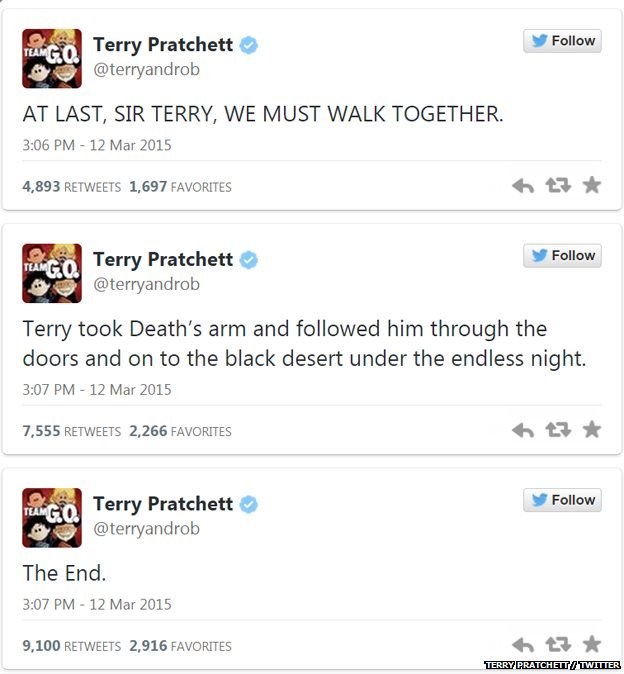
May the Small Gods welcome him.
And here’s the chart I mentioned above, which you can find here.


 I Just Read About That...
Leave a comment