 SOUNDTRACK: MARAJ-“Gettaway” (Tiny Desk Contest Runner-Up 2015).
 Last week, a Tiny Desk Contest winner was announced. This week, All Songs Considered posted ten runners up that they especially liked. And I want to draw extra attention to a couple of them.
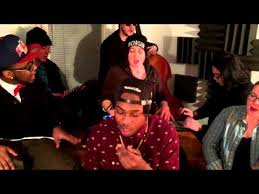
I know very little about these bands, but I assume that these folks are all members of Maraj. They are from Kalamazoo MI and they do hip hop with a twist. I loved that there was a live upright bass player. And that the music had a steel drum sound (although it was all electronic).
The verses were done by two different rappers Motor Cit Kam–whose flow is incredibly fast and clear (even if I didn’t actually know what he was saying, the style was great) and Dari G who has a very different flow (and also sings a beautiful backing vocal later). I enjoyed that there were two rappers, but I liked even more that the third verse (or perhaps bridge) was sung by two of the women in the band. They totally change the tone of the song—an excellent mix of rap and singing.
What I thought set this song apart was that the chorus–while the music was the same, the slower singing gave a very different sound to the song. It really changed the flow from the fast first verse. And the singers–all six of them–all sing well together.
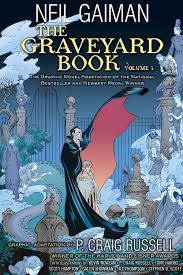
[READ: December 23, 2014] The Graveyard Book
Back in 2009, I read the prose version of this book. Now in 2014, it has been re-imagined as a graphic novel. And it’s funny, now that Gaiman has well established himself as a novelist, that I forgot he was originally a graphic novelist. So this format works for him quite nicely.
As I said, I read the book five years ago, but I didn’t remember all the details. Naturally the most exciting parts came back to me as I was reading it, but the little details has been lost to time.
I gave a rather detailed review of this book here and there’s really no reason for me to rewrite what I thought about it because it is pretty much unchanged.
But in sum: the story is about Bod Owens. His family was murdered when he was 18 months old. He escaped to a graveyard (while the killer tried to track him down) and he was raised by ghosts. They keep him safe from Jack, the killer, whose superiors want him to finish the job.
The first few chapters are basically short stories. I loved the episodic nature of these “chapters” which are about the same person but are resolved as if they were short stories. So when the story comes full circle in the later chapters (or in Volume 2 in this version), it feels even more powerful and more satisfying.
The big difference here is the artwork, of course.
Seven artists worked on Volume 1: Kevin Nowlan, P. Craig Russell, Tony Harris, Scott Hampton, Galen Showman, Jill Thompson and Stephen B. Scott
Five artists worked on Volume 2: David Lafuente, Scott Hampton, P. Craig Russell, Kevin Nowlan, and Galen Showman
While each artist’s style is different, they work in the same overall style of dark shadows and angular features.
Nowlan’s baby in chapter 1 is wonderfully knowing, with a creepily adult expression that makes him rather intimidating. Russell’s Bod is older, and he gets to introduce us to Scarlett. Harris and Hampton have very different styles (I don’t know whose is whose)–one is rather cartoony, while the other is really really creepy. Galen Showman’s matches the others quite well, and the presence of the dead witch is handled very well. Jill Thomson gets to do the brightest chapter-the danse macabre, and then Stephen B. Scott draws the brief interlude.
Volume two’s stories are much longer. Lafuente gets some great use of color with some dream sequences and school scenes. Hampton is back (and now I can tell this he has the creepy drawings from that chapter in Vol 1) And Russell, Nowlan and Showman return for the final epic conclusion.
Their mildly different styles really do allow for the differences in story arc and purposes and it’s a nice combination.
I don’t believe anything is left out of these stories from the original (obviously some things were, but nothing major) and I’m sure Gaiman had a lot to do with the production as well. As for whether to read the graphic novel or the novel? I think it’s a matter of personal preference–you probably get more details in the novel, but I think you may get slightly different, and possibly unintended details from the artists.

 I Just Read About That...
Leave a comment