 SOUNDTRACK: THE BEATLES-Yellow Submarine (1969).
I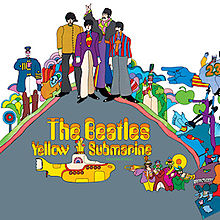 ‘ve enjoyed listening to the Beatles lately, but I’ve been marveling more at how they were (I assume) pressured into releasing songs almost constantly (this is their tenth album in six years). So, this album, a soundtrack to the film, came out six weeks after The Beatles. Six weeks after a double album which was still on the charts (still #1 in the US) this album came out.
Even though it sold very well, I imagine it has to be the least-listened to Beatles album (even though it is the other vinyl Beatles album that I own, which I got when I was a kid).
There are 13 tracks on the disc. Two are repeated Beatles songs. Four are “new” songs (meaning they were thus far unreleased, but they were recorded a while back) and the rest are orchestral songs from the movie, composed by George Martin.
The repeated songs are “Yellow Submarine” (from Revolver, although obviously it makes sense here) and “All You Need is Love” which was just recently released as a single (and on Magical Mystery Tour in the US and which works fine in the movie).
The new songs include: “Only a Northern Song” written by George Harrison. It was recorded during the sessions for Sgt. Pepper. I didn’t know anything about the song, and I thought the lyrics were kind of, um, dumb? But now I see that they were written because Harrison was angry about being a contracted songwriter to the Beatles’ publishing company, Northern Songs: “It doesn’t really matter what chords I play/What words I say or time of day it is/As it’s only a Northern Song.” The song itself is kind of unusual. It opens with a big organ sound. Then with the lines saying it doesn’t matter what chords the play, the backing music is pretty out there–not quite wrong, but certainly off.
Harrison got a second song (this has to be the most songs per disc for Harrison). “It’s All Too Much.” It also starts with an organ. It’s the only psychedelic song on the album (and has Indian overtones). It was recorded during Sgt Pepper and was supposed to appear on Magical Mystery Tour. I like the song, but at 6 and a half minutes, it’s a bit long (the original mix was 8 minutes!)
“All Together Now” is a goofy song. It’s clearly something written in five minutes–the lyrics and melody are so simple–but man is it catchy and fun to sing along to. The final new song is “Hey Bulldog.” I really like this song a lot and I’m bummed that it’s kind of overlooked on this soundtrack. The riff is really hard rocking (even on piano) and I like the silliness with the barking and whatnot at the end.
The second side was the orchestral songs. Most of them are about 3 minutes long. If you know the film, they’re fun to listen to to revisit the visuals, but they’re not what you get a Beatles album for. Of course, I always listened to sides one and two of my records, so I must have listened to the score three or five dozen times back in the day.
[READ: June 10, 2014] “A Mistake”
This was one of the 2014 New Yorker stories that I thought I had posted about but which I just found in my drafts pile.
This is the story of a boy from India who has emigrated to America with his family.
As the story opens we learn that the boy’s father always wanted to leave India, he felt he could do better in America, although the boy’s mother had no interest in leaving her home.
There’s some very funny lines about the father. Like “I used to assume that my father had been assigned to us by the government. This was because he appeared to serve no purpose…all he did was sit in his chair in the living room, drink tea and tread the paper. Often he looked angry.” But then his father left for America and a year later called for them.
It’s interesting to see the family marvel at American conveniences that seem so easy to take for granted. And even more amazing to think that a family from India would find hot running water to be amazing.
They enjoy America–the libraries are huge! Although the narrator finds himself picked on here–told he smells funny–even though at home he was fairly popular. On the other hand, his brother, Birju is very popular–he is athletic and handsome and makes friends easily. The narrator really just loves watching TV and going to the library.
In stereotypical fashion the parents expect that the children will succeed tremendously here because Americans have given up and become complacent. They force the boys to play tennis (a rich persons sport) and to study a lot. Birju who is older is forced to study for the Bronx High School of Science admission test. Their dad had heard a coworker talking about this school and so he had to get in. They made him study three sometimes five hours a night for this one test.
He fears the worst. He is tired, his English vocabulary is not very good, but perhaps his math and science will make up for it. And the narrator can just sit back and watch his brother struggle and study.
The end of the story (I’m jumping ahead here) changes things tremendously. The narrator’s concern that his parents love Birju more than him is given a test. And even though a terrible thing happens, the narrator feels a sense of lift in his life. Until he realizes just what he had lost and just what it is he is thinking.
The story went in a direction I certainly didn’t expect. I enjoyed so much the beginning about how the family assimilated and the struggles they went though but the ending seemed excessive. Although thinking back on it now, that was a very memorable sequence.

 I Just Read About That...
Leave a comment