 SOUNDTRACK: THE BEATLES-Sgt. Pepper’s Lonely Heart’s Club Band (1967).
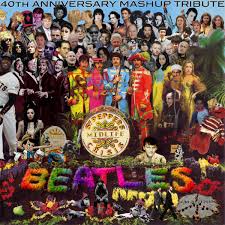 A few years ago I started writing about Beatles records–a thankless task if ever there was. I got held up at Sgt Pepper, so it seems fitting to get back to the Beatles after enjoying the cover album from the Flaming Lips.
I have long thought that this was my favorite Beatles album–it was the first one I bought on vinyl, after all. But when I was writing about the records last time, I discovered that I like Revolver a little better. I’m surprised by this especially since I really enjoy all of the amazing musical advances the band made with this album (and the psychedelics too). I mean, to pretend to be another band, to add a full orchestra–the band had pretty much given up touring at this point–and to have added so many interesting things to this record is really amazing. And I don’t mean to say that I dislike the record, just that I think Revolver is better.
The title opening is great with the horns and sound effects (just so you know, Paul’s voice is all in the right channel, something that sounds really weird if you only listen to the left!). In fact the whole album has all kinds of fun stereo manipulations.
“With a Little Help from My Friends” has so many great vocal parts and I love the bass–slow and simple but playing unexpectedly high notes. This apparently also means that Ringo is Billy Shears. Speaking of the concept, this album doesn’t really work as a concept album–I mean, overall, what’s the “message”? There are some songs about love (the lonely hearts club) but there’s also some songs that are not at all about love. And how does say “She’s Leaving Home” connect to “Mr. Kite?” It doesn’t really matter, I suppose.
“Lucy in the Sky with Diamonds” is just great–everything about it from the harpsichord to the weirdo processed vocals and the big drums for the chorus (the chorus could actually be a bit bigger) still sound tremendous. “Getting Better” sounds very old school Beatles to me–I like it but it doesn’t really fit the psychedelic nature of the album. The harmonies are great (“it can’t no worse”). It’s also a strangely simply love song I believe, even though it seems like it’s about life in general. On a sour note, what’s with the Beatles beating their women?
“Fixing a Hole” has a great melody line and instrumentation. I have always liked “She’s Leaving Home,” I think it’s pretty and the lyrics are great. But I suddenly find it to be a bit too slow and string-heavy–guess I’m just a rocker at heart? Interestingly there’s no other Beatles playing instruments on the song. “Being for the Benefit of Mr. Kite!” is all sung in the right speaker. It’s a wonderfully weird song with great instrumentation.
I’m constantly surprised by “Within You Without You” just because it is completely Indian–no Beatle plays on the song at all, expect for George. There are also uncredited Indian musicians on swarmandal, dilruba, tabla, and tambura–imagine that there are Indian musicians who can actually say they played on Sgt Pepper, and be telling the truth! I feel like with a 5 minute song (twice the length of any other song on the disc, except the closing) that Indian music should have become much more popular (or maybe people just skipped the track–it was track 1 on side 2 after all.
The delightfully silly, but somehow profound “When I’m 64”–vocals sped up a bit and bouncing from left to right ear seems like a trifle but is still fun. “Lovely Rita” is a fun jaunty song. I like that he thought she was cute dressed as a military man. Interestingly, she pays for dinner. “Good Morning” I feel is more known for the chorus, while the verses are a bit obscure. Although it’s interesting to hear the kind of fast verses that Lennon sings (and that scorching guitar solo (from Paul!) is pretty cool).
I’m intrigued that “A Day in the Life” comes after the song that seems like it should end the record (the Pepper reprise). “A Day in the Life” really does get better with each listen–the closer you listen, the better it gets, too. It’s a great way to end any disc.
So yes this album is great and incredibly influential. I love listening to it. The biggest surprise to me is that the album is only 39 minutes.
Thirty-nine minutes!
[READ: January 24, 2015] “Last Meal at Whole Foods”
This story is set in a Whole Foods (duh). The narrator is eating dinner with his poor mother. He says that she is till young which is the tragedy, since she is close to death. They had a doctor’s appointment earlier which was meant to be “a formality.”
While they are eating he tells us that she has maintained an appetite even though she was always just a nibbler. But as of late her apatite has been voracious.
The man then reflects back on the location of the Whole Foods. Twenty years ago this street was apart of a dicey neighborhood. The only building was the Goodwill. The Goodwill that he and his other shopped at when they first moved to the area.
On their first outing there (his mother was so excited to get to building) she bought him a football jersey–even though he didn’t follow the local team. But the jersey proved to be a very cool item and the boys all talked to him about football because he wore it–there was even a rumor that he was related to the name of the back of his shirt.
The street has been all gussied up now with Whole Foods and Starbucks, although the Goodwill is till there–and it will no doubt outlast everything else.
After dinner, they play Scrabble. It is August, but the narrator asks if he should start a fire in the wood burning stove–in order to “create a moment.” His mother agrees, although by the end of the game he is sweating profusely.
When they played Scrabble when he was kid, his mother always encouraged him to play better words than just ‘cat’ or ‘dog.’ She was eager to help and this compounded his powerlessness. But now in the present his mother is reduced to spelling works like ‘at’ and ‘or’ and he considers helping her. But more importantly he wants to play something amazing with his letters: aamasjp.
When he finally sees the word, the word he has been struggling over, the symbolic victory to make his mother proud, he realizes that she has fallen asleep.
The next section of the story has the narrator checking out an assisted living facility–more depressing with each step. But even more depressing was his decision to take him mother to see Life of Pi in 3-D. And he says that desolation in 3-D is something no one should experience.
The end of the story sees him and his mom in a diner (so their last meal was not in Whole Foods). The team whose jersey he wore when he was a kid is on the television. Over the years they have done nothing but disappoint and yet still the people always expect more from them. They diners as the team plays well, and then the last line undercuts everything. It’s a great ending to a sad story.
I have really enjoyed the stories I’ve read by Sayrafiezadeh.
For ease of searching, I include: Said Sayrafiezadeh

 I Just Read About That...
Leave a comment