 SOUNDTRACK: DAVID BOWIE-“The Laughing Gnome” (1967).
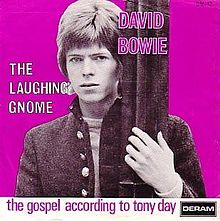 I have always liked David Bowie. Never loved him, but always liked his radio hits (and a bit more). Suffice it to say that I have never heard of “The Laughing Gnome” before reading about it in this book.
What a strange little song. I can’t tell if it came out before or after his debut solo record (he has the same haircut), but I gather it was released as a novelty record.
It’s a delightful little song. Very sixties mod with a healthy nod of dance-hall. The very different thing of course is that in the song, the main singer (Bowie) meets and sings with a sped-up-voiced Cockney “gnome.”
So the song is clearly a novelty song (what else would you call it?). Except that the production is really great and the music is really good too. Despite the gnome, the song isn’t really a “funny” song (well, there are jokes and puns, I guess). It’s certainly weird and certainly silly, but it holds up pretty well to repeated listens (even if the chorus is “ha ha ha hee hee hee I’m a laughing gnome and you can’t catch me”).
Bowie doesn’t really acknowledge the song anymore, although he did joke that he was considering performing it in a new ‘Velvet Underground-influenced’ style. Before that happens, hear the original
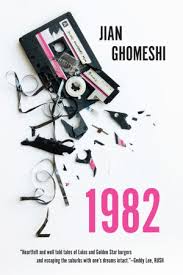
[READ: November 22, 2014] 1982
So yes, I know that Ghomeshi is in the midst of a scandal in which he is pretty undeniably a sexually abusive scumbag. I’ll say nothing more about that since things are still under investigation {formal charges were brought today]. But it doesn’t look good for Jian.
This is rather upsetting. For the women involved, obviously, but also for those of us who liked Jian and thought he was one of the good guys. Which I did. I loved Moxy Fruvous. I loved his solo album. I had a brief email exchange with him before he joined the CBC, and his show, Q was one of the best interview shows out there. He always seemed so nice and on the right side of so many issues. Ugh.
But anyhow, this is about the book, not him (although the book is about him as well). I only heard about the book when I was looking for news about his scandal (I had no idea he had written a book). The book is called 1982 because it is all about his life in the year 1982, a formative year in his childhood.
Here’s what we learn about young Jian: he was born in England. His family moved to Canada when he was young. They eventually settled in Thornhill, a suburb of Toronto, where his was the only Iranian/Persian family there. He was poor at hockey. But he loved David Bowie and was inclined towards new wave music.
The story is told in a non sequential style, which I found enjoyable (it was good for establishing suspense). The main focus of the year seems to be his attempts to be with Wendy, his heart’s true love. Wendy is super cool, a few years older than him and she looks just like Bowie. After longing for her for most of the year, he plucks up the courage to ask her to the Police concert that summer (Police Picnic ’82–evidently the Police did annual festivals in Toronto during the 80s, huh). She is super exited to go (if not necessarily with him).
We see him before, during and after the concert. We hear about his early new wave bands and a slight foreshadowing about Moxy Fruvous.
The main takeaway from the book, however, is the writing style. It is very….childish/simple/repetitive. Which is very odd for someone who writes great sophisticated lyrics and who does not speak this way when he interviews people. At first I assumed it was written this way for one of two reasons. The first is because it was a reflective memoir–recreating the style of a younger more naive person (although he should have talked better than this). The second is because at times he treats the book as primer about the 1980s for those who are too young to remember. Is he talking down to the audience? It’s not clear.
There’s really nothing wrong with either of these reasons, but the whole book just comes across as so oddly juvenile. And repetitive. Did I say repetitive? We hear the same segments of stories a few times, and even stranger, we often get things where he tells you a bunch of things and then says that he made “a short list (shortlist?)” of the same things. So he talks about going to Canada for the first time and being scared of the unknown:
I had been told about the snow. And I had been warned about all the spiders. And I had overheard our next-door neighbour in England, Mr. Boggart, telling my mother that Canada was a ‘vast land.’ That sounded scary as well. I was afraid of all of these things.
I have made a short list of the things I was scared of finding in Canada before arriving in the 1970s:
- spiders
- snow
- vast land
- slippery ice
- bearded father
It’s weird.
The biggest repeat in the book is David Bowie. Bowie wishes he got a royalty every time his name was mentioned. In fairness, it did make me want to listen to more of Bowie, but wow.
Some other oft-repeated things:
- his red and blue Adidas bag (boy, that should have been on the cover)
- Wendy
- Wendy looked like Bowie
Things are more interesting when he diversifies his musical tastes. Indeed, his memories of the Talking Heads live at the Police concert are awesome and really make you relive that feeling of a life-changing concert experience.
Another great musical memory (and one that I found really moving) was when he and his best mate found out that Rush were preparing for their upcoming tour by playing in a studio right in their hometown. So he and his friend camped out in the parking lot behind the studio and waited for the guys to emerge–for over a week! The fact that Geddy and Alex actually acknowledged him at the end was a wonderful conclusion and was very satisfying.
His stories about school are also interesting–that there were two schools in his town (a “normal school” and an “artsy school”). And how he grew up with an immigrant family who would really rather him be an engineer than, gasp, a musician. But Jian made progress. He joined the theater folks, he started doing morning announcements at school and he even started a band.
I also enjoyed his discussion about his prehistoric 1982 seems in 2012. Talking on phones with cords (which meant no privacy). Traveling across town to buy a vinyl album and then having to travel all the way back before you could play it. Not being able to double check things on the internet. How did we ever survive?
The book ends in a very unexpected manner. He has one of those moments that seems to happen to everyone in fiction (could this really have happened to him in real life) where two women are expecting to dance with him and he has to choose one. But the ending is a cliffhanger. What a peculiar ending making us have to decide what happened, especially since the rest of the book was so explicit.
So yea, I enjoyed some of the book. I wish it didn’t repeat itself so much. But I liked seeing suburban Canada through his eyes and “meeting” Rush. I have to wonder what Wendy is doing these days.
Speaking of these days–there’s no indication in the book of anything salacious about his future (actually current) self. Although given all I have heard about Big Ears lately, it was a little creepy to see him acknowledged at the back of the book.

 I Just Read About That...
Leave a comment