 SOUNDTRACK: BEACH HOUSE-Bloom (2012).
 I loved Beach House’s previous album–the way it was magically lighter than air with swelling melodies and the unearthly vocals Victoria Legrand. Bloom opens with “Myth” which continues the magic–the simple but beautiful opening melody and then a soaring chorus which is just amazing.
But something happens after that first song, and the album suddenly comes down to earth. Perhaps it is the fairly conventional guitar and drum sound that opens “Wild” (it’ sa very cool 90’s ear guitar sound, but I feel like it doesn’t quite work with her voice. The song is still pretty, but I kind of lose interest before it ends.
Similarly, I like the simple synth opening to “Lazuli” and her voice soars nicely here, but I’m not compelled to pay attention all the way through. As I’m writing about the songs, I want to say that they are all pretty with nice melodies. And as each song opens, I smile with recognition at the quality of the song. But I keep drifting away from the song before each one ends. Is it because each song is nearly five minutes? Maybe.
The more I listen to the album the more I like most every song–there’s something about each one that I find engaging, and yet overall the album just doesn’t grip me as much as the previous album did.
It still sounds magical, but something is missing, and I’m not quite sure what that is.
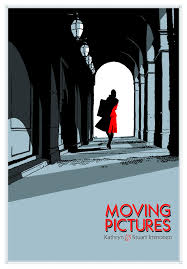
[READ: October 24, 2014] Moving Pictures
This graphic novel was simply fantastic. It was one of the most powerful and moving stories I’ve read in graphic format in a long time. I loved everything about it (even if some of the details of the story were a wee bit confusing–see below). The story explores the relationships that formed during the Nazi occupation of Paris. Specifically between a Canadian museum curator and a German soldier.
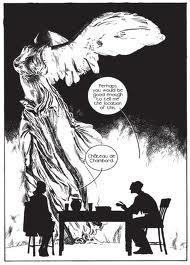
Primarily, I loved the artistic style of this book. It is black and white with some very dark sections–especially in the interrogation room where harsh shadows obscure so much. As the book opens, we see a woman sitting at a table under a harsh lamp. It is only when the POV shifts to her profile that we see the very fine and delicate lines that comprise her face. And that balance of fine lines and huge swaths of black is really stunning.
 There is then a flashback. The woman from the room, Ila, is speaking to another woman who looks more or less like her (it is hard to tell the women apart as they are both blonde, with such think lines for features). They are at a train station and Ila is encouraging the other woman to take Ila’s papers and flee. She says she won’t be needing them.
Then we return to the room, where a man, who we learn is Rolf the soldier, enters and begins interrogating her. He asks her questions, but after a few, she asks him if he has been drinking–something is clearly unusual about this interrogation. In the course of the questions, we learn that Ila is the curator at a museum. And he begins asking her the locations of certain works of art. What is gorgeous here is that the two remain silhouetted, but the artistic pieces are blown up to full size as background images. And they are wonderfully rendered.
Then he asks about some small things “hidden” in the basement. And then he asks if she is still mad at him. This interrogation seems more personal than political. We also learn that he asked her to keep one small artifacts and that she can’t remember where it is.
In another flashback we see her with a man named Marc. We see that Marc is with the woman from the train station whose name is Jane. And that he two women are packing up the art into crates with a comment hovering over them–“If they want it, they’ll just take it.” We also learn that both women are from Canada and that Jane wants to go back–she misses snow, she wants to get married, and she wants Ila to go with her. But Ila is happy here, despite everything.
In yet another flashback we see how Ila and Rolf met. He is a military art commission officer who is cataloging everything in these galleries. But he also seems to have an appreciation for art. Soon we see that he and Ila have entered a relationship. And then we see him ask her to get him a piece of art for him. She says she won-t steal it–that’s his job, but she consents to his request.
And as the story slowly draws to a close, we see the compromises and troubles that indiscretion has caused.
The only trouble I had with the book was that Marc and Rolf look quit a bit alike, so it’s not clear on first reading exactly who is asking her to do what. But on closer inspection, it becomes clear and the story is even more powerful and interesting. I love the juxtaposition of the title (which of course has to reference Rush in some way, eh?). And in this instance, the multiple layers of the phrase really work well.
I hope to find more of this husband and wife’s work.

 I Just Read About That...
Leave a comment