 SOUNDTRACK: THE DECEMBERISTS-Long Live the King EP (2011).
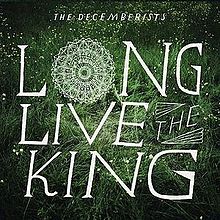 Long Live the King is an EP that was made of outtakes from their previous (and so far final) LP The King is Dead. In the style of that album–straightforward folk songs with country tinges, this EP makes a fine companion. “E. Watson” is a classic storytelling Decemberists song. It has a great chorus and really wonderful harmonies. There’s a pedal steel guitar on “Foregone,” which adds a neat sound to this really catchy song. In fact, the chorus is one of the catchiest things they’ve done, and it’s hard to believe they tucked it away on this EP instead of the album.
“Burying Davy” (which I had been mishearing as Burying Babies, such is the darkness of Colin Meloy that that was a real possibility) is a much creepier song. The melody is dark and minor chord and yet it’s somehow still catchy and strangely fun to sing along to. “I 4 U & U 4 Me” rumbles along with a great Smiths-esque bass line. This version is a home demo (although there’s no non-demo version that I know of). “Row Jimmy” is a cover of Grateful Dead song that I do not know. It’s the slowest and most shambolic song on the EP. I don’t especially like it, but I do like the way he sings “Get Down and” before some choruses. “Sonnet” is a pretty straightforward folk song. It’s done on acoustic guitar and features Meloy’s falsetto at certain times. But just as the song seems to be a pretty standard acoustic guitar ballad, a whole bunch of horns blast in and play along.
Even though this is an EP of predominantly folk songs, there’s some cool headphone stuff going on in this album as well (especially the guitars on “Burying Davy”), so turn it up and tune out for 25 minutes or so.
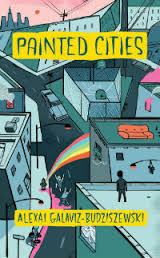
[READ: October 18, 2014] Painted Cities
Painted Cities is a collection of stories (I assume they are all short stories although the early ones read a bit more like essays) that are all set in the Pilsen district of Chicago. Evidently AG-B grew up there and these stories are about the people and gangs in this largely Latino neighborhood (the fact that his name is Alexai Galaviz Bidziszewski, which conjures up so many different nationalities, although few of them Latino has certainly confused me, although I have no doubt that these are all based on reality).
There are fifteen stories in the book. I enjoyed the first couple, then I got a little tired of the gangland/macho tough guy aspect of the stories. But just as I was a bout to give up on them, he threw in one with magical realism that I really loved, and the rest of the book was equally interesting. I will say that this region of the country is completely unknown to me and while I don’t typically like gang related stories, these stories did not dwell in the heartache of gangs, but used them as a periphery around which to establish the stories.
Daydreams
I enjoyed the premise of this story. The narrator explains that his mother used to look at negatives of pictures rather than the pictures themselves, so he grew up with the most insistence vivid, but exactly opposite color spectrum in his head.
1817 S. May
In this story the narrator and his sister used to pan for gold from the fire hydrants that they would open up on hot summer days (because there was so much silt at the curbs). This is tied to the games the kids would play when the maintenance man would open those fire hydrant and the kids would hook up something to it to make it spray all over the street. The blocks would have contests to see whose water would go the highest and their block always won. I kept picturing scenes from Do the Right Thing in this story.
Painted Cities
This is one of several stories that has multiple parts. The first Hanging Gardens is about Rom who paints amazing graffiti–so good that building owners asked him to do murals. And one particular art piece that he must have done overnight, was hauntingly beautiful. It was a about a girl who was killed. Her tears reflected the city–how did he get such detail out of spray? The second, Residue, is about a guy in the neighborhood who gets beaten up by a girl’s boyfriend. The third, Underground, is about seeing cities below the ground connected by the subway. The final one, The City That Works, is about Puppet and how he can play Richie Valens pretty well out in the streets.
Freedom
This is a story about the narrator and his friend Buff. They were both young and they built a “house” on the top of the pierogi factory. Buff was a tough kid who bragged about nonsense and threw rocks at cop cars. He eventually joined the Latin Counts and was ultimately shot dead. But during that one summer when they were ten, the narrator and Buff were like kings of the world from atop their perch where no one saw them–until Buff stepped over the line.
Childhood
In this story, Rogelio’s mother begins having an affair with the guy who lives above Sergio’s apartment. Sergio and his brother discover that they can hear them having sex if they hold up a bunch of paper towel tubes to the ceiling. They soon begin letting all the kids in the neighborhood listen. Rogelio doesn’t know any of this–he thinks his mom is working. But since his father left he has become more distant and more religious. And Sergio makes fun of him without revealing anything. This all comes to a head when the Virgin Mary statue goes missing–and secrets are revealed. A fascinating mixture of sex and religion.
Snake Dance
This one is in multiple parts. The first Climbers, is about people who explore in the dark. The second, Distance, is about what lies behind a wall. The third, Damascus, is about the laws of Damascus. The fourth, Snake Dance, is about Papo, a drunken friend trying to make the narrator’s wedding the best ever and ruining parts of it because he is so drunk. I really didn’t enjoy these short pieces all that much.
Maximilian
This is three stories about the narrator’s cousin Max. He was an unpleasant, violent guy. And this was the story, following the previous one that made me start to lose interest in this book.
God’s Country
But this story is the one that saved the book for me. In it, Chuey gains a power from Sonora, God’s Country (even though he himself has never left Pilsen). He is able to bring things back to life. He starts small, with rats and birds. But he eventually builds up to larger animals. They begin scouting the neighborhood for dead things to bring back to life. Then, when a girl who Chuey has a crush on asks him to save her overdosed brother, he’s got to try, right? I loved the magical realism of the story and the great way the story ended. It just cut the wind right out from the sails of the story and it was really powerful.
Side Streets
This story shows how kids in the neighborhood used to pretend to be Caspar, a guy who was shot but still managed to walk to a bar and order a beer so he could get change to call an ambulance.
Blood
This is an instructional piece about what to do when you go into the local bar. From an older to his younger brother,
Blue Magic
This is the final story with multiple parts. The first, The Edge, is about living at the edge of the earth–the point at which you will go no further. The second, Streetlight, is about climbing into a local girl’s window. The final one, Blue Magic, is about dancing and dancing.
Growing Pains
This story is about a boy who spoke no Spanish and his grandmother who came in from Mexico one week ago. Part of the story is their journey to pick her up at the airport. But mainly the story is about how the boy’s mother coped with her own mother visiting.
Sacrifice
This is a tough, gritty story. It’s written by a man who has adopted his wife’s son (who is now five). But the boy’s father keeps sneaking around, breaking into their house and leaving love notes for the boy’s mother. The narrator loses his patience and does what he thinks is necessary. How can he tell his son what happened? I found this one very moving.
Supernatural
This is a weird story about a ghetto miracle–about people believing that the radioactive waste water would heal them.
Ice Castles
The only time the narrator saw his father–who worked long hours driving a cab–was at night whenever a local house caught fire. He would drive his son to watch these fires and then watch the fireman out them out. They would stare at the blazes for hours until they were out. Then they would return reeking of smoke and hoping it never happen to them. The ice castles would form when the buildings were put out in the middle of winter. A Beautiful image from a horrible tragedy.
~~
I’d certainly read more from him, although I’d like to see him move out of the neighborhood for the next group of stories.

 I Just Read About That...
Leave a comment