 SOUNDTRACK: DINOSAUR JR.- I Bet on Sky (2012).
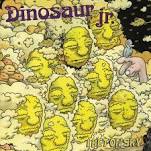 I have been so pleased with the reunited Dinosaur Jr. I’ve enjoyed each of their albums, and feel like they really have hit a great stride of songwriting. The only difference to me is that these songs are all pretty long, something I don’t really think of as a Dino Jr thing. They do often have a few longer songs, but on this disc, 5 songs are over 5 minutes and two are nearly 5 minutes long.
As with the last album, I’m not sure why Lou Barlow agreed to reuniting. Barlow is a great songwriter and has successful other projects. He gets two (short) songs that he write and sings and that’s kind of it. I mean, they sound great and really flesh out the album, but it seems like a weird thing for him to do unless he just likes playing the old Dino stuff again.
And then of course there’s Mascis. It’s amazing how much of a slacker J Mascis sings like and yet what a careful and meticulous guitar player and songwriter he is. And yes, it’s great to have Murph on drums, too.
“Don’t Pretend You Didn’t Know” opens just like a great Dino Jr song—that guitar is unmistakable. It’s a fast rocker. With a big old Dino chorus. There’s a lengthy outro solo that really stretches out the song into a jam. “Watch the Corners” is the other kind of Dino song, a chugger with big slow open chords and a nice riff. (and again a wonderful chorus). “Almost Fare” is the other, other kind of Dino song, poppy with a kind of cute riff and a slow drawl in the vocals. And “Stick a Toe In” is a slower ballad–the fourth kind of song that Masics writes so well. It has a nice chorus (with piano (!)) and some dramatic steps in the chorus. Suffice it to say that although they all sounds like Dino Jr., it’s impressive how many styles of song Mascis writes so well.
Barlow’s first song is “Rude,” a short fast punk rocker. At just under 3 minutes (with no solo) the song pounds along with a very funny chorus: “I wish I didn’t care cause caring is rude.” Even though it changes the flow of the album, it just adds to the diversity that is Dino Jr. In “I Know It Oh So Well” Mascis’ ringing guitar comes back It’s a simple song with just a few chords and a simple interstitial riff, but he makes it sound very full.
“Pierce the Morning Rain” is the only short Mascis song on the disc (and perversely it gives the album its title). It has a very heavy metal guitar riff and a super fast paced (and sung) tempo. “What Was That” is a slow burner with many elements of classic Dino—a great solo in the background of the song and a cool riff along with Mascis’s patented delivery. “Recognition” is Barlow’s other song. It almost makes 4 minutes. It sounds more like part of the record (and, strangely, also like the popular Sebadoh tracks). You can really hear Barlow’s vocal style shine through and it’s a great counterpoint to all the Mascis on the disc. It’s also great song—kind of slow and angular but with a cool fast riff in the bridge. It also features a pretty wild (and un-Masics-like) guitar solo
“See It on Your Side” is the last song and at nearly 7 minutes, it feels a little long. Although that may be because the song seems to end and then starts again. And yet, that end solo is pretty great. It’s a very notable Mascis type riff that starts the song. Even with all of the long songs, the disc still clocks in at around 45 minutes, which is really a perfect amount of Dinosaur Jr. consumption. Looking forward to the next release.
[READ: October 1, 2014] The Eye
 I have had Nabokov on my list of authors to read for a long time. I have read and enjoyed a few of his books and planned to read his oeuvre at some point, just not quite yet. And then, as serendipity would have it, I stumbled on a book of his novellas (the Penguin classic edition) and decided to read them. Because they aren’t really meant to be taken as one item, I’m going to mention them individually.
The book includes a Foreword by Vladimir (his son Dmitri translated this with help from Vladimir) that talks a bit about when he wrote it and how he didn’t bother to include details about the location because it wasn’t important to the story (it’s a surprisingly casual foreword).
“The Eye” is a strange story (technically a novella or a very short novel) in which a man, despondent at the beating he receives, tries to kill himself and then believes that he does.
The narrator has been having an affair with a married woman named Matilda. He’s been a little bored with her lately, and is pretty much over her. But one night when the narrator is working as the house tutor for two boys (the boys are completely disrespectful to him and every scene with them is very funny), the cuckolded husband comes over and really beats him up. Just really lays into him (the narrator’s protestations about this not even being his house are rather amusing). I especially liked that the husband calls first and doesn’t tell him who he is “So much the better–it’ll be a surprise.”
The narrator is so devastated by this attack that he goes back to his flat and shoots himself. Before doing so, he talks about his preparations for suicide and just how silly they are. It’s an interesting look at acceptance of death. But anyway, after he shoots, a few minutes pass and he realizes that even in death, human thought continues. So his death-imagination has him going to the hospital and being mended.
It also imagines him going to see Weinstock at the bookstore. Weinstock, an amusing character who seems to disapprove a lot of what people say.
Because of the phantasmic nature of the story, details all seem a little foggy. And since he believes he is dead, I guess they are not that important to explain. He finds himself renting a room beneath a Russian family. Among the residents are Vanya (a boy’s nickname for a a beautiful young girl) and her married sister Evgenia. The narrator settles in to hanging around with this family and he becomes the “eye” (or spy or watcher as the Russian word is usually translated). He watches everything that happens with the family, and we meet Mushkin and Bogdonvaich and an enigmatic character named Smurov.
When Smurov enters the story he seems exceptionally dull. His contributions to the conversation are bland, but it is clear that he fancies Vanya. And as the narrator observes this scene, he becomes rather obsessed with Smurov. It turns out that Smurov is the occasional house guest of the family and he seems to be (again in a rather dull way) making advances on Vanya, even though she is engaged and is soon to be married. But the narrator finds him so utterly compelling that he can’t seem to stop thinking about him. He wants to know what others think about him, he wants him to succeed in this hopeless cause. He even looks for a diary entry about Smurov (in a very elaborate heist) only to see that the author of the diary assumes that Smurov is probably homosexual.
The ending of the story is very cool, and makes you have to revisit some things. It’s not a genius work, but it is clever and rather funny. And I may have to reread it again to see how it plays a second time.

 I Just Read About That...
Have dove into any of the novels since this review?