 SOUNDTRACK: CHVRCHES-Tiny Desk Concert #356 (May 12, 2014).
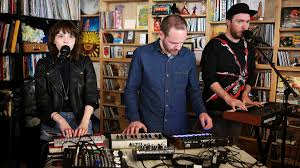 Chvrches are just on this side of the kind of synth pop that I like. I simply can’t deny the awesomely catchiness of “Recover” which must be due to Lauren Mayberry’s wonderful voice, or perhaps the bubbly synth sounds that the three of them generate. In this Tiny Desk version, they brought all kinds of synths along with them. I don’t know what they normally play live, but this is an amusing sight to see 4 keyboards (for three players)—all of the musicians with their arms hanging down as they play their instruments (synths that are about a foot long and boxes with lots and lots of dials).
“Gun” is a darker sounding song, but again Mayberry’s voice is so clear it cuts through the dark sounds.
I enjoyed that before they played “The Mother We Share” she asked if she could curse. NPR says yes and she says good for them. (There is a parental advisory for that one curse word too). She also says this is the nicest but oddest gig that they have played. She is charming and it just makes me like them even more.
[READ: June 3, 2014] Neurocomic
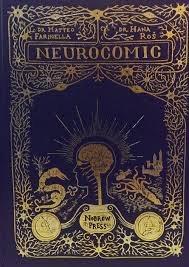
First I saw the name of the publisher–Nobrow Press–then I saw the name of the graphic novel–“Neurocomic” and I imagined some sort of sci-fi riff on Gibson’s Neuromancer. Then I saw that both authors were doctors and I thought that it was going to be some kind of science book. But the cover has a drawing of a brain and a squid and some other kind of creature and from there I just decided I had better see what this was.
So, this actually proves to be a very basic history of neuroscience. With a plot.
As the story opens our hero, a rather generic looking fellow, is walking along a landscape when he sees a woman (presumably beautiful) with whom he seems to fall in love. He is suddenly sucked into someone’s brain and then onto a forest floor. He is confused and upset and has to find a way out.
Welcome to chapter 1: Morphology. Our hero learns he is not in a forest, he is in a brain and those trees are neurons. And he has run into Santiago Ramon y Cajal (1852-1934) and Camillo Golgi (1843-1926). They explain to our guy about neurons and axons, but really he just wants out. So they tell him to enter a neuron and on we go…
Plummeting through a neuron until we meet Scott Sherrington, the man who named the synapse and Sir Bernard Katz. Then our man falls through some openings and meets a (fairly hot) nuerotransmitter. But rather than seducing him, she tells him about how drugs interact with the brain. And we see the scary Antagonists and friendly Agonists.
Then he is taken aboard a submarine by Alan Hodgkin and Andrew Huxley. They talk about Electricity in the brain (as the submarine gets attacked by a kraken).
He lands on an island and meets Erick Kandel and a banjo playing slug-like creature. Kantor introduces him top Pavlov and Pavlov’s dog (who seems like the only reasonable person in Brainland). The dog shows him a way out which means meeting Hans Berger who was able to map the whole brain through electroencephalograms.
As he makes his way to the end, he finds the real man behind the curtain, which gives the book a very meta- slant. All of the above people are nueroscientists, and they provide interesting insights into how the brain works (although they don’t really help our protagonist on his quest).
So the book is actually quite instructive and a little bit amusing as well. The dialogue is a little stilted–not the sciencey stuff which makes sense that it would be somewhat stilted, but the narrative of our hero and his quest is a bit forced into this arena. But the drawings are simple and cool and yup I learned a thing or two as well. I imagine if I needed to know this for a tesm this would be a pretty good way to learn it–although it is pretty short on mnemonic devices, surprisingly.

 I Just Read About That...
Leave a comment