[ATTENDED: May 1, 2014] The Figaro Plays: The Barber of Seville
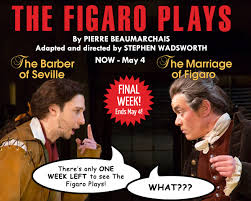
 I won tickets to see The Figaro Plays at McCarter Theater. And yes, there are two different plays going on at the same time. I have to say, I’m super impressed that they put on two Figaro plays on alternating days starring many of the same actors—how complicated must that be?
The Figaro Plays are, well, I’ll let the McCarter site, explain:
Stephen Wadsworth makes his triumphant return to McCarter Theatre with The Figaro Plays, two thrilling new translations of the great farces that inspired Mozart and Rossini’s operas: The Marriage of Figaro and The Barber of Seville…. Wadsworth brings his genius to these two delightfully scathing social satires. Figaro, the famous barber, has his hands full with schemes, plots, and a master who chases all the wrong women. Lush, lively, and a little bit naughty, these plays are chock-full of hilarious misunderstandings, passion, disguises, and sumptuous period costumes.
The plays were written by Pierre-Augustin Caron de Beaumarchais, um …who? He wrote three plays about Figaro and Count Almaviva: Le Barbier de Séville, Le Mariage de Figaro, and La Mère coupable. And so Wadsworth translated, arranged and directed two (I don’t know if the third one was too much to do or not very good or what–according to Wikipedia, it is rarely performed, and the synopsis doesn’t sound great)
So you have certainly heard of these two The Barber of Seville or the Useless Precaution (written in 1773) was turned into Gioachino Rossini’s opera, The Barber of Seville (1816). The Marriage of Figaro (written in 1778) was turned into the opera Le nozze di Figaro, ossia la folle giornata (The Marriage of Figaro, or The Day of Madness), K. 492, composed in 1786 by Wolfgang Amadeus Mozart,
So that’s a lot of background information, and I knew none of it before seeing this first play. I wasn’t even sure if there would be music or not. So no, they were not the operas, indeed, Barber has no music (well, one love song strummed on a guitar).
And it was hilarious.
The entire play was very funny, but there were two aspects that were especially funny. The first was the “political” commentary. Figaro is a working man, a servant, who is (among other things rattled off in a very funny section) a barber, a bloodletter, a poet and a songwriter. He is very clever. The first person he meets in the play is Lord Almaviva, who is standing outside the window of the window of a woman named Rosine. Almaviva is waiting just to catch a glimpse of her. Meanwhile, Figaro has stumbled along and is reading aloud about his dire financial troubles. It turns out that Figaro and Almaviva know each other (from some prior servant situation) and Figaro immediately begins talking (to us and to him, even though he is not listening) about the conditions of servants versus those of Lords. It’s a very funny rant with some very funny put downs of the aristocracy.
That introduces the second funny part of the production, this speech and many other have lots of asides to the audience.
Obviously I know nothing about this play in the original French, nor have I heard of other productions about it. So I don’t know if Stephen Wadsworth added these very funny nods to the audience, but I doubt it. They are rather over the top but they are ever so funny. Figaro asks the audience for coins to pay his bills, Lady Rosine asks the audience if a character in disguise is who she thinks it is and on several occasions the play addresses the state of theater. These had some of the funniest winks and nods to the audience—at one point the two on stage are speaking about comic theater and saying that it is all very obvious that the young girl always outwits the old man… and both character slowly turn to the audience and stare at us for a few beats before resuming the story.
Did 18th century playwrights break the fourth wall? I don’t know, but I like to think so.
The political content continues through the story—with money and the acquisition of it running as a thread throughout.
As for the story itself, it s a very simple one of love at first sight. Almaviva saw Rosine in Madrid and has followed her for six months through the cities of Spain back to her home in Seville. She lives with Dr Bartholo who is her ward. Rosine’s parents died about a year ago, so she is still in mourning. But Dr Bartholo intends to marry Rosine (even though he is “three generations” older than her).
Bartholo keeps Rosine locked up and is very jealous–including only opening the shutters if he accompanies her to the window. Despite this, she has been aware of Almaviva following her. She doesn’t know who he is but she finds him handsome and hopes he will take her away from her situation.
And so the matchmaking begins. What was different about this story than many comedies of this nature is that there was no mistaken identity subplot (a minor thing at the end), or some great misunderstanding that throws a wrench into the works (again, a minor one at the end), there was no “convincing” the one that the other loved her or him. It’s all very easy—except for the matter of Dr Bartholo and how the young lovers will ever get together.
But that doesn’t mean there aren’t complications and farcical situations (there are!) and costume changes galore. There’s a drunken solider who has a wonderful time mangling Dr Batholo’s name (I wonder what the original French version of things like Fartolo actually said). There’s a false singing instructor and then there’s the Lord dressed as a student.
Figaro (the clever one) is charged with taking care that the servants are not going to get in the way (since he is the doctor’s barber, he has access to the house) and he takes extreme measures to keep everyone occupied. And thus the farce commences.
Speaking of Fartoli, I was greatly amused at how vulgar this play was. Not in terms of bad language—it is family friendly—but in terms of actual vulgarity. There were several enema jokes as well as a laxative joke, and of course “Fartoli.”
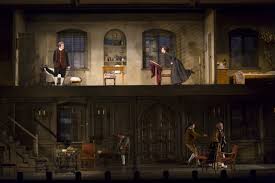
And finally the stage set. Wow, what a gorgeous, sturdy set. A two-story building was created and action took place on both floors, and I can’t get over how solidly built it was—nothing wobbled, locks were snapped solidly and doors shut convincingly. It was very impressive. But not as impressive as their costumes and wigs. Their clothes were outstanding–from Figaro’s shabby “jesters” clothes to Almaviva’s gorgeous finery, the clothes were utterly spectacular. As were the wigs. Especially wonderful was music teacher Don Bazile’s who had basically a long bowl cut on top and then in the back–lengthy tresses underneath the bowl cut. The mullet to end all mullets..
I cannot get over how much I enjoyed this play. And I’m looking forward very much to The Marriage of Figaro tomorrow.

 I Just Read About That...
Leave a comment