 SOUNDTRACK: SOFA-Grey [CST002] (1997).
 It’s not nice to compare bands to other bands, because it seems like they are copying the original. But since I just mentioned Slint the other day, I thought it worthwhile to mention Sofa today. They have similar sensibilities—noisy guitars, spoken/screamed vocals and a decidedly quiet feel.
I love the way this disc opens with the song “On/Off”—it has a simple bass with syncopated drums. And then the buizziest buzz saw guitar thrown in counterpoint notes. And then the singer comes in, sounding like Joy Division never went away. The song builds into a cool noise and then backs off again. But song two, “CH. 2 Chi.” changes everything—a blistering punk song with super fast chaotic drums and fast vocals. The guitars are again punctuating rather than keeping melody. And when it plays the two high chords it adds incredible tension. “Monotone” begins a simple song of two notes (and some great noisy guitars). The vocals are less Joy Divison and more spoken punk. But each verse adds something new to the music, which gets more complex. “Current” has a more conventional post-rock sound—buzzy guitars and quiet vocals. It’s a good calming moment.
“80 000” has a slow menacing vibe. It builds a few times into some really noisy chaotic sections, where the guitars are willfully out of tune—and all the while the spoken word lyrics are quiet enough to make you lean in closer. “Red Lake” is another slow number (they could maybe have used a faster one by this point), but I really like the riff and the way the guitars play off of it. And there’s an actual hummable chorus too.
The fast noise comes back on “Comma” with a frenetic guitar line and pummeling bass. Even the stop/start of the chorus are frenetic. And when the song occasionally slows down, the guitars still punctuate with astonishing noise. “The Fence” opens with a cool bass riff and simple but interesting drums. “Travel” is a slow song that opens with just guitar notes and spoken/sung lyrics. I don’t care for these more atmospheric songs (especially when they push 6 minutes) but the band does it well. “Stress” follows this. This is the shortest song on the disc just under 3 minutes of furious mayhem. “Medicine Hat” ends the disc with another slower song, but this one has a lot of interesting components, like the bass and guitar line that interweaves throughout the song.
This was Constellation Records second release (Ian, who plays guitar, co-founded Constellation). Sofa broke up around the time of this release, which is a shame as it was a good one. I’d like to hear more from them (they have some earlier records with unknown availability).
[READ: April 5, 2014] Polina
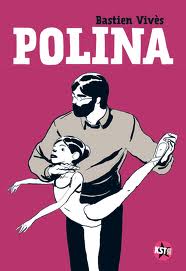
This was a simple and enjoyable graphic novel about a young ballerina who grows up in the world of ballet. (I admit I was attracted to the title because I thought it might be about Olympic figure skater Polina Edmunds who I remembered primarily because the name Polina which was unusual to me–it is not about her).
It is a bout a fictional ballet dancer. When we first meet young Polina, she looks so tiny in the back seat of the car as she is driven to class. And her teacher, Mr Bojinsky looks like such a large man next to her–with his full beard and large hands. He is an intimidating figure and all of the girls are afraid of him. And yet, it is an honor to be even considered by him.
So when Polina unexpectedly gets chosen for his class, she is elated and fearful at the same time. At first Bojinsky seems really mean and the way his hand more or less covers her whole chest as he gets her into place portended all kinds of things. But rest assured, and perhaps this is a spoiler, but if is, it is one that I would like to know–nothing bad like that happens to Polina. Phew. She is not molested, or raped or left dying in an alley. It’s not that kind of story. Rather, it is the story of a young girl trying to make it as a dancer.
When she is at Bojinsky’s school, she is aware that she seems to care more than the other girls who are more interested in meeting boys and having fun. As she grows and matures we see that Bojinsky’s advice (that she sort of resisted at first) was sound and she becomes an impressive dancer. So impressive that she is invited to join the theater (and to live there while studying).
But the theater doesn’t agree with her. The headmistress has very different style and is confrontational to Polina about Bojinsky. She falls behind there. But Bojinsky comes to her and invites her to perform in one of his own dances. She is thrilled and is now working twice as hard, ensuring that she keeps up with her theater work as well as her Bojinsky dance.
By now Polina is a young adult. She is dating another dancer and she is growing more opinionated. On the advice of her boyfriend, the two of them and some friends from the theater decide to head away–she asks Bojinsky if she can defer on his dance which he agrees to–and they head off for a dance troupe led by Mikhail Laptar. Polina nad her boyfriend succeed tremendously. Even Bojinsky comes to see her–but she cannot face him after the show. Then Polina gets injured. And she is suddenly replaced both as the lead and as the affections of her boyfriend.
Now she has a decision to make–go home, go to Bojinsky, or set out for something new.
I found the story to be wonderfully moving. Polina was a very real character, and the emotions she conveyed were believable and actually made her a more endearing person. And the art was very helpful in conveying those expressions and tones. Having said that I didn’t love the art. It was expressive and powerful, but it’s not really my style. The lines were very dark and there were often times when the characters’ faces were completely blank–eyes pale or covered by glasses, or at times, faces drawn just as ovals. I grew to appreciate the stylistic choices by the end because they were so effective. Indeed, this technique was the way to pick Polina out of the crowd both when she was young an as she got older–she has a very dark line on the side of her nose or just a dark nose in general, and this simple technique was a quick shorthand for noticing our heroine.
I assumed the book was Russian (it feels so Russian), but it was actually translated from the French by Polly McLean.
For ease of searching, I include: Bastien Vives

 I Just Read About That...
Leave a comment