 SOUNDTRACK: NOBEL PRIZE PLAYLIST-CBC Radio 3 (2013).
 In honor of Alice Munro’s Nobel Prize, CBC radio has a playlist of “Literary Music.” Now, I have made many literary playlists over they years myself (including “My Baby Loves a Bunch of Authors” by Moxy Fruvous which is not included here), but this one consists of a few bands that I don’t know (and two that I do).
- Library Voices–“Generation Handclap”
- The Darcys–“Pretty Girls”
- Kathryn Calder–“Right Book”
- AroarA–“#6”
- Arkells–“Book Club”
- Dan Mangan–“Road Regrets”
- John K. Samson–“When I Write My Master’s Thesis”
Samson is the only artist I know well, although I know Dan Mangan a little. It’s a good listen and I’m sure if you scrutinize the lyrics you’ll find their literary worth.
Listen here.
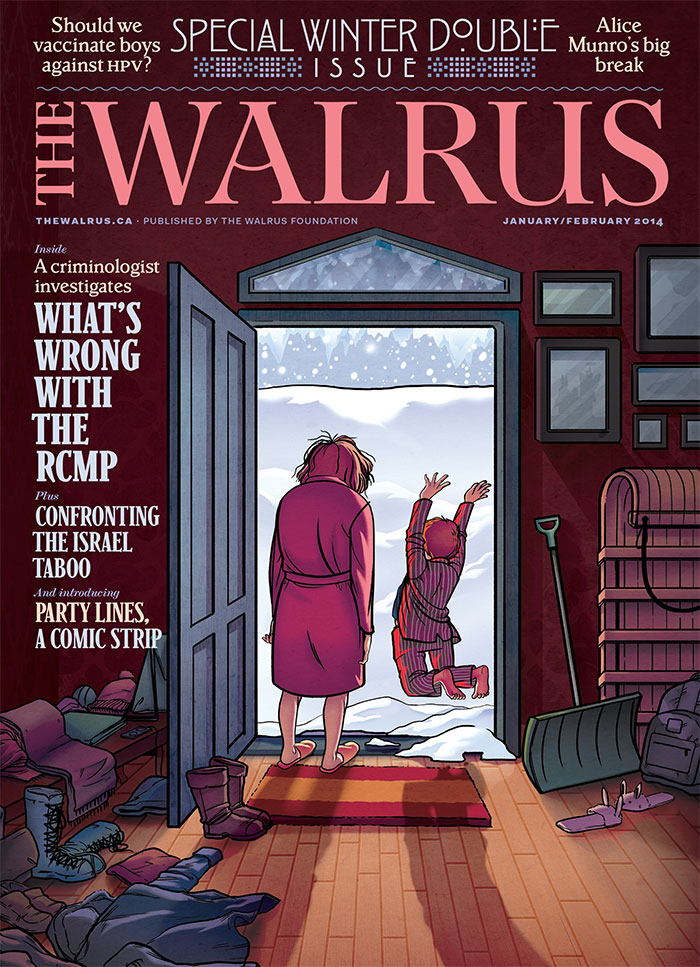
[READ: January 18, 2014] “Her Big Break”
I’ve been a fan of Alice Munro for a while, and I’m always happy to see her in the New Yorker. Strangely, I have never read any of her collected short stories. Maybe some day….
When Munro won the Nobel Prize for Literature, I imagined she’d get a lot more press. And then I realized that it’s a literature prize. And she’s Canadian. So, perhaps a few columns in Canada’s The Walrus is all she’ll get.
But this article, which is really entirely this below letter and a brief introduction, explains that on November 18, 1976, Charles McGrath, a fiction editor at The New Yorker, sent Alice Munro her first acceptance letter from the magazine for her story “Royal Beatings.” Soon after this, she signed a first-reading agreement with the magazine, which I gather means that they will see any of her short stories before she can send them anywhere else.
I am including this letter in its entirety because I assume that most people, like me, have never actually seen an acceptance letter from a magazine for a piece of fiction (I have several rejections). But even if you have seen an acceptance letter, I can’t imagine that it will every be as thoughtful and considerate as this one. i also love that as recent as 1976 The NEw Yorker was kind of prudish about their fiction. I mean, now, the cursing is rampant, but back then the fiction was a more genteel breed.
I have not read “Royal Beatings,” but you can bet I’ve added it to my short list.
Dear Ms. Munro,
Your story “Royal Beatings” has occasioned as much excitement around here as any story I can remember. It’s an extraordinary, original piece of writing, and we very much want to publish it. Everyone who has read it has been moved by the story’s intelligence and sensitivity, and has marvelled at its emotional range.
I’m familiar with some of your other work, and, to be honest, it’s a little embarrassing to me that you haven’t been in our pages long before now. I hope we can run “Royal Beatings” very soon. What I propose to do, then—with your permission, of course—is to undertake some preliminary editing. This is our usual procedure, and in the case of “Royal Beatings” what it would consist of is mostly my suggesting a few alterations in expression and pointing out a few places where I think some more information might be needed. I think it would be a great help to the reader, for example, if a lot of the background information—the fact that Flo is Nadine’s stepmother, say, and even the fact that the story takes place in Canada (American readers think everything happens in America unless you tell them otherwise)—could be planted closer to the beginning of the story, and I’d also like to clarify the chronology a little. One of the story’s strengths is the way it moves so easily back and forth in time—in fact, it seems to work much the way memory works—but, even so, I think there are a few places where events tend to run together, and where it’s not clear how much time has elapsed. These are hardly crucial problems, and I’m sure they can all be taken care of very easily. I will send the edited manuscript back to you, and will try to explain my reasons for suggesting a change, and you will then be free to disagree or to make suggestions and alterations of your own. Our policy is to edit simply with the aim of achieving clarity; the last thing we want to do is interfere with an author’s style of writing. And I think I can say that in most cases our editors and writers have arrived at a state of mutual trust.
The only possible difficulty I can foresee with “Royal Beatings” has to do with—well, I don’t really know what to call it. Our Naughty Words Policy, I guess. As you may know, The New Yorker is somewhat conservative about what it will or will not allow in the way of language and/or subject matter and though we’re a lot better than we used to be, we still have a long way to go. I’m afraid that Mr. Shawn, the editor-in-chief—who, by the way, likes “Royal Beatings” a great deal—has questioned, on the ground of “earthiness,” both the paragraph about toilet noises on page 3 and the rhyme about pickled arseholes. Personally, I don’t think the toilet-noise passage is absolutely essential to the story; in fact, I think it may be a distraction. The rhyme, of course, is more problematic. If you feel very strongly about either of these points I can go and try to argue your case, though I can’t guarantee that I will win. I do think we can reach some compromise, however, and troublesome as it may be, I hope you will try to understand our position in this regard.
The subsequent procedure is that after we—you and I, that is—agree on a preliminary text the story goes into galley proofs. And at that point you will be paid. (We can’t do this sooner, because we pay on a word rate, and that also makes it impossible for me to say in advance what the payment will be. We never pay less than a thousand dollars, though, and my guess is that “Royal Beatings” would bring at least two and probably three times that much.) After that, and shortly before publication, we prepare a final author’s proof, which contains further queries from me and from Mr. Shawn, some queries about punctuation from our grammarians, and possibly some factual questions from our checking department. This sounds formidable, but is really only finicky; you will have the final say about all matters of text, and the text that you approve in the author’s proof will be the final text that appears in the magazine.
I hope all this is agreeable to you, and I wish you would write or, better still, call me (collect, of course) and let me know whether or not you want to go ahead. (I’m here at the office most days from 10:30 or so until 6, though I will be out of town next Thursday and Friday, November 25th and 26th.) “Royal Beatings” is a rare and wonderful piece of work, and we will be honored if you will let us publish it.
Yours sincerely,
Charles McGrath

 I Just Read About That...
Leave a comment