 SOUNDTRACK: PHISH-The Siket Disc (1999).
 This is an (almost) entirely instrumental disc. It’s exactly the kind of thing that people think of when they imagine Phish—long jams with no structure. But unlike some of their more frenetic jams, this is a kind of enjoyable chilling out disc. The compositions are actually select excerpts from the long-form improvisations of the “Ghost Sessions.”
There are 9 songs and most of them are short. Except for “Whats the Use” which is an 11 minute track with a very cool guitar riff (that reminds me again of Frank Zappa) and some cool accompanying keyboard sounds.
“Me Left Toe” is about 5 minutes and has a nice build up within it. And “The Name is Slick” is a bit more staccato and less smooth than the other songs and it holds up for 4 minutes.
Most of the other songs are short jams (with 4 tracks being about 2 minutes or less). Although there are a couple of weird, nonsensey tracks like “Fish Bass” which is just a weird series of noises. Or “Quadrophonic Toppling” which has some spoken words (just the title repeated) as does “Title Track” which has the repeated word “Siket”and laughing. “Insects” is a little unsettling as well.
“The Happy Whip and Dung Song” is 5 minutes long and, despite some weird effect on the keyboards, feels like a full song. “Albert” is a short, pretty, gentle ballad. It’s a nice ending to this disc. While this is by no means an essential Phish disc, it is an interesting insight into their recording process and is as I said, a good chill out album.
[READ: October 28, 2013] “Eternal Winter”
I had never heard of the Aral Sea before reading this article and I am surprised that I haven’t and I’m shocked by what has happened there. Near the city of Karalpakistan (no connection to Pakistan), near Uzbekistan and Kazakhstan, lies the Aral Sea. It was once the fourth largest body of water on Earth, larger than lake Michigan. It is now shrunk by approximately 74%.
It was through the Soviet Union’s thirst for development and “progress” that canals were built which diverted water away from the Sea. This effectively slowly dried out the lake (which the Soviet Union knew would happen). The Soviet Union also dumped insecticides and toxic waste into it, rendering what is left of the sea bed largely poisonous. Anything that is not poisonous is heavily salinated making it worse than useless. And to make it worse (if that is possible), the windstorms that frequently occur simply pick up the toxic dirt and dust and blow it all around the land. Without the water, the temperature soars in the region–often reaching 120 degrees.
One of the reasons for the diversion of the water was cotton. Cotton is a thirsty crop and it was discovered that Uzbekistan was well suited to the climate for the crop. They just needed more water. And so in the 1950s, the Amu Darya river was diverted away from the Aral Sea and into the Uzbekistan deserts. And cotton flourished there. Then in 1960, the Aral Sea began to shrink.
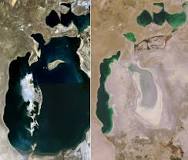
Before and after photos of the Sea
Bissell visits the town of Moynaq which was once a coastal city. They were fishermen and harvested 12 million tins of fish a year. Moynaq is now dozens of kilometers from the sea. And of the 178 species of animal life that lives in the Sea, only 38 now survive.
In 2002, Bissell wrote that by 2010 experts estimated the sea would be completely gone. Conservation efforts began in 2005 and by 2008 the sea had rebounded somewhat, but information is scarce and very hard to calculate at this time.
Regardless, life in the area is so desperate now that those few remaining there are in a really hopeless situation. Relief efforts are met with indifference and often seem futile. Like the one that Bissell witnesses in which an incinerator for medical waste is not only not operated properly, it is overflowing–with the waste simply flying around in the winds.
Bissell makes sure that Americans don’t feel too smug about the Soviet’s environmental disgrace reminding us that it was around the same time that the Sea was diverted that Ohio’s Cuyahoga River caught on fire. And it was only through the EPA that America managed to clean up its horrific failures. By 1989 only 10% of America’s waterways were polluted. Hope you don’t live in that 10% area.
Between 50-100,000 residents fled the Moynaq area in the last ten years, but since the dissolution of the Soviet Union, traveling between countries has become very difficult, leaving many citizens in a serious quandary.
Bissell tours the area seeing the remains of ships that were simply left, once the water got too low. They were large ships, used to fishing and harvesting ample quantities. And now they were grounded–stuck in a desert. The most dramatic item is the photo of the group of sailors who once lived in the city which is now a desert.
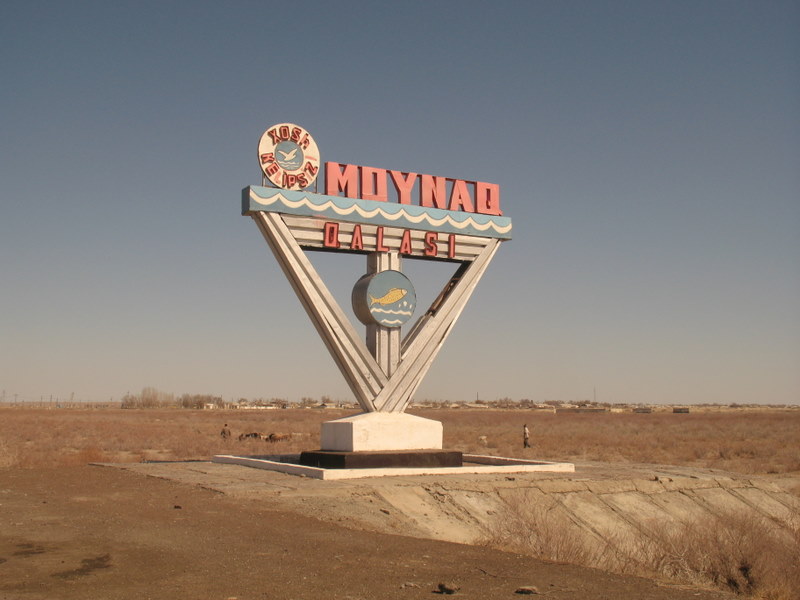 There are organizations designed to help with the Aral Sea, but it really seems like help is too late.
The area has actually become something of an environmental disaster tourist destination, which is kind of sick. There are dozens of videos up on YouTube with reasonably current footage of the disaster. Seeing these giant ships sitting in the middle of sand is shocking
.

 I Just Read About That...
Leave a comment