 SOUNDTRACK: TOULOUSE LAUTREC-“Yesman” (2013).
 Toulouse Lautrec are an alternative rock band from Romania. Once again, I would not have ever heard of them had I not looked fora song about Lautrec (since he is mentioned in this section of the reading).
Toulouse Lautrec have two albums out, Heroes and their new one Extraordinar. They sing in both Romanian and English and this song (which is the first thing that came up on my search) is entirely in English.
It starts out with some very cool guitar riffs (very math rock–I actually considered it might be an instrumental). Even the bass is doing something interesting behind the guitars. Then about 50 seconds in the vocals begin. And the singer has an almost American twang to him.
The chorus is a simple one, with ooh hoo hoo hoos. But the real fun is at the end of each verse–the I say no I Say no and I say yes I say yes.
I listened to this song a few times and really liked it a lot. It’s simple but solid alt-rock. Then I found their website and watched a few more of their videos. I really like the sound that they get–kind of buzzy guitars but otherwise very clean.
Check out the video for Yesman
and their site (which is in Romanian, but Google Translate will help you navigate)
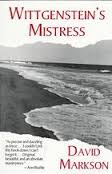
[READ: October 20, 2013] Wittgenstein’s Mistress p. 61-120
This book is proving to be far less daunting and far more loose and fun than I anticipated. As you can see by my “read” date, I finished this almost two weeks ahead of time. In part it’s easy because unless I am gravely mistaken, there’s nothing really to “remember” about the story. There are details and I think they are ponderable, but there’s nothing that seems to really impact the story. It’s more a series of ideas.
It’s really quite an audacious piece of writing.
Wittgenstein gets his first mention on page 61
“Once Bertrand Russell took his pupil Ludwig Wittgenstein to watch Alfred North Whitehead row, at Cambridge. Wittgenstein became very angry with Bertrand Russell for having wasted his day” [61].
There are some meaty existential issues brought up like
“Surely one cannot type a sentence saying that one is not thinking about something without thinking about he very thing that one says one in not thinking about” [63].
As she is writing, she is often certain about something but then a few sentences later she corrects herself (for example, that the tape deck in the van was playing Vivaldi, no Berlioz; or that she read a biography of Brahms that turns out to be a different book).
There are a lot of thought about painters in this section, Toulouse-Lautrec, Modigliani and the idea that because of the materials that Leonardo used, the Last Supper was actually deteriorating while it was being panted (“because of a foolish experiment he had tried with oil tempera on the plaster”) [68].
She eventually gets to the idea that she is suffering from a depression—that she has stopped typing for the day because of it. She states that depression is not the same as anxiety which is “the fundamental mood of existence.” She says it was either Kierkegaard or Heidegger who said that [it was Heidegger].
Then she speaks of almost being hit by a car and we wonder were there other people after all? But no, it was a taxi which apparently loosed itself and rolled down the hill. I like that she throws in the now anachronistic for her “Naturally you can never find a taxi when you want one” [76].
We learn that she is slowly destroying another house—she takes boards away one a day for kindling. And then says
“The world is everything that is the case.
I have no idea what I mean by the sentence I have just typed, by the way” [78]. [It actually comes from Wittgenstein’s Tractatus Logico-Philosophicus].
But she had the sentence in her head all day. Along with the word bricolage
Throughout this section she keeps returning to the biography of Brahms that she believed she read and then burned (and that there may be another copy in this house, and possibly one in another house as well). Then she remembers she actually read about Brahms in a Children’s music encyclopedia.
She reopens ideas from the Odyssey and when she mentions Penelope spending 20 years weaving, she notes “I doubt that I believe one word of it, myself.” [82]. She also ponders whether Homer was a woman or if he existed at all. And by ponder I mean talks about it for a sentence or two.
There’s a lengthy section about trying to find the road that leads to a nearby house. It’s a house she can see from her own window but when she finally gets to it (the road was hidden by a fallen tree) she realizes she can not see her own house from that house—the windows are not in the right place.
There’s another shout out to William Gaddis and The Recognitions (she has not seen a copy of it in 12-15 years—so that’s how long she has been alone, presumably).
The copy of the book that I took out from the library has some notes written in the margins, and on page 99, my writer is kind of chastised by the very book she is writing in:
“Actually I did well in college, in spite of frequently underlining sentences in books that had not been assigned” [99].
Wittgenstein reappears on page 1900, with her saying that he never read Aristotle and also that “Wittgenstein was too hard to read in any case” although she says she read one sentence by him which she found not difficult at all. “You do not need a lot of money to buy a present but you do need a lot of time” [which I believe is not be Wittgenstein].
I also enjoyed the very practical comment about her not typing Kierkegaard’s first name because of the line through the o in Søren. And also that the two dots in Dürer and Brontë was kind of a hassle too.
And speaking of Brontë:
“the considerable likelihood that Emily Brontë never even once had a lover.
Which is presumably an explanation for why so many people in Wuthering Heights are continually looking in and out of windows, in fact” [91]
She talks again about the car that she drove into the Mediterranean Sea and how she was flipped over in the cab. And how she enjoyed wearing the soccer jersey that she found in a nearby van when she needed new clothes (and yes there’s more talk of underwear).
Then there is the section about Gertrude Stein meeting people and how “a little bell rang in her head, informing her that he was a genius” meaning Alfred North Whitehead (the same bell went off when she met Picasso) [111].
Then she mentions her son Simon again. She still has pictures of him, although the slides that she took, in fact all of her slides, are surely gone—or not really gone, since they last forever, they are just lost. And that Simon’s birthday was July 12th, not that she has any way of knowing what day it is.
She also enjoyed hitting tennis balls around even if they were a little flat and the racket a little springy. Speaking of sports, after mentioning again about how she does not like baseball she says
It is not even unlikely that I could name certain baseball players , should I wish.
I cannot imagine so wishing.
Babe Ruth and Lou Gehrig.
Sam Usual. [This is a funny mistake and the first time I noticed that she has made a factual error, I wonder if there are more. Well, now that I think about it I believe she was wrong about that Wittgenstein quote too. I wonder how many more errors there are].
There has been a ton of name dropping in this book which I know has put off some readers. Are readers supposed to know all these people and their works too? Do we get more out of it if we know them? And we need to know art and music and philosophy, too. She even knows Picasso’s birthday. So I leave you with a quote that many people must have wondered about her:
“I am now perhaps showing off” [105].
Happy Halloween, everyone.
For ease of searching, I include: Emily Bronte, Soren Kierkegaard, Albrecht Durer.

 I Just Read About That...
Leave a comment