 SOUNDTRACK: VOIVOD-Phobos (1997).
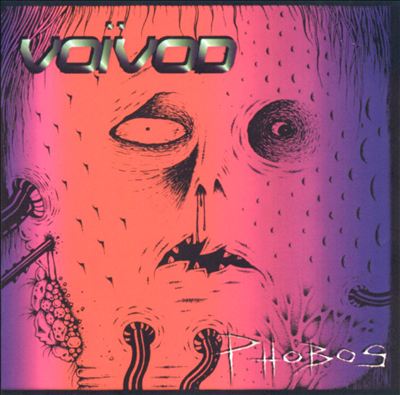 It’s tempting to say that Phobos is a carbon copy of Negatron, but that’s not true. While the line up is the same, and the overall tone is very similar—very heavy, aggressive music—there are subtle differences. The first is that the album sounds vaguely more electronic, as if they were really flirting with industrial after the experiment with Jim Thirwell on the last album. E-Force’s vocals, while still abrasive and screamed have a lot of processing on them which makes them far more interesting and actually quite a bit more understandable. There’s also a lot of weird electronic effects that link the album and make it feel more “spacey.”
And while there are different sections of songs and parts that are actually quiet, this i still a difficult album–the vocals especially are exceedingly harsh and will turn off people who like the instrumental sections. I hate to sound like the band’s declining popular are all down to E-Force, but he is the weakest link in the band at this point. Whats weird about thee two E-Force era albums is that although they are very very heavy with several weird parts per song, the basic structure of them is very conventional. So instead of sounding proggy and weird, they sound more like a bludgeoning metal band. Which didn’t really work for them. Indeed, the band intended to if not call it quits at least take a hiatus after this album.
Phobos opens with “Catalepsy I” an introductory song—noises and whatnot. And indeed, these electronic noises link all of the songs of the record, with different sounds in between the tracks (like the way “Bacteria” opens with spacey effects and electronic drum noises for 35 seconds). But the first proper song “Rise,” has an opening guitar riff that is quite normal—dark, but normal. It’s true that the heaviness of the chugging section is heavier than most (like earlier Voivod), but it’s still not that strange. Until the verses come in. And here’s where E-Force’s vocals are a little different—more processed and robotic sounding. It actually works a lot better. And in the middle of the song while the heaviness is ongoing, that opening normal guitar riff comes back. Rather conventionally.
“Mercury” has a more typical Voivod guitar riff although the pounding heavy chords are still quite heavy. There’s more of the distorted vocals and weird chords for the bridge. It also begins a series of increasingly longer songs. This one is nearly 6 minutes. While “Phobos” is nearly 7. It also has an interesting echoing staccato guitar riff with E-Force’s vocals very distorted (like Nine Inch Nails or Skinny Puppy). The bridge is a crazy noisy monstrosity and yet the middle section is very simple: loud chords delivered at a slow pace with interesting effects and fiddly guitar solo noises. “Bacteria” reaches over 8 minutes long. But it is unlike any of their earlier prog songs. It has an interesting echoing guitar opening and a bunch of staggered parts. But once the song’s major chords start up it sounds probably most like the previous album except for the lengthy instrumental/psychedelic section starting at around 5 minutes.
The album slows down somewhat with the 1:48 “Temps Mort” a short instrumental with what sounds alike an accordion. It’s a weird little time out (which is what the title means), and I like it a lot.
“The Tower” has an underwater kind of feel to it amidst the bludgeoning guitars. The middle and the end have some very cool heavy trippy/spacey metal which is so radically different from the heavy Voivod chords that make up the proper song. Indeed the very end is a minute of mellow spacey guitars. “Quantum” is a pretty straight ahead (for Voivod) metal song with echoed vocals that take some of th edge off (until he screams the chorus). There’s another cool instrumental section. In fact, the whole album has great instrumental sections, it’s kind of a shame the vocals are so offputting (although at the end of this song they are so distorted and computerized that they sound very cool)
“Neutrino” opens with those big loud slow ringing chords of noise before the simple but creepy solo riff comes in. It’s 6 minutes long and has another interesting guitar line amid the noise. It takes 3 minutes (of 7) before the vocals come in and the song gets much darker. “Forlorn” is the closest thing to a hit on the album. The chorus is really easy to sing along to. And the verses are actually pretty straightforward. It’s very very heavy and isn’t going to make the radio anywhere, but it’s still catchy. The album proper ends with “Catalepsy II,” more swirling noises that sound like the beginning.
There are two bonus tracks on the CD. “M-Body” was written by Jason Newsted and is the most industrial mechanized/voiced songs on the album. It’s certainly out of place, although it does hint at what is to come on their next album. “21st Century Schizoid Man” is a cover of the King Crimson song. They’d done Pink Floyd and King Crimson fits pretty nicely. As with the Floyd covers this one is very heavy. Piggy gets the guitars right. But as with the rest of the album, E-Force’s vocals just don’t work. Whereas Snake’s weird pronunciations accented the covers in a cool way, E-Force just seems to be forcing his way through the track (the fact that he puts 3 syllables in “century” is pretty unforgivable. Overall the song is pretty great, although I’m not so sure about the guitar solo which sounds like Piggy doesn’t really know what to do.
And that’s the end of this Voivod lineup. Two albums and a lot of lost fans.
[READ: September 20, 2013] Terry
I have known about this book for a pretty long time. I was never really that interested in reading it because, while I don’t know all that much about Terry Fox, I felt like I knew enough about him to not bother with a full bio.
For those who don’t know (basically anyone from the U.S.), Terry Fox was a young man who developed cancer at the age of 19 in 1977. and had his leg amputated. To draw attention to cancer research he decided to run (yes run) across Canada on the Trans Canada Highway. He had a prosthetic leg, he practiced running every day (he was already a natural athlete) and he decided that in 1980 he would run from the Atlantic Ocean to the Pacific (he even had a bottle of water from the Atlantic that he wanted to pour into the Pacific). His plan was to run between 26 miles a day. Yes, run a marathon every day. He called it the Marathon of Hope.
When he started out, the media coverage was nothing but as he progressed and his friend (who drove the van alongside him) started making media attention, Terry’s cause became more well known. And by the time he made it to Ontario, he was a huge personality—making TV appearances, talking to anyone and, most importantly, making a ton of money for cancer research.
He got as far as Thunder Bay, Ontario, when the cancer returned and he had to stop. He had run for 143 days and for 3,339 miles (out of a total of 5,000). By then he was a national hero with people from all over the country sending him mail and wishing him well.
I knew some of this before reading this book, but what I didn’t know was just how much of a generous and kind soul Fox was. He wore only a T shirt with his Marathon of Hope written on it (he wanted no logos or corporate sponsorship). He accepted nothing for himself except food and lodging if it was donated. He took none of the money that he raised for himself—not even to buy new clothes for the run. And he always had a smile for people—even as he blistered and was in terrible pain.
The book itself is typical of Coupland’s photo essays. It is not a full biography at all, but rather a collection of photographs from Coupland’s research. With each picture he comments on it in some way.
Photos include early school and team photos, the hat that he wore during chemo, the socks and sneakers that he wore out during the run and even photos of the tons of correspondence he received.
I admit that I didn’t read the whole book. The last fifteen pages are a list of “where the money goes” circa 2005. It looks at grants and awards and who received what for doing which kind of research. While I’m sure it is interesting and informative, I wasn’t that interested.
But for the main part of the book, I was moved to tears throughout. And the photos making it all the more real (the photos of the gold ball and the lemon, which seem silly at first are really quite affecting). And so in addition to being a great biographical sketch of terry Fox (Coupland admits there are much better biographies of the man himself),it was also a really good look at how generous and kind people can be, whether they have adversity or just wish to help others.
It’s fairly hard to find this book in the states (my copy came form a library in Toronto). I feel a little bad that I didn’t buy the book as proceeds go to the Terry Fox foundation, but anyone can donate and read more about him at Terry Fox.org

 I Just Read About That...
Leave a comment