 SOUNDTRACK: VOIVOD-Angel Rat (1991).
 So if you’re Voivod and you have just released a prog rock metal masterpiece, what’s your next step? Hire Terry Brown, famed producer of the early Rush catalog! And then try to go somewhat more commercial. And name your new, commercial album… Angel Rat?
Oh but then—never a good sign—after recording the album, original bassist Blacky left the band. It’s hard to find out exactly why (personal reasons) but he then went on to form The Holy Body Tattoo Dance Society and to create electroacoustic music.
When this album came out I was very disappointed in it—it is so far from the angular prog rock of Nothingface that I assumed the band had utterly sold out. I mean, there’s ballad moments on it, there’s hardly any dissonant chords, and most of the songs are simply verse bridge chorus. The band sounds a lot more commercial (sadly for them, the album tanked). Listening to it now with fresh ears it actually reminds me a lot of Blue Öyster Cult, especially with Snake’s vocals and the chord structures that Piggy presents. And since they used Terry Brown there’s a Rush element as well. Once I divorce the album from what came before I actually like the album quite a bit. The songs are remarkably simple (I feel like Piggy could have been playing all the parts himself at the same time), but there’s still enough interesting weirdness that the songs don’t sound boring. And once you get used to the overproduction and the fact that Snake can sing, there’s some really good stuff here. Conventional but good.
It starts out pretty heavy with a chugging guitar but soon you notice that Snake is actually singing…nicely. His voice sounds polished and good. And then you notice that the guitars are fairly conventional—there’s almost no dissonance. True it is still heavy metal and there’s some slightly obscure chords, but for the most part it’s not all that weird. Even the guitar solo is a fairly conventional speedy solo. And when the chorus comes in it’s actually quite pretty. Speaking of pretty, the band photo is one of the more glammed up moments in Voivod’s career and, without being unfair, they are not a terribly pretty band, so this is kind of a funny picture.
“Clouds in My House” is also quite a pretty song, although admittedly the verses are a little dark (with that squeaking guitar solo sound that was popular around that time in heavy metal). But the chorus is downright upbeat. There’s a cool section in the middle with a noisy (but very simple) bass popping and a guitar solo over the top of it—it reminds me a lot of Rush in sound). “The Prow” is the catchiest thing that Voivod has ever done—great sing-along verses and a big chorus. “Best Regards” has more BÖC simiarlies—the chorus in particular has a very BÖC structure. There’s also a some great bass on it. Again, not the complicated bass of previous album, but a great rumbling sound that works very well as a riff while Piggy solos. “Twin Dummy” is another fast song. This one features some of the stranger lyrics on the album. Away says that he backed off on some of the concepts for this album and let Snake so his own thing. So this song seems to be about ventriloquist dummies with the strange opening lyric “Dummy says…” But the music is fast and furious here—some weird chords and really fast bass. There’s also some keyboards on this track (pipe organ type sounds) that reminds me of Rush from around this period.
Title track “Angel Rat” sees Snake crooning over a very simple guitar ballad intro. It’s almost unthinkable. And yet the band keeps it interesting—especially Blacky’s bass. Again, I don’t know why he left, but his bass is featured nicely on this album anyhow. Blacky opens “Golem” with a powerful (but again simple) bass. There’s an occasional funky note, but it’s a very staccato song. The drums have a strangely pop quality (the way he fills in the gaps). It’s a little unsettling how obvious and catchy it is. And even more unsettling is the solo—which has a very jazz feel. I can’t even really tell what’s going on—is that Piggy or a keyboard? “The Outcast” has probably the most conventional early 90s metal sound (except…is that a harmonica?) Snake even does a falsetto at the end of a verse! Probably the biggest surprise is that the final lines are “everything’s gonna work out.”
“Nuage Fractal” at least has a very Voivod title. And the chorus sounds a lot like recent Voivod (except for the solo section). The biggest surprise has to be “Freedoom” which opens with a very pretty guitar ballad sequence. Something that early Voivod would have stomped all over. Snake is whisper-singing and Piggy is playing gently for two whole minutes. Interestingly, once the full band kicks in for the last two minutes, it is one of the heaviest sections on the album. So even when they’re being conventional, they can’t do it for too long. The bass in particular sounds very Geddy Lee to me on this track. The final song “None of the Above” Is another political song—this one about global destruction. The music is surprisingly upbeat for such a topic, but Blacky’s bass is wonderfully deep and rumbling here.
So yes, ever the chameleons, Voivod have made an album that could have sold a lot of copies–except that they’re a little too weird to do so. But it was a good experiment and resulted in some great songs.
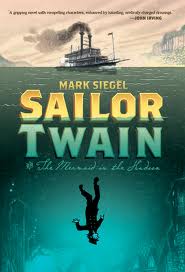
[READ: August 15, 2013] Sailor Twain
Sarah got me this book for Christmas. I didn’t read it until right now because it’s fun to stretch out Christmas gifts as long as possible.
This book is a lengthy graphic novel from our friends at First Second. It is complicated and a little confusing (the whole story is a flashback that is sort of explained in the very beginning). It’s also very beautiful.
Except, I might say, for the main character. The background images and the interstitial pages are really beautiful and detailed. But the main character is very cartoony–very two-dimensional with a triangle nose and big circular cartoon eyes. I found this very disconcerting for about a third of the book. Siegel does manage to make him very expressive and uses the big circle eyes to a good drawing benefit through, but the character just looks so–surprised?–all the time that it was hard to not notice him. Of course later on his big eyes come in handy during the darker sequences, but I still found it an odd choice. So too were the really cartoony choices of some of the other main characters–very big, comical noses or fat round faces. It certainly made the characters distinctive, but as I said, I was unsettled by it.
As the story opens, Captain Twain sits in a bar and is approached by Miss Camomille. She asks to speak to him but he says he wants nothing to do with her or his past. She holds out a necklace and says he can have it if he tells her the story. He is shocked to see it and reluctantly agrees.
In 1887 while crossing the Hudson River, Captain Twain saw a stag in the water. Seaman Lafayette asks Twain if he saw it, but when Twain describes it as a beast, Lafayette looks confused and a bit cross. We quickly learn that Lafayette’s brother Jacques-Herni had the head for business–he had built two steamboats that sailed the Hudson and made boatloads of cash. Soon after Jacques Henri’s younger brother Dieudonné came to join his brother (even though he knew nothing about boats). Then Jacques Henri began acting strangely and soon he vanished. Dieudonné became secluded for weeks until he one day came out and started womanizing every female passenger he could–it was assumed that that was his manner of grief. Twain tolerated it but the crew was upset by it.
Lafayette was growing on Captain Twain’s nerves. Until one night Twain saw…a mermaid. He pulled her on board and into his cabin. She had been wounded and he vowed to himself to fix her. At around the same time, famed author C.G. Beaverton wrote a new book about the Hudson River and two chapters dealt with mermaids in the Hudson. Lafayette had requested the book, but Twain intercepted it and began reading it carefully.
Twain sees that Lafayette is writing to Beaverton, and he begins to suspect that Lafayette knows about his mermaid. He begins to grow jealous and realizes that he is falling for the mermaid. Even though he is already married and has an incapacitated wife waiting back home. But when he intercepts a letter from Beaverton to Lafayette, he sees that Beaverton has written about a cure for being in the thrall of a mermaid–take seven lovers at once or kill the mermaid. That must explain Lafayette!
And then two things happen that ratchet the story up. Beaverton arrives on board–with some surprises to share. And the mermaid escapes. Twain freaks out. Soon after, she comes to the boat inviting him down under the sea. He refuses. But later, in Part Three, he decides to go, and the seas open up for him.
When he gets down below we learn a whole new level of the story. The undersea world is full of people who have heard the mermaid’s song and have been rent asunder–split in two. he even finds Jacques-Henri, who explains everything about what happened to him. He tells Twain to go back on the ship and show a nesting doll to his brother–this will help his brother learn the cure to defeat the mermaid’s curse and rescue everyone below the sea. But then Twain hears the mermaid’s song and is split in two. Now one half of him wants to defeat the mermaid and the other half wants the mermaid to prevail.
The final section is very exciting as it is a race to the end, with significant consequences. We learn what happened to Miss Camomille. The ending is bittersweet, and need a little calm unpacking. But man is it a good story.
Highly recommended with patient reading.
For ease of searching, I include: Dieudonné, Blue Oyster Cult.

 I Just Read About That...
Leave a comment