 SOUNDTRACK: KANYE WEST-Late Registration (2005).
I  can’t get over how much I’ve been enjoying Kanye West’s music as of late. So much so that I went back and bought Late Registration. I wanted to check out his early stuff, so naturally I started with…his second album. And it’s a really enjoyable, soulful, gospel-filled rap album. Complete with Kayne’s bizarre, humorous and often offensive lyrics.
Musically the samples are wonderful—they create a very specific feel of pop soul that both works with and sometime against the lyrics. The album suffers from two things that I’ve found I do not like in rap, and in articular in Kayne’s albums. It bugs me when rappers intro their songs with several “uh, yeah”s. I don’t know why but it does and that’s how Kanye opens the disc.
And, I wish there weren’t so many guests on the record. While I understand the guest singers who provide backing vocals, I don’t get all the guest rappers (and there are a lot: Paul Wall, GLC, Lupe Fiasco, Common, Game, Jay Z, Really Doe, Nas, Cam’ron Consequence). I mean, I’m not here for them, so why devote so much time to others, it makes you seem like you couldn’t thin of enough to say (and we know that’s not true about Kanye). After a few listens, I have grown to appreciate the guests, but I like Kayne’s style so much that the other guys are just distractions.
Late Registration is largely produced by Jon Brion, who has made some amazing music with Fiona Apple and Aimee Mann—and while it is certainly stripped down Brion, the flourishes that Brion often employs are apparent here. Like the tinkly pianos and farty bass that opens “Heard ‘Em Say.” There’s some falsetto R&B-esque vocals from the singer from Maroon 5 here—I had no idea he sang like that. It fits very well with the song. And the instrumental section at the end is very Brion.
“Touch the Sky” uses a long sample (slowed down quite a bit) of Curtis Mayfield’s “Move on Up.” But the sample is so much of that original song that it almost seems like cheating. Except that he has slowed it down and modified it somewhat, and…his raps work perfectly with it. The other really crazy sample is from Gil Scot-Heron which samples “Home is Where the Hatred Is.” The strange thing is that the song is 1:44 and the last 45 seconds of the song are just Scot-Heron’s song playing along by itself. It’s weird to have given up that much to another song…but it sounds great.
“Gold Digger” is a very funny song about, well, gold diggers. The topic isn’t new (the fact that it samples an ancient Ray Charles song attests to it), but the chorus of “I ain’t saying she’s a gold digger, but she ain’t messin’ with no broke niggers” is great. There’s also an intro section with Jamie Foxx doing his now patented Ray Charles. It’s a pointed song but done with a very funny twinkle in his voice (the Kayne twinkle). “Drive Slow” is a cool slow-tempoed number with a great sample from Hank Crawford and an interesting slowing effect at the end of the song. “Crack Music” is a great political song equating making records to selling crack. The metaphor works well. And this is one of Kayne’s strong pro-black songs. It’s really powerful.
The surprising thing is the two really sensitive songs: “Hey Mama” which is a sweet song to his mother in which he promises to go back to school and get his doctorate and “Roses,” which is an angry but beautiful song about his grandmother being in the hospital. There’s a great verse about her being poor and therefore not getting the best care: “you telling me if my grandmother was in the NBA right now she’d be okay” As well as a line about a nurse asking for his autograph while they are worried about his grandmother—although, realistically, how often is a nurse going to meet a star like Kayne? The end of the song has some great soulful crooning by (as far as I can read) an uncredited singer. And I feel like Brandy, who opens up the next song really falls flat in comparison to this unnamed singer (I don’t care for the way newer black singers wail their scales). But the Etta James sample of “My Funny Valentine” that floats through “Addiction” is gorgeous.
“Diamonds from Sierra Leone: is a surprisingly political song that samples “Diamonds are Forever.” There’s two version on the album. I like the remix featuring Jay-Z a lot less, in part because I’ve never been a huge Jay-Z fan, but also because his verses completely interrupt the flow of the song. “We Major” has a very retro, almost easy listening vibe. There’s a lot of backing vocals going on and they remind me somewhat of Ben Folds Five’s backing vocals (which is pretty weird, I suspect). This song is interesting for its talk of worrying about daughters—as with many rappers, women are bitches and hos unless they are your grandma, your mama or you daughter—which is kind of awkward, really.
“Celebration” is perhaps the weirdest juxtaposition of contents. It’s a celebration, bitches. A celebration apparently about the fact that he and a woman (who had a fatty) accidentally had a baby (“You my favorite accident”). That line makes it sound like the child is at the party, which makes the chorus “Grab a drink, grab a glass, after that I grab your ass” hard to fathom.
“Gone” has a nifty piano melody (and some cool interstitials very Brion-infused melodies) that plays under Cam’ron and Consequence’s raps. The song is kind of a muddle (although a funny muddle) until Kanye comes in at around 4 and a half minutes. I really like the way the album ends: with Kayne rapping “Sorry Mr West is gone” and the music completely cutting off.
The bonus tracks include the original of “Diamonds from Sierra Leone” and “We Can Make It Better” (which features Q-Tip, Talib Kweli, Common and Rhymefest). It’s an interesting track (especially the sped up backing vocals) but it seems like a bit of a throwaway (which is surprising given the number of guests). “Late” is a unlisted bonus track which is very strange. There’s lots of “ah ha ha has” in a posh sounding falsetto). But there’s some witty lines in here, especially this verse:
They said the best classes go to the fastest
Sorry Mr. West there’s no good classes, and that’s what yo’ ass get
Not even electives? Not even prerequits?
You mean I missed my major by a couple of seconds?
Now I’m in the shop class or the basket weavin
With all the rest of the muh’fuckers underachievin
So Kayne is clever and stupid. A great rapper and a not so great singer. And amazing producer and a good song writer. And this is as good an album as I’ve heard it was.
[READ: August 8, 2013] The Commitments
I have been reading a number of big, heavy books lately (which I have yet to post about…later in the week), so I decided to take a break with a light, fun book. And one that I’ve read before (and seen the movie of many times). I looked on the inside cover where I wrote the date of acquisition (a thing I did for a while until I realized it was kind of silly, and yet I’m glad i did it here) October 1993, almost twenty years ago.
But aside from Jimmy playing songs on vinyl, there’s very little that’s dated about the album–which may even be the point of the book.
This is the story of a bunch of misfits in Ireland who join together to form a soul band. The nucleus of the band is Jimmy Rabbitte, a local kid who lives and breathes music. He had Frankie Goes to Hollywood before anyone else and he knew they were shit before anyone else.
Some of his mates have started a band (called hilariously And And! And) which plays new wave. Jimmy tells them they should play soul instead. He plays them some James Brown and they love it. Which leads to the talk of music and sex. And they are really into it. And then there’s the oft quoted line from the movie: “The Irish are the blacks of Europe. And Dubliners are the blacks of Ireland. And the Northside Dubliners are the blacks of Dublin. So say it once and say it loud, I’m black and I’m proud.”
And so they begin a quest to find the rest of the band. Jimmy puts an ad in Hot Press (the Irish music magazine) and interviews everyone (some very funny jokes in there). And the recruits form a crazy quilt of characters.
While there is a plot, it’s very minimal–the band forms, they get good, [spoiler] they breaks up. Really the story is all about the characters. Doyle’s credits prior to this book (his first novel) include screenwriter (and teacher–a former roommate of mine had him as a teacher). And this book reads like a perfect screenplay. It’s obviously been fleshed out into a novel, but the book is probably 75% dialogue and it works wonderfully. Doyle has captured young Dublin speak perfectly (according to my former roommate, who would know).
But it also reads “natural” and flows easily (it helps a lot if you know Irish slang and locations, otherwise about ten percent of the swear words and locations will be lost). But it’s that localness and specificity that really sells it as a bunch of young people hanging around, making music and slagging each other off.
The inter-band rivalries ring rtue–with each boy lusting after the three backup singers (The Commitmentettes) and being jealous of the one guy who seems to have scored all three (Joey “The Lips” Fagan). The banter is just so real, that you imagine you are sitting in the room with them. And there is something incredibly funny about the Irish teasing and slang (especially to a non-Irishman) that just seeing them say “Jaysus” makes me laugh. (Perhaps I’m an easy laugh, or maybe I’m just picturing the actors from the film saying it).
If you love music, this is a great book about loving music, playing music, getting absorbed in music and letting music take over your life. There is also an amazing dis of jazz in this book and it may be the only play you’ll ever see Charlie Parker torn apart with such vehemence. Joey “The Lips” Fagan, a man who has played with the greats of soul worries about their sax player listening to jazz. And when he gets to Charlie Parker:
The man had no right to his black skin! Polyrhythms! I ask you! That’s not the people’s sound–Those polyrhythms went through Brother Parker’s legs and up his ass. And who did he play to? I’ll tell you, middle class white kids with little beards and berets. in jazz clubs. Jazz clubs! They didn’t even clap. They clicked their fingers. Charlie Parker was born black. And he could play But he abused it, he spat on it. He turned his back on his people so he could entertain hip honky brats and intellectuals.
And while I’m sure many people have had bad things to say about Miles Davis, Fagan’s summary is pretty intense: “the biggest motherfucker of them all, Miles Davis.”
All of this hatred comes from the most interesting character in the story. All of The Commitments are kids, except for Joey “The Lips” Fagan, an older man (“he looks like my da”) who claims to have played trumpet with everyone–from James Brown on down (and he has blurry pictures to prove it). It’s never entirely clearly whether he actually did what he said (the coda at the end is very funny), but he is passionate about soul and plays like an angel. After the above rant he says, “The biggest regret of my life is that I wasn’t born black.”
The biggest difference between the film and the book is the way it deals with race. The above quote about being the blacks of Dublin, in the book all of the “blacks” are actually “niggers.” And that word is used a lot through the book. But what’s interesting is that it’s done in an embracing way rather than a derogatory way. It seems to be like a practically innocent form of appropriation, kids who are trying to embrace a culture without fully understanding it. I have no idea if that’s what Doyle intended–but it was surprising to see that word used so much.
Race issues are clearly a part of this book (interesting for Ireland). Indeed, since this book, Doyle has addressed race a lot. Many of his recent stories deal with blacks in Ireland, and his middle period, more serious novels explore black culture extensively. So don’t be offended by the language, trust it for its realism.
Of course, race is only a small part of the book, it’s really a paean to music and to North side of Dublin. Witness the way that the punters in the crowd get so excited when the singer starts referencing places in Dublin during the end of “Night Train”–you can feel the exhilaration at hearing their local spots mentioned in a classic song (Doyle conveys that so well).
So the book is a fast, enjoyable read. If you’ve seen the movie you’ll recognize everyone in it here (since the book almost reads like screenplay the movie is a perfect adaptation). If you haven’t seen it, you can either watch the film or read the book, it’s pretty much the same thing (although the music is better in the movie).
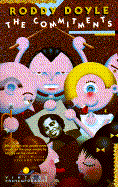 Oh, and my copy has this awful cover. I have always hated t he cover o fthis book. It just bothers me like nothing else. If any cover made me not want to rea da book it was this one. I’d love to trade it for the sensible one above.
This book actually proved to be the first in (yes) a trilogy (of sorts). All three books are set in Barrytown in Dublin.

 I Just Read About That...
Leave a comment