 SOUNDTRACK: AMANDA PALMER–Live at Newport Folk Festival (2013).
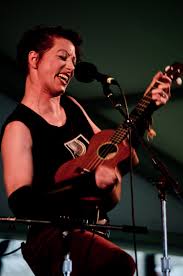 Amanda Palmer has been in the news a lot lately, although more for her actions than for her music. First she crowdsourced for her album (earning praise and vilification), she gave a TED talk about the experience and recently made the British tabloids because her nipple popped out at the Glastonbury Festival. (Of course, unlike another famous incident like that. Palmer handled it wonderfully, criticizing not only the Daily Mail but also the entire media industry for caring so much about (female) nudity). I’ve gained a lot of respect for Palmer in the last year or so and yet I (still) didn’t know all that much about her music.
So there she is at the Newport Folk Festival. I don’t really know what her “normal” music sounds like, but nearly this whole set was performed on a ukulele (as befits a folk festival). She plays a few songs on piano and also has some surprise guests–her dad (duetting on Leonard Cohen’s “One of Us Cannot be Wrong” and Neil Gaiman (her husband) coming out to sing the very disturbing song “Psycho”). She also did a Billy Bragg cover (which was actually a cover of a cover, but Bragg’s version is more well known) of “The World Turned Upside Down.”
The rest of the set included, as I said, mostly ukulele songs (with an occasional foray into piano). Some highlights include “Map of Tasmania” (a very funny song based on Australian slang) and “Coin-Operated Boy” a Weill-ian song (which is very vulgar). The rest of the songs are long(ish) meanderings about Palmer and her reactions to life. Her songs are interesting in their story-telling sensibilities. Like, “The Bed Song” and “In My Mind” and “Bigger on the Inside” (which is her response to things around her and a fan’s questions to her–it’s very long and rather samey, but lyrically it’s quite effective). Her delivery is a bit over the top (in perfect theatricality that some will hate). Her melodies are quite nice (although it must be admitted the piano based song “The Bed Song” has some of the prettiest music)–you can’t really do a lot with melody on the ukulele.
My favorite song is “Ukulele Anthem” a funny song about rocking the ukulele. I think it speaks to Palmer’s strengths–stream of consciousness, funny and sardonic lyrics set to a simple melody. It’s a fun song to listen to and see how it evolves.
So overall I enjoyed this set quite a lot. Although interestingly I still don’t really know what her music normally sounds like. I assume she doesn’t often play the ukulele, but who knows. This was an interesting set and Palmer is proving to be a fascinating person.
NPR had this show online although I don’t see it anymore.
[READ: July 30, 2013] “Mastiff”
I read this story the day after I read “Stars,” and while I know there’s no connection between the two, this story also features a woman walking in the woods. She is also something of a misanthropist (“Sometimes, in the midst of buoyant social occasions, something seemed to switch off. She could feel a deadness seeping into her, a chilly indifference…and the coldness in her would respond, I don’t give a damn if I ever see any of you again). And there is a big dog (never described like a wolf but it is about as a big). That’s a bit too much coincidence for me. In fact, JCO is so prolific I wouldn’t be surprised if she read McGuane’s story on Monday and wrote her response to it for the following issue.
This story begins with a man and a woman on a trail. They see a huge mastiff pulling a youngish guy up the trail. The woman is terrified of the beast (and is embarrassed to have shown that to her boyfriend), but she has a huge sense of relief when the dog and the young man take a different trail.
Her companion makes a joke about the woman’s unease. They have been dating for a short period and she hated her role in their relationship (she also hated that she was petite which tended to keep her submissive, anyhow). She resents his comments but says nothing. They continue hiking.
The man loved to hike and he asked her on this hike as a special treat. He had told her to pack accordingly but she didn’t listen—no backpack, no extra layer, not even a water bottle. This seemed to upset him (and made him patronize her). [We have a third person narrator who is mostly with the woman but occasionally seems to peek into the man’s head—I found this a little disconcerting]. After a few minutes when they reached a plateau (and she was ready to leave), he took out his camera and started taking pictures—more or less ignoring her.
While the man is taking pictures she muses about him and her bad relationships in the past. She as popular among her fiends, but she was insecure especially around men. After the dog incident, she had made a point of being friendly to other dog owners (there were a lot on the trail)—just to show him, you know, that she wasn’t afraid. She also spoke to the strangers, although he wondered, “What’s the point of talking to people you’ll never see again.”
As happens in a story named “Mastiff.” they run into the dog again. There’s a part earlier in the story where we learn that she was attacked unprovoked by a German Shepard. Once again, we have an unprovoked dog attack–the mastiff charges at her growling and snarling [although the breed is not known for this]. But then the man jumps in to save her—absorbing much of the abuse himself.
And suddenly the story goes in another direction, with the woman accompanying the man to the hospital, going through his things to find his cards and suddenly feeling much closer to him than she felt that far—being rescued will do that.
There were some wonderful turns of phrase that I liked: “Naked and horizontal, the man seemed much larger than he did clothed and vertical.” Although I had to take issue with this character owning an art gallery—that easiest of cliche professions—although it wasn’t really relevant to the story. But aside from that, this was an enjoyable fast paced story. It explored people’s darker moments and used the dog as a catalyst for human interactions.

 I Just Read About That...
Leave a comment