 SOUNDTRACK: PINKISH BLACK-“Razed to the Ground” (2013).
 After playing No Age, Lars Gottrich came in to show what real heaviness is with a new song from Pinkish Black. Unlike most of Lars’ songs, this was neither death- nor speed- metal. Rather it has a very 80s goth sound. But it’s more Birthday Party than Sisters of Mercy.
There’s no guitars, just loud drums (with a lot of cymbals), a pulsing bass keyboard riff and some spacey high keyboard notes thrown along the top of the song. There are elements that I liked about the story. However, the synths in the solo give it a very cheesy horror movie feel and I have to admit that although I like a lot of bands from the era, this feels like a pale imitation.
[READ: June 20, 2013] “The Call of Cthulhu” and “The Whisperer in Darkness”
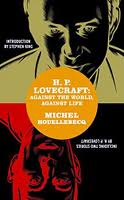
Both of these stories appeared in Michel Houellebecq’s H.P. Lovecraft book, but I wanted to treat them separately for ease of searching and discovery.
After my long history with Lovecraft and after reading Houellebecq’s book, I anticipated being blown away by these stories. And so, with my expectations so high, I was naturally disappointed. I was especially disappointed with how normal these stories seemed. Houellebecq made me think the stories were practically non-narrative in form—that they eschewed all manner of conventional storytelling. That his writing was so weird that no one would publish it. But in these two stories everything seems completely normal. Psychologically these stories are different, but aside from content, they are fairly conventional stories.
Maybe they aren’t mind blowing because they were written nearly 100 years ago and the entire world has changed drastically since then. It may also be because I have read all of the derivatives of Lovecraft enough that there’s nothing new in his work. And it may also be that in the past 80 years, we have thought of things that are much scarier than these, in part because of Lovecraft himself. Or maybe I would have been into them a lot more had I read them when I was a teenager.
“The Call of Cthulhu.”
My disappointment was especially prevalent with “The Call of Cthulhu.” I mean Metallica wrote a song about it…it must be mind-blowing.
And yet, it’s actually a fairly pedestrian story told in three parts. Lovecraft layers the story in an interesting way. And the final revelation is pretty cool, but the majority of the story is done through fairly academic style work.
 We find papers from the late Francis Thurston. Thurston talks about papers that he found which were left behind by his uncle George Angell, a professor at Brown University. (Houellebecq pointed out Lovecraft’s racism and you can see it in little things like that Angell was killed after being jostled by a “nautical looking negro.”)
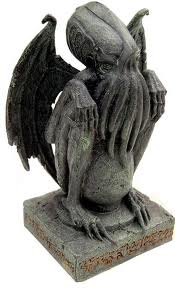
The first part of the story talks about a bas-relief sculpture (which is quite tiny). The sculpture is of a creature that is part octopus (a tentacle face) part dragon (with wings) and part human (with a human frame). A student at the Rhode Island School of Design (I loved that Lovecraft uses so many real things in his stories) created the piece based on dreams he had. And this creature is Cthulhu.
In the second part, we learn of the first time the Professor heard the name Cthulhu. It was during a 1908 Archaeological Society meeting. A New Orleans police officer had found a statuette made of an unidentifiable stone that was captured during a voodoo ritual. Even the archaeologists couldn’t determine what it was. In addition to the material being unidentifiable, the sculpture was very similar to the one mentioned above. The practitioners of the voodoo ritual were all mixed blood (Lovecraft hated these impure individuals) and were trying to call forth Cthulhu from his home in R’lyeh. The chanted phrase being translated as “In his house at R’lyeh dead Cthulhu waits dreaming.”
At this same Society meeting another member mentions a cult of Esquimaux in Greenland who worshipped a similar icon.
The final section is about Thurston’s own investigation. In 1925, a ship, the Emma, had a battle with the Alert. Although unprovoked, the Emma was able to fight of the half-caste pirates, but they lost their ship. So they took the Alert. The ship headed for an uncharted island where the entire crew died except for the sole survivor, Gustaf Johansen.
Thurston goes to visit Johansen and his (by now) widow gives him a manuscript (that was written in English). It is a detailed account of Johannes’ encounters on the island. It is this manuscript that is the most exciting part, as Johannes talks all about what he has seen and recognizes the monsters as part of Cthulhu. It also ties together some natural phenomenon with the release of Cthulhu himself.
But the remove of the story takes some of the intensity out of it. While it does work as a good introduction to the Cthulhu mysteries, it’s not a terribly exciting story in and of itself.
“The Whisperer in The Darkness,”
“The Whisperer in The Darkness,” however, was a much more exciting and excruciating story and I can imagine that when it was written it must have been very intense and a bit mind blowing. Of course reading it now I kept thinking of Futurama, so we can see how far our culture has come since 1930.
This story begins with the main character (and writer of the story) Albert Wilmarth talking about folklore. There has been flooding in Vermont lately and in the wreckage and debris, people witnessed strange, unearthly bodies floating down the rivers. Wilmarth dismisses these stories as people putting in pieces of folklore—people have always imagined great beings who live in remote location (like the mountains of Vermont).
Some people adamantly disagree with him, saying without doubt that they saw pink crab like humans floating in the river. But he remains steadfast in his opinions.
But then he receives a letter from Henry Wentworth Akeley, a man who lives in a farmhouse near Townshend, Vermont (Wilmarth lives in Boston and has never been to Vermont). Akeley is a serious, sober man who is also an intellectual, and he tells Wilmarth that he has proof of these Great Ones, the aliens that live in the woods. He has heard them (and made a recording of them) and has seen evidence of hoofprints around his house. He sends Wilmarth some pictures and they begin a correspondence with Wilmarth starting to believe him more an more.
The letters grow more intense as Akeley falls more and more under attack from the Great Ones. He has purchased dogs to fight them (and keeps ordering more when those are killed). He has even shot one of them (which left green slime and a limb which evaporated). Indeed, some of their correspondence has been intercepted (including a stone with glyphs on it) and Akelely believes that they are on to him.
Then a strange thing happens, Wilmarth received a new letter—this one is typed rather than in Akelelys horrible scrawl, which explains that he has been wrong about these aliens all along. They are not evil, are not out to kill him. Rather they are there to show him the wonders of the world—of the universe. He invites Wilmarth up to his house to see for himself and assures him that all will be safe.
Wilmarth agrees to go and after arranging transportation he makes it to Akeley’s place. There he finally meets his penpal, who is now old and infirm—far more than Wilmarth would have expected. But Akeley speaks with such joy at the pleasures he has been shown that he begins to convince Wilmarth a wee bit. After giving him a good meal (with very bad coffee), they reconvene for their more lengthy conversation.
Akeley asks Wilmarth to pull down one of the metal urns on the shelf (this is where Futurama came in). In the urn is a brain which has been surgically removed from the host body. (The body is fine and doesn’t age when in this state. The surgery is way beyond anything our minds could imagine). The brain then travels everywhere the Elder Ones do—with complete sight hearing and taste. It can then be plugged in for ease of communication. Akeley says it is amazing and he can’t wait for Wilmarth to join them.
Wilmarth is made uneasy by all of this—by the sounds and vibrations in the house. And during the night he sneaks around and sees something utterly horrifying–so he flees.
The immediacy of this story is what made it so much more intense and unsettling than the first. And the great reveal at the end was wonderfully paced and structured. And, while I don’t know exactly what kind of horror stories were around in the 1930s, I imagine that this one probably went further than most of them at the time.
It’s hard to imagine that other Lovecraft stories are anything other than sightings of these creatures, which might get a little repetitive. But I’ll have to find out for myself one of these days.

 I Just Read About That...
Leave a comment