 SOUNDTRACK: NO AGE-“No Ground” (2013).
 I’ve been hearing a lot about No Age lately, but I don’t really know much about them. I keep thinking they are a different, older band (although I can’t think of which one for some reason). Anyhow, this new song from their new album is a simple, propulsive rocker. It starts out with some echoing guitar notes until the fast, fast bass comes in.
It’s followed by some quickly strummed guitars and low sung, almost chanted vocals.
The song feels like it builds speed throughout, although I don’t think it actually does. I didn’t realize that there were only two guys in the band—and that explains their limited musical sound. But unlike a number of other two person bands that I’ve really enjoyed as of late, this song feels a little flat. There is some appeal to it, but overall I want a little bit more.
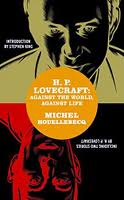
[READ: June 16, 2013] H.P. Lovecraft: Against the World, Against Life
I have been “into” H.P. Lovecraft for about thirty years. Interestingly, I had never read anything by him in that time. I got into him via Dungeons and Dragons which had a whole selection of monsters from the Cthulhu mythos. And then Metallica did a song called “The Call of Cthulhu” and even though I bought several of his paperback collections and proudly displayed them, I never read them. When McSweeney’s imprint Believer Books published this little title by the practically Lovecraftianly named Michel Houellebecq, I was excited to read it, too (because at this time I had assumed that I had actually read some Lovecraft). But like my Lovecraft books, it languished on the shelf.
Until now.
I decided that it was time to finish off some of those McSweeney’s books that have been sitting on my shelf for years. And this was on the top of my list.
I have said before that I don’t really enjoy non-fiction. That’s not exactly true, but I do prefer fiction. And yet there is something about the non-fiction that the McSweeney’s folks create that I really enjoy—whether it’s subject matter, skilled writers or simply good taste, I find I can really get into these non-fiction works. As I did with this one.
This book has an introduction by Stephen King. King talks about how important this essay is because, while it is an intelligent, dare I say intellectual, appraisal of Lovecraft, it’s not “academic” which I take to mean it is very readable. Which is true. Houellebecq makes some assertions which King says he disagrees with, but that for the most part he finds him to be right on.
Oh, King also says that the one story he never wrote (which anyone is invited to attempt) is called “Lovercraft’s Pillow,” which he said if he ever wanted to do correctly would entail dredging the depths of madness. Indeed.
Houellebecq says he got into Lovecraft at age 16 (which is about when I first got into him) when all of Lovecraft’s books were available in French. Obviously, Houellebecq is French. This book was translated and was very readable) by Dorna Khazeni). He immediately immersed himself in Lovecraft’s world (which I would have done). I have to say that reading him now for the first time (two stories are included in this volume, to be reviewed tomorrow), I think he’s much better suited for 16 year olds.
The key to Lovecraft is the opening quote from the book: “Life is painful and disappointing.” As an adult Lovecraft had always felt this way about life. As such, he hated realistic fiction. Houellebecq quotes from Lovecraft letters like
I am so beastly tired of mankind and the world that nothing can interest me unless it contains a couple of murders on each page or deals with the horrors unnamable and unaccountable that leer down form the external universe.
It seems that Lovecraft was a pretty happy kid who liked playing with his toys. But when he turned 18 he suffered a nervous breakdown, realizing that he could no longer play with toys, that he was now an adult. Fun was no longer allowed and therefore, life was meaningless. Of course, so was death. (Which is why the deaths of his characters have no meaning—there is no noble death). And that’s why Lovecraft is comforting to those who have an aversion to life.
He concludes the first chapter by saying how remarkable it is that so many different writers have continued in Lovecraft’s footsteps, not just making sequels, but recreating Lovecraft’s worlds using the exact same words. And indeed, that is remarkable.
He compares it to Sherlock Holmes, whom Lovecraft enjoyed. Arthur Conan Doyle created a world which many people have continued. Houellebeck says that Lovecraft’s mythology is just as long-lasting and powerful as Holmes’. The difference is that Holmes’ stories center around memorable characters while Lovecraft’s seem to care not at all about characters. They are all about the experience.
Houellebecq says that in a typical weird story a person exists happily and then cracks start to appear in his life. For Lovecraft nothing was further from the truth He had no wish to spend thirty or even three pages describing a family or a person. Rather, he just jumps in and sets the stage, expecting that his audience is full of fanatics just waiting for the next piece of the puzzle. He is also not interested in the “fall” of a person. There is no morality. Rather “each [story] is an open slice of howling fear.” He never, ever wrote about sex or money.
The money piece is interesting as he never had very much. He was cheap and spent money on very little. But he also never really had a job, so he didn’t make money easily either. He always wanted to travel to Europe but could never afford it.
Critics were always harsh to Lovecraft. Even those who praised him, would praise his imagination but not his style. Houellebecq scoffs at this, noting that Lovecraft does not cater to subtle, minimalist or restrained styles that critics like. His works are overblown and over the top. They stand in direct contrast to the man himself who was always discreet and polite.
Hoellebecq talks about Lovecraft as a person. He was terribly racist, reactionary and puritanical. He loathed eroticism and anything regarding progressive behaviors. He was aristocratic, scornful and dismissive of humanity. And yet, paradoxically, on an individual level, he was kind and helpful. He often assisted would be writers and others in need.
Perhaps the most surprising thing about Lovecraft is that he married someone. And she was Jewish! Sonia Greene was eight years older than him, previously married and had a sixteen year old daughter. And somehow she seems to have immediately fallen in love with the man. He was always polite which may have had something to do with it, but he played very aloof because he knew nothing about women.
When they married they moved to Brooklyn, which appears to be where Lovecraft developed his overtly racist tendencies—after moving from his largely WASPish life in Providence, he was exposed to the hustle of the city and all of the different races and “foul mongrels” that the city presented. He grew more disgusted with humanity.
But he was also…happy. His life with Sonia was a pleasant one. And it would have remained so, if they only had some money. If his stories had been successfully published they could have had money to create a stable life. But they weren’t. And when Sonia lost her job, he went out to find a proper job, but he was useless at everything. Even his application letters were more accusatory than requesting.
She moved to Cincinnati, but he couldn’t bear the thought of the Midwest, so he stayed din New York. They lived apart from each other and eventually divorced after five years of this strange arrangement.
He continued to write and indeed, wrote the Great Texts after he moved back to Providence. He died of intestinal cancer on March 10 1937. During his illness, he remained an exemplary patient–polite and affable, stoic and courteous.
And as we all know, after he died that’s when he work really took off.
Lovecraft wrote some 60 short stories/novellas. According to Houellebecq these eight are considered the Great Texts:
- The Call of Cthulhu (1926 short story)
- The Colour Out of Space (1927 short story)
- The Dunwich Horror (1928 short story)
- The Whisperer in Darkness (1930 short story)
- At the Mountains of Madness (1931 novella)
- The Dreams in the Witch House (1932 short story)
- The Shadow Over Innsmouth (1932 novella)
- The Shadow Out of Time (1934 novella)
Two of these great texts are included in this book “The Call of Cthulhu” and “The Whisperer in Darkness”, which I’ll post about tomorrow.

 I Just Read About That...
Leave a comment