 SOUNDTRACK: IRON MAIDEN-Iron Maiden (1980).
Steve Harris was on That Metal Show recently. Harris is the ba ssist and primary songwriter for Iron Maiden and has been since their first album in 1980. When I was in high school Iron Maiden was my favorite band hands down. I had all their albums, I had all their singles, all their hard to find British vinyl 12 inch singles, even a few pictures discs. Wonder if they’re valuable?
Every album was an epic event for me–I even played “Rime of the Ancient Mariner “off of Powerslave to my English class (not telling anyone it was 13 minutes long).
And then, after Somewhere in Time, I just stopped listening to them. Almost full stop. I did manage to get the first four albums on CD, but the break was pretty striking. I actually didn’t know that they’d had personnel changes in the ensuing years. I’d vaguely heard that Bruce Dickinson left, and that others followed, but I don’t think I quite realized that they were back to their big lineup these days.
Anyhow, Harris was so earnest and cool that I had to go check out some of their new stuff. Which was okay. I’d need more time to digest, but then I had to listen to the first albums again.
And wow I had forgotten how much the first Iron Maiden album melds punk and prog rock into a wild metal hybrid. There’s so much rawness in the sound and Paul Di’Anno’s vocals, not to mention the speed of some of the tracks. And yet there’s also some epic time changes and starts and stops and the elaborate multipart Phantom of the Opera…. Wow.
The opening chords of “Prowler” are brutal. But what’s surprising is how the second song “Remember Tomorrow” is a lengthy song that has many ballad-like qualities, some very slow moody sections–although of course each chorus rages with a great heavy riff and a blistering solo. On the first two albums Paul Di’Anno was the singer. He had a fine voice (it was no Bruce Dickinson, but it was fine). What’s funny is that Bruce does the screams in “Remember Tomorrow” so much better in the live version that I forgot Paul’s vocals were a little anemic here.
However, Paul sounds perfect for the rawness of “Running Free” a wonderfully propulsive song with classic Harris bass and very simple metal chugga chugga riffs. And this has one of the first real dual guitar solos–with both players doing almost the same riff (and later Harris joining in on bass).
“Phantom of the Opera” is the band’s first attempt at an epic multi-secton kinda-prog song. It opens with a memorable, if slightly idiosyncratic riff and some wonderfully fast guitars/bass. There’s a great slow bit that morphs into an awesome instrumental soloing section with bass and twin guitars playing a wonderful melody.
“Transylvania” is an instrumental that is challenging but probably not one of the best metal instrumentals out there, although again when Dennis Stratton and Dave Murray play in synch solos it’s awesome. This track segues into “Strange World” a surprisingly trippy song (with effects that seem like keyboards but which aren’t). It’s slow in a “War Pigs” kind of way, but it doesn’t entirely break up the album, because there are other slow bits on the disc. It is a little out of place though.
Especially when “Sanctuary” blasts forth. True, it wasn’t originally on the album (in the UK), but man, blistering punk or what! “Charlotte the Harlot” was always one of my favorite songs (it taught me what a harlot was after all), it’s quite proggy, with a lot of stuttered guitar work and a middle section that features some loud and complex bass. The disc ends with the by now almost immortal “Iron Maiden.” A great raw riff opens the song, a harmony guitar partners it and the band blasts forth. Who even knows what the lyrics area about, the song just moves and moves–There’s even a great chaotic bass/drum break in the middle. And listening to the guitar noises in the solos at the end. Amazing. It’s quite the debut.
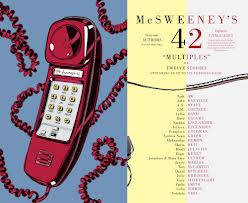
[READ: June 7, 2013] McSweeney’s #42
I have made it a point of (possibly misguided) pride that I have read every word in every McSweeney’s issue. But this issue has brought that to an end. As the title states, there are twelve stories in the book. But there are also sixty-one authors writing in eighteen languages. And there’s the rub. One of my greatest (possibly misguided) shames is that I don’t speak any other languages. Well, I studied Spanish and German, I know a few dozen words in French and I can read the Greek alphabet, but none of these would help me read any of these stories. So, at least half of this book I didn’t read.
But that’s kind of the point. The purpose of this book is to make a “telephone” type game out of these stories. Stories are translated from one language to another and then re-translated back into English. The translators were mostly writers rather than translators and while some of them knew the second language, many of them resorted to Google Translate or other resources to “read” the story. Some people read the story once and then rewrote it entirely, other people tried to be as faithful as possible to the original. And so what you get are twelve stories, some told three times in English. Some versions are very similar and others are wildly divergent.
I normally write about the stories in the issues, but that seems sort of beside the point as the original stories were already published and were selected for various reasons (and we don’t even see any of the original stories). The point here is the translation(s). So, in a far less thorough than usual way, I’ll list the contents below.
Adam Thirwell was the editor for this book and in his note he explains the whats and hows and whys (and a lot of what I just said above).
I
“Skrift Prover” a story in Danish By Søren Kierkegaard
English…..Clancy Martin-“A Preface to Writing Samples”
Dutch…….Cees Nooteboom-“Een vooruwoord bij Staaltjes van Schrijkunst”
English…..J. M. Coetzee-“A Foreword to Samples of the Writer’s Art”
French…..Jean-Christophe Valtat-“Un Avant-Propos à Quelques écrits d’un écrivain”
English…..Sheila Heti-“What I Would Like to Say”
Swedish….Jonas Hassen Khemiri-“Översättarens anmärkning”
This first story was really good. Kierkegaard has fun with the idea of a writer appealing to his audience for his financial success. The first two versions are remarkably similar (so much so that while I thought it was neat that the two versions were close, I thought it wouldn’t be a lot of fun reading this whole book is things were only slightly different), but Sheila Heti’s version is quiet different (as you can tell from the title). She explains that although she is Canadian she doesn’t really know French. She often went with her gut rather than finding the real word. And it changes some details significantly.
II
“Los de abajo” a story in Spanish by Enrique Vila-Matas
English…..Colm Toíbín-“The People from Below”
German….Daniel Kehlmann-“Die Leute aus dem Untergrund”
Hungarian.Péter Esterházy-“Emberek a fȯld alatt”
English…..Julie Orringer-“People Underground”
French…..Laurent Binet-“La peuple de sous la terre”
English…..Tom McCarthy-“People from Underground”
The title of this story comes from a quotation within the piece, and as you can see the stories remain fairly faithful to the style. Although by the third English one, the form has changed. McCarthy breaks it up into smaller sections which I found aided in the reading of the story.
III
“Geluk” a story in Dutch by A.L. Snijders
English…..Lydia Davis-“Luck”
French…..Yannick Haenel-“Chance”
English…..Heidi Julavits-“Chance”
German….Peter Stamm-“Zufall”
English…..Jeffrey Eugenidies-“Happenstance”
Icelandic..Sjón-“Atvik”
This was a very short story. This was one of the most fun to read because it is so almost poetic that a lot of license could be taken. Add to that that Julavits tried to intuit words that she didn’t know (which is how attic became grape arbor). I also enjoyed reading how Sjón wrote the story (which I obviously couldn’t read). He had his 13 year old son read and then retell the story. Then a few weeks later he wrote his version without ever having read the original.
IV
“[title in Japanese]” a story in Japanese by Kenji Miyazawa
English…..David Mitchell-“The Earth God and the Fox”
Spanish….Valeria Luiselli-“El Dios Terresre y el Zorro”
English…..Jonathan Lethem and Mary Faye Lethem-“The Fox and the Earth God”
Urdu……..Nadeem Aslam-“[title in Urdu]”
This is a kind of myth. It’s a very dark tale. Both versions are quite similar. Although the Lethem version has slight variations which made it more enjoyable for me.
V
“Das Tier in der Synagogue” a story in German by Franz Kafka
English…..John Wray-“In Our Synagogue”
Hebrew….Etgar Keret-“[title in Hebrew]”
English…..Nathan Englander-“The Creature in Our Shul”
Spanish….Alejandro Zambra-“Los Murmullos”
English…..Dave Eggers-“The Animal of the Church”
Thirwell used this in his introduction as an example of how one word can change everything. In this case Synagogue to Shul to Church. Eggers’ version was quite different and his explanation in its entirety was “I took some liberties.”
VI
“[title in Arabic]”a story in Arabic by Youssef Habchi El-Achkar
English…..Rawi Hage-“The Four Seasons, Without a Summer”
French…..Tristan Garcia-“Quatre saison sans été”
English…..Joe Dunthorne-“Four Seasons with Two Summers”
Italian……Francesco Pacifico-“Quattro Stagioni, due estati”
English…..Vendela Vida-“Four Seasons, Two Summers”
I liked how this story went from No Summers to Two Summers. I found the first story a little slow, but I really enjoyed the other two. Indeed, I enjoyed Vida’s version which seemed to use a lot of things from the first two. She translated it and then put it away for a bit and then rewrote the story. It had a very natural feeling.
VII
“симфония N 2” a story in Russian by Daniel Kharms
English…..Gary Shteyngart-“Symphony No. 2”
French…..Frédéric Beigbeder-“Symphonie nº 2”
English…..Chloe Hooper-“Second Symphony”
Dutch…….Aaron Grunberg-“Symfonie nr. 2”
English…..Ivan Vladislavić-“Tango”
Portuguese.José Luís Peixoto-“Tango”
This story was crazy they way each one varied so very much from the previous one. The story itself is just a couple of paragraphs. Each paragraph is about someone different with a kind of, “eh, but don’t worry about that person” ending. In the first one, the final paragraph ends with a surprise balding. The second version also has an assortment of characters but with none of the same details, except a tipped over chair. The third story expands it to two pages–imagine how much he added! Weird.
VIII
“Cipele” a story in Serb-Croat by Danilo Kiš
English…..Aleksandar Hemon-“The Shoes”
Spanish….Alan Pauls-“Los Zapatos”
English…..Francisco Goldman-“My Shoes”
French…..Camille de Toledo-“Tout sera oublié”
This was my least favorite of all the stories. I just didn’t care that much about the shoes. By the final one, I appreciated it all a bit more (in the way that familiarity breeds appreciation), but these stories didn’t deviate enough and I didn’t really enjoy the premise.
IX
“Incontrarsi” a story in Italian by Giuseppe Pontiggia
English…..Zadie Smith-“Umberto Buti
Chinese….Ma Jian-“[title in Chinese”]
English…..Tash Aw-“Tian Huaiyi”
Spanish….Álvaro Enrigue-“Tian Huaiyi”
What I really liked about this ring of stories was that it went from a story about an Italian man to one about a Chinese (with Tash Aw’s version changing the location entirely). I liked the way he grabbed the story and did his own thing with it. I must admit I didn’t enjoy Zadie Smith’s translation, which surprises me as I like her style so much.
X
“Hogy visszanyerjük” a story in Hungarian by László Krasznahorkai
German….László Krasznahorkai-“Um zurückzugewinen”
English…..Lawrence Norfolk-“The Frightful Hunt”
French…..Florence Zeller-“Bandusie”
English…..Wyatt Mason-“Band U.S.A.!”
Spanish….Rodrigo Fresán-“Haciendo Tiempo”
English…..Sarah Manguso-“Killing Time”
Norfolk turned this story into a poem with a very complex rhyme scheme. As such, it’s really hard to know what the original story was like. I’m fascinated that Zeller turned it back into a story with a wholly new title and that Mason then played off of that title. He then made it the most vulgar story around with all kinds of slang and curses–almost daring the poor next person to have to deal with all of that. By the time Manguso gets it it’d be interesting to know if she even recognized the original. Incidentally, Manguso had translation help with Alexis Romay, a person that I have worked with and who I know to be a great translator. Nice to see your name in print Alexis!
XI
“The Making of a Man” a story in English by Richard Middleton
Spanish….Javier Marías-“Cómo se hace un hombre”
English…..Andrew Sean Greer-“How to Become a Man”
German….Julia Franck-“Mann Werden”
English…..A.S. Byatt-“Manhood”
Hebrew….Orly Castel-Bloom-“[title in Hebrew]”
English…..Adam Foulds-“Manhood: Strophes”
This was the only story that started in English. Javier Marías had selected it for a compilation of stories by writers who either didn’t write many stories or who died young. The story is brief and quite dark–about a youngish student who helps a woman to dispose of a body. What I enjoyed was the way each person dealt with a very simple (yet multifacted) English sentence and had to really work with its meaning. I’d like to read the original of this one just to see how everyone did.
CODA
“L’Incendio di Via Keplero” a story in Italian by Carlo Emilio Gadda
English…..Adam Thirwell and Francesco Pacifico-“The Fire on Chance Street”
Thirwell says that Gadda is an untranslatable Italian writer–he uses many dialects, dialects that wouldn’t make sense if done as an English story. Indeed, very few of Gadda’s works have been translated. So Thirwell and Pacifico took a stab at this story. It is very stream of consciousnesses, and I found it simultaneously enjoyable and yet very long. I know I had “I’m almost done with this book and it’s the last story” syndrome and I couldn’t really get into it. After reading what Thirwell says about the story though, I’d like to try it again when I can devote all may attention to it.
So I enjoyed this collection very much. I enjoyed the premise and the execution. I must admit that I did not enjoy the design. Well, I did like the red vs black text for distinguishing the stories, but the cover (which looked great) made it very hard to travel with. The cover is broken into three parts–a harder paperback type cover which covers half of the book, a softer paperback cover that covers 3/4 of the book and then no cover for the last quarter which means that the edges curl up and get dirty and nearly ripped. In other words, it doesn’t travel well. And should I ever learn another language, I’ll come back to the unread stories.

 I Just Read About That...
Leave a comment