 SOUNDTRACK: RODRIGUEZ-“Sugar Man” (1971).
 This song was played a lot on WXPN, and when I first heard it I couldn’t imagine what new artist was talking about “sweet Mary Jane.” So it turned out that this song was over 40 years old but it had been resurrected for a movie called Searching for Sugar Man, which is a documentary about Sixto Rodriguez and how he released two albums and then disappeared.
There’s something extremely catchy about this song–the loud down strums that stand out over the quieter strumming, the crazy high frequency sound that sails throughout the song and that hint of horns that gives more depth to this simple folk song. All of these elements make this song more complex than it might have been. In fact, the song seems like it’s going to end after about two minutes but there’s the instrumental section full of crazy sounds and electronics.
And even though it seems over after that there’s one more verse and chorus to go. And then the song just drifts away echoing into nothingness. It’s quite a catchy little number.
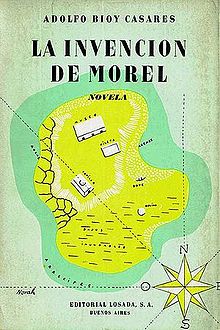
[READ: June 4, 2013] The Invention of Morel and Other Stories
Roberto Bolaño recommended this main story (the other ones as well, I assume). He’s a big fan of Bioy Casaraes. But also, Jorge Luis Borges has a prologue to the story in which he states of “The Invention of Morel”
“I have discussed with the author the details of his plot. I have reread it. To classify it as perfect is neither an imprecision nor a hyperbole.”
Holy crap.
I can’t say exactly that it I perfect although it is quite fine. It deals with all kinds of interesting issues and is inspired by (maybe that’s not exactly the right word) The Island of Dr Moreau. The funny thing is that Morel is neither the main character, nor even a major character for half the book.
The story starts on an island with the narrator writing this book down to leave a record of “the adverse miracle.” We learn that the narrator is a fugitive and he was told by an Italian rug seller in Calcutta that the only possible place for a fugitive like him is an uninhabited island. And on this particular island in 1924 a group of white men built a museum, a chapel and a swimming pool. But no one dares to go there—not Chinese pirates, not even the Rockefeller Institute because there is a fatal disease located on the island—anyone who has visited there has been found later dessicated.
The narrator decided to go there anyhow. And he found safety there. For 100 days and nights he was alone and then on that 100th night he was awakened by music and shouting and people strolling up and down the island.
The narrator spends much of the rest of the story spying on and hiding from these people. Their clothes are from another era (so they are eccentrics), but he’s still afraid of being caught by them.
He backs up to describe where he thinks he is but an editor’s note says that his suggested location is doubtful (which is part of the original story and very amusing in my opinion). He describes the island and the buildings (and even includes a map). And in exploring the island, he discovered motors in the museum—these motors seem to control the lights and any electricity.
Then he tells us about Faustine. Faustine is the woman that he sees most on the island. And he is utterly taken with her. He learns her routine, he watches her (careful not to be seen in his unshaven and desert-island appearance. But he slowly build up the courage to talk to her. And yet every time he tries to interact with her, she pretends he is not there. She ignores him utterly. He’s not sure what to think, he tries many different ways to get her approval but…nothing.
It is around page 30 (of 90) that we learn of Morel. Morel is speaking with Faustine and they seem to be an item or a potential item. The narrator is devastated. And angry. He is still afraid of being caught (knowing that if he is caught he will be sent back to prison), but he attempts more and more bold moves.
Things start getting weirder from here. One day he notices that two moons and two suns are visible.
More and more people are around but they all seem to ignore him. He speculates 5 possibilities: He is imagining the people; Maybe his weird diet on the island has made him invisible (but he is not invisible to the animals, so that can’t be right); Perhaps they are from another planet (but yet they speak French perfectly); He is insane, in an asylum; He is traveling amongst the dead in another plane. And he likes the idea that his is dead.
And then the truth is revealed. I don’t wish to ruin the truth because it is quite an achievement. And I imagine if I had read this in 1940 or maybe even 1960 I would have been blown away. Reading it now, the thrill of the discovery is lost somewhat, but I can see why Borges was so impressed at the fantastical nature of the story.
By the end of the story he resolves to join the people, and that leads to a whole new level of interesting ideas and coolness. And it seems like his resolution causes the destruction of his senses. The final line is a plea, one that is quite impassioned and really makes the story quite extraordinary. Perhaps Borges is not wrong after all.
The other stories in this collection were less exiting for me, although I can see why Bolaño likes them because they are stories of layers within layers–a technique that Bolaño uses, too.
“In Memory of Pauline” is the story of love lost and uncontrollable rage, but it is told in a fascinating way—with the plot of the story coming after the fact.
“The Future Kings” reflects back on a circus performance in which seals featured heavily. The narrator was a young boy when this circus had such an impact on him. But it was his brother Mark and his sister Helen who were really taken with them. Mark was so mesmerized that he went back stage and asked if they could visit the seals. The story quickly jumps ahead to college, where the narrator studied hard, and Mark was much more relaxed until he decided to study animals. And so he and Helen went off to study. The story jumps ahead again this time after the narrator has become a writer of espionage and the war has broken out. Mark and Helen are holed up with a bunch of seals and the bombs are closing in. It’s certainly an unusual story.
“The Idol” is a story of magical powers–whether real or imagined–is not explicated. The narrator is an interior designer who buys antiques. On one excursion he buys a mysterious idol, and he meets an enchanting woman named Genevieve. She comes to him some time later looking for a job and perhaps place to live. He is made uncomfortable by this but thinks of his friend Garmendia who could use some help around the house. Genevieve goes there and soon enough, Garmenida is complaining that she is ruining his life—she is all he thinks about. They make arrangements for her to leave but after she does Garmendia now accuses him of stealing his woman. I enjoyed this story quite a bit, especially when the idol comes into play.
“The Celestial Plot” begins with the statement that Captain Ireneus Morris and Dr Charles Albert Servian disappeared from Buenos Aires . The narrator explains that soon after this happened he received a package that included the complete works of Louis Auguste Blanqui and a manuscript entitled “The Adventures of Captain Morris” signed C.A.S. This story turns out to be all about parallel universes (I didn’t even know they talked about such thing back then). Morris is a pilot and winds up in an alternate Buenos Aires, suspected of being a spy (I give this away because it seems obvious when you read it now that that’s what happened, but as with Morel, I feel like this was way ahead of its time. It’s really captivating story., especially when it gets fully explicated.
I admit I didn’t give these last two stories a fair shot, I wanted to read something else so I kind of half-heartedly read them.
“The Other Labyrinth” opens with the story of a dead man and the manuscript in his pocket (Bios Casares loves this layering). The story concerns a man who agrees to murder the chief of police. The story is convoluted with numerous people getting involved with the manuscript and by the end I rather lost interest.
“The Perjury of the Snow.” In this one, A.B.C. writes an introduction to “An Account of the terrible mysterious events that occurred in General Paz” A.B.C talks about the writer Villafañe and his obscure style. He presents the aforementioned account as edited by A.B.C. himself. I f0und the beginning of the story a bit long-winded, but by the end the possibility of an alternate reality, a fascinating mystery, the death of a woman and all manner of treachery was topped only by the story of how all of the pieces fit together. The story was long but I enjoyed it by the end.
I feel like if I read these two again in a few months I would really enjoy them, so I’ll keep that in mind. A.B.C. proved to be a fascinating writer. This book was translated by Ruth L.C. Simms. I wonder who else has translated his works.

 I Just Read About That...
Leave a comment