 SOUNDTRACK: TRICKY-“Christiansands” (1996).
 This book is set in Kristiansands, and so naturally this song was ringing through my head the whole while I was reading it. I’ve known this song for ages, but had no idea that Chirstiansands was an actual place in Norway.
This song is dark and tense. Over a slinky beat, a spare guitar riff introduces Tricky’s voice as he rasps (his voice is slightly modified to give him a weird echo). And while he’s reciting his verses, the gorgeous voice of Martina Topley-Bird, repeats what he’s saying in a whispered voice until she sings out the chorus “I met a Christian in Christiansands.”
The verses repeat with Tricky emphasizing, “master your language and in the meantime I create my own. It means we’ll manage.”
I honestly don’t know what the song is about, and it feels like it never properly ends–that riff, at once menacing and gripping never seems to conclude. It’s a masterful track and hard to forget once you’ve heard it.
[READ: May 11, 2013] My Struggle Book One
I read an excerpt of Book Two from this series in Harper’s. And despite the fact that nothing really happened in it, I was drawn in by the writing style. This first novel is very similar in that not a lot happens but the voice is very captivating. The translation is by Don Bartlett and it is fantastic–I can only assume the original Norwegian is just as compelling. So, despite the fact that this autobiographical series contain six books (six!) and totals over 4,000 pages (how could this be if Book one is a mere 400? Books 4-6 are over 1,000 pages each), I decided to give it a try. (Incidentally, Book Two has just been translated into English this month).
This series has caused some controversy because it is given the same title as Hitler’s Mein Kampf (Min Kamp in Norwegian), and also because he says some pretty means stuff about people who are still alive (like his ex-wife). Although there isn’t much of that in Book One.
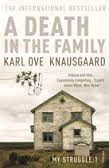 Indeed, Book One basically talks about two things–a New Year’s Eve party when Karl Ove was youngish and, as the bracketed title indicates, the death of his father. (The title A Death in the Family is the same book as My Struggle Book One–from a different publisher. It has a totally different cover but is the same translation. I don’t quite get that). But indeed, these two events take 430 pages to write about.
How is this possible? Because Karl Ove writes about every single detail. (I assume this why the books are considered novels, because there is no way he could remember so much detail about every event). I’m going to quote a lengthy section from a New Yorker review (by James Wood) because he really captures the feeling of reading the book:
There is a flatness and a prolixity to the prose; the long sentences have about them an almost careless avant-gardism, with their conversational additions and splayed run-ons. The writer seems not to be selecting or shaping anything, or even pausing to draw breath…. There is something ceaselessly compelling about Knausgaard’s book: even when I was bored, I was interested. This striking readability has something to do with the unconventionality of “My Struggle.” It looks, at first sight, familiar enough: one of those highly personal modern or postmodern works, narrated by a writer, usually having the form if not the veracity of memoir and thus plotted somewhat accidentally, concerned with the writing of a book that turns out to be the text we are reading. But there is also a simplicity, an openness, and an innocence in his relation to life, and thus in his relation to the reader. Where many contemporary writers would reflexively turn to irony, Knausgaard is intense and utterly honest, unafraid to voice universal anxieties, unafraid to appear naïve or awkward. Although his sentences are long and loose, they are not cutely or aimlessly digressive: truth is repeatedly being struck at, not chatted up.
That idea of being bored but interested is really right on–and it may sound like a bad thing, but it’s not. You can read along thinking that there’s no way he is going to give so much unimportant detail. But you get this description of drinking a cup of tea:
After a while I picked up the teapot and poured. Dark brown, almost like wood, the tea rose inside the white cup. A few leaves swirled and floated up, the others lay like a black mat at the bottom. I added milk, three teaspoons of sugar, stirred, waited until the leaves had settled on the bottom, and drank.
So it takes up a lot more space than “I drank a cup of tea” and while it’s not exactly gripping, neither is it boring or dry. The way her writes, everything seems important, somehow.
The book opens more or less with the explanation that it is March 2008 and Knausgaard is at his desk, “listening to the Swedish band Dungen and thinking about what I have written.” He’s thinking about this book. [Also, I need to jump in here and say that Knausgaard’s taste in music is exceptional. We are roughly the same age (if only I had written 8 novels by now), and we have an esoteric taste in common. I wish there was an index for all the bands he listens to because they are consistently great. A sampling from page 178-180: Echo & the Bunnymen, R.E.M., Green on Red, David Bowie, The The, The Police, The Stranglers, Talking Heads, The Chameleons, U2 (October), Eno Byrne, even Agnetha Fältskog (one of the A’s in ABBA). The soundtrack to this book would be awesome.
Music is an important part of Knausgaard’s life. When he was young, he was in a crappy band (crappy mostly because he was terrible on guitar) and they had a very bad debut performance (given in exquisite detail). Later he formed a band with his brother (he played drums this time). They were better (and were named Kafkatrakterne), but in this case it was mostly his brother’s band, and Karl Ove felt bad for tagging along in this one (and in everything else his brother did before he went to college).
The first part of the book talks about his youth–mostly college in Kristiansand. There’s a section about his deflowering (which is detailed and surprisingly erotic in its detachment). And then at least 70 pages of the book are devoted to an upcoming New Year’s Eve party. Seriously. From the procurement of beer (a difficult thing when you’re underage, although for the most part he is given no trouble) to the hiding of said beer from the adults who are giving him a ride (in a snowbank), to the trouble of acquiring said ride, to the mishaps of the ride, to getting to the party, to hoping to go to a better party to ultimately hanging out with the people he didn”t want to hang out with and then ultimately trying to sober up before getting home. And while there are some diversions thrown in, this takes up nearly half of the first half of the book. And I couldn’t look away.
He is obsessed with detail. And this detail really pays off in the second half.
The second part picks up with the death of his father. He did not like his father (nor did his brother). His father split from his mother after the kids had grown, and he had somewhat recently taken up with a much younger woman. He had, appropriately begun dressing like a younger hippie as well–which Karl Ove couldn’t stand. The last time that Karl Ove had seen his father was over a year before his death. During that time his father had moved back in with his own mother (Karl Ove’s grandmother), where he proceeded to drink himself to death. There are many anecdotes about the awful life he led there–he fell and broke his leg but just lay there drinking while his mother took care of him and when they finally arrive, the full impact of his father’s miserable life hits them with full impact.
When Karl Ove and his brother arrive, they find that the house is a disgusting filthy mess–excrement all over the place, bottles everywhere, a putrid piled of unwashed clothes, and a seagull which their grandmother feeds in the house. Here’s where the details are really powerful as Karl Ove enumerates the detritus and awfulness that he has found, making it ever so much more real. The boys set to work trying to clean the place up. And again, the detail is excruciating as he talks about the cleaning products and the number of garbage bags and how they disposed of them and how long it takes to do one room–you will feel like a slacker if you have ever cleaned anything. We don’t really get his brother’s point of view, although he seems far more stoic. It appears that Karl Ove, for all of his distance and contempt for his father (which seems justified) is really an emotional person at heart. He breaks down many times thinking about what his father’s life was like and how his grandmother coped with him.
Their grandmother clearly has dementia. She is the one who found her son dead, but she seems unaffected by the incident. At the same time, she keeps repeating herself, and giving the boys dirty looks as they try to clean the place. Not only that but she keeps peeing in her clothes, more or less undoing the cleaning that the boys are doing.
This sequence of depressing awfulness last about 200 pages. But interspersed, Karl Ove throws in so much–philosophical ideas, past memories, thoughts about his wife and soon to be born daughter, as well as reminiscences about his father and grandmother. But most of this section is incredibly detailed information about how Karl Ove and his brother dealt with the week of the funeral–cleaning the house, going to the undertaker, planning the reception and wondering what to do with the money that their father left them.
Again, all of this is in incredible detail–like that his brother puts on his indicator and pulls out into traffic. The detail is staggering and yet the way Karl Ove writes, everything seems to be fraught with tension. Even if nothing comes of it–the sequence where he gets off the plane with just his carry on seems like something bad will happen, but nothing does–the tension is palpable and I think that’s what keep the book so interesting. The fact that nothing unexpected happens isn’t really a disappointment, it’s almost a relief–like a constant state of…phew.
As the book nears the end he actually introduces a real plot–what is the actual cause of his father’s death–there was blood on his nose, but their grandmother says he died sitting in his chair. This actual tension–the first real honest to God tension in the book, which is brought up with about 50 pages to go–goes unanswered! Now, he has some 3,000 pages left with which to answer it but wow, a cliffhanger on a book like this, who’d have guessed.
This series is not for everyone, clearly. Karl Ove isn’t really all that nice of a person. But he is honest and there is something very compelling about him. I’m very interested to read book two, although I’m intimidated by the 1,000 page books that are coming later. I hope I have the fortitude to finish the series.


 I Just Read About That...
Leave a comment