 SOUNDTRACK: GOAT-“Run to Your Mama” (2012).
 I was intrigued to hear this song by Goat (whom I don’t know) because of the picture below. Now that is a band photo!
Goat are a Swedish band and, like a bunch of Swedish bands recently, their guitar sound is very retro–a big open clean guitar sound. But the riffs that they play are also very retro, this song sounds incredibly 70s–classic rock/heavy metal 70s.
The lead singer is the female of the trio, and she has a great raspy voice (and I assume she does the backing vocals as well).
The song feels like it could be an epic workout (especially when the solo kicks in and it is lengthy and, apparently, on a xylophone). But right after the solo (at just under 2 and a half minutes), the song just ends. It’s fantastic and I’m looking forward to hearing more from the album.

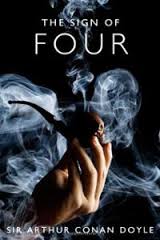
[READ: May 12, 2013] The Sign of (the) Four
I recently found out that the Sherlock Holmes book that I was supposed to have read in high school (from a reading list that I know I read at least some of) was actually not by Sir Arthur Conan Doyle. Rather The Seven Per Cent Solution was a relatively recent (1974) book by Nicholas Meyer. The only thing I remember from the book was learning that Holmes was an addict (and passing that news along to my mother with a tone of “see people have always been bad”).
Anyhow, in The Sign of (the) Four, the book opens with Holmes shooting up a seven per cent solution of cocaine. The reason being that the cocaine kept his brain active when he had nothing else to do. Holmes is bored, just waiting for something new to come along. But Doyle doesn’t keep us waiting long. A young woman, Mary Morstan, calls on Holmes for help with a case. Or actually more like a series of interesting puzzles. The first is the disappearance of her father, Captain Arthur Morstan in December 1878. He came home from the war and then disappeared. Holmes asks if he could be hiding, but she says no, he was very excited to come home and see her. Since he has been gone, she has been employed as a governess and the family she assists have more or less taken her in as a member of the family.
The second puzzle is that she has received in the mail one very expensive pearl a year since 1872. It always comes on the same date and the sender has remained anonymous. This all started when she answered an anonymous newspaper ad that asked about her. With the last pearl she received a letter that said she has been wronged and the sender asks to meet her. He also says that she shouldn’t come alone. So she asks Holmes and, by extension, Watson to accompany her.
Through a series of vehicles, they meet Thaddeus Sholto, a friend of Captain Morstan, who confirms that the Captain died in 1882. Sholto’s father and Captain Morgan were in the war together. Six years ago they had a fight over a treasure. During their argument, the Captain suffered a heart attack and died. Sholto’s father totally freaked out and hid both the body and the treasure. Some time later, in declining health, his father confessed his sins, but on the night he died, he saw a man out the window who later broke into the house and left a note that said The Sign of Four (incidentally, the title of the book is variously The Sign of The Four and The Sign of Four; Doyle himself had written it both ways). Thaddeus and his brother Bartholomew take over the treasure. Well, Bartholomew takes it over and allows Thaddeus to send Mary the annual pearl as a payment for what happened to her father.
On the night that the story takes place, they travel to Bartholomew’s because he is in declining health. But when they arrive, they find him dead–from a poisoned dart. And the treasure is missing.
Holmes makes some decisions and predictions. Although the police immediately take Thaddeus (and others) into custody, Holmes assures everyone that Thaddeus is in no way responsible. And he determines through a series of clews, exactly what happened here. But not everything works exactly as Holmes predicted (he’s not wrong exactly, he just doesn’t have all the information). They follow a trail which ultimately goes awry.
The second half of the story involves Holmes and Watson waiting for any sign of a boat, on which the guilty parties must have fled.
When the criminal is finally caught, he tells his story. As with the first novel, the end of this novel is quite a lengthy history of the guilty party (it’s nowhere near as long as the one in the first book which went all the way back to Utah, but it’s a solid twenty pages). The criminal explains everything in great detail that led up to recent events. His story goes all the way back to the war in India, where he was captured and made a compact (the Sign of Four) with three other men (there’s a pretty intense amount of racial insensitivity here, although the Sikhs come out quite well). It transpires that he and the other three men originally stole the treasure (after killing the owner) and so he believes it is rightfully theirs (despite assisting in a murder, he is a man of his word and won’t take more than his share). But he confided the story about the treasure to Sholto the elder, who ultimately stole it from the Four.
Meanwhile, Ms Morstan and Watson really hit it off. Indeed, Watson falls hard in love for her (they’ve spoken about three times). And by the end of the story, he proposes. I had read some of the backstory about Doyle’s hatred for Holmes. He didn’t think much of the stories and didn’t want to write any more (and they weren’t selling well initially anyway). The ending of this story seems to set up perfectly that the series would end. Watson would marry Marston (which Holmes didn’t approve of because although he thought Marston was an unparalleled woman, he felt that love interferes with logic). And with Watson gone, Holmes’s final line is,
“For me..there still remains the cocaine bottle.” And he stretched his long white hand up for it.
Wow, what an ending!
Of course, Doyle was persuaded to write a series of short stories about Holmes, which were later collected in several volumes. And I’ll get to those in a while too.

 I Just Read About That...
Leave a comment