Feeds:
Posts
Comments

Archive for April, 2013

peach6SOUNDTRACK: THE DICKIES-“Eve of Destruction” (1979).

dickiesI didn’t know the original of this song until I listened to it just now (man it is depressing).  I have known this Dickies cover since the 90s, which speeds up the original almost twice as fast and makes the lyrics pretty much inaudible (which makes it less depressing).

The Dickies have done a lot of great covers, and while this one was never one of my favorites (I’m a “Town without Pity” and “Hair” man, myself), I always enjoyed the “over and over and over again my friend” part (and the squeaky guitars).   And now after listening to the original, I really prefer the cover.

[READ: April 2013] Lucky Peach Issue 6

I haven’t been reviewing Lucky Peach issues in their entirety because they are mostly about food and cooking and recipes and I don’t really have anything to say about that (I enjoy the articles a lot, but I don’t need to comment on them).

But I wanted to bring special attention to this issue, which is all about the Apocalypse.  And there’s a couple reasons for that.  Zombies are huge, that Mayan end of the world business was all fun, and of course everyone seems to think that Obama will cause the end of the world.  But on a more serous level, global warming is unchecked and no one seems to care about the environment at all, and with the weather being as crazy as it is, all bets are off as to what our world will look like even ten years from now.  So why not read a magazine that has recipes for all kinds of things that might still be around in a decade.

The first half of the magazine is all about preparing for the apocalypse.  There’s a degree of tongue in cheekedness in it but it is entirely sincere: there’s plenty of recipes for canning, there’s information about seed savers and a fascinating article about Seafarming, which I seriously hope takes off, as it sounds like it could be a real solution.  There’s some fascinating information about Shelf Life and even a recipe entitled “pollution” which looks like a polluted sea but seems very expensive to make.  I also really enjoyed the brief story about the couple who won a honeymoon in a bomb shelter for two weeks (compete with all of the canned food they could eat–oh, the Fifties). (more…)

Read Full Post »

ember

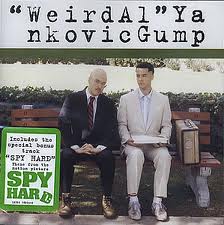
SOUNDTRACK: “WEIRD AL” YANKOVIC-“Gump” [single] (1996).

gump

This was the second single I purchased from “Weird Al”‘s Bad Hair Day album, this time it was “Gump” with six, yes six, B-sides.  The first one was “Spy Hard” the theme from the movie (starring Leslie Nielsen).  It’s a funny theme song, very Bond, but also with great spoofy lyrics.  It wasn’t available anywhere else, although it has since been released as its own single (with no B-Sides).

The rest of the B-Sides include “Since You’ve Been Gone” from the album and a karaoke version of the same song.  This karaoke version is quite funny and is probably the best B-side he’s released.  The band provides the backing vocals to keep you in place.  Which means that in the middle of a quiet bit you suddenly hear “red hot cactus up my nose!.”

Then the B-sides get even weirder–an instrumental version of “Callin’ in Sick”
which really nobody wants.  And then two more versions of “Spy Hard,” and instrumental and an orchestral mix.  I can’t really tell them apart, and frankly they’re rather useless anyhow.  So all in all, not a great single, but that karaoke song is pretty great.

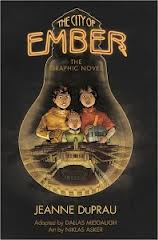
[READ: April 20, 2013] The City of Ember: The Graphic Novel

I have had the City of Ember t trilogy on my to-read list for a long time, but I’ve never gotten round to it.  So I was pleased to see this graphic novel version.  I know that the novel is pretty long, so I was surprised that this graphic version could be polished off in less than an hour.  (It’s also written at a level that is more appropriate for younger kids—the dark darknesses of the novel are condensed to just one or two pages in the beginning.  Of course, how young you want your kids reading books about corruption and dystopian societies is something else entirely.  The focus is on the kids’ attempts to escape and their working together (again, I haven’t read the novel so I don’t really know how that breaks down in the book).

So the story as presented here is a simple one.  The city of Ember is the only place where there is light in an otherwise dark world.   As the story opens we see a classroom where children are set to pick their future occupation.  Lina, our heroine, picks Pipeworks laborer, which she is utterly distressed at—she wanted to be above ground. Later, Doon, our hero, chooses Messenger, but he is disdainful of the whole process— courting the wrath of the mayor who says he’s going to keep an eye on Doon.

When class ends, Doon offers to switch jobs with Lida (which I assumed would get them in trouble, but didn’t).  Lida is thrilled to work as a messenger and agrees eagerly.  Doon believes that he can cause trouble from the inside by working in the Pipeworks.  Although when he finally gets down there he sees that it is a much bigger and more daunting project than he ever imagined. (more…)

Read Full Post »

SOUNDTRACK: WRECK AND REFERENCE-“Absurdities & Echoes” (2013).peach 5

wreckI followed Lars’ blog on NPR and after listening to yesterday’s Altar of Plague and I wound up here with Wreck and Reference.  Lars describes this song as the band’s “most melodic and mysterious.”  If this is the band being melodic, I can’t imagine what the rest of it is like.

The song opens somewhat conventionally but quickly shows something unexpected with some rapid fire drums.  And then the vocals come in.  The guy sounds like he is drowning–both in his angst and in the recording technique–he’s either under a ton of reverb or just buried in the mix. The lyrics are incomprehensible, although they seem quite impassioned.  After the verse there’s a lot of noise and snare drums–martial without exactly being military-like.

I guess there is a melody in there, but it’s not an obvious one.  The song has an accompanying video which you can watch at the link above.  It’s as peculiar as the song.  Incidentally, this song comes from their 7″ called Content, which is pronounced “No Content.”

[READ: April 18, 2013] “Supreme Cloud Ear”

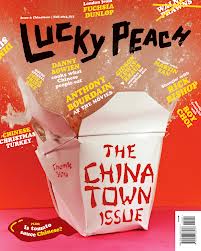
This issue of Lucky Peach was the China Town Issue.  So all of the contents were about Chinatowns across the country.  I really enjoyed it, as there were so many interesting things to read about.  This short story was set in a Chinatown.  A young couple is planning to meet Beverly.  Well, actually Andrew has met Beverly but the narrator is meeting her for the first time.  There’s an air of power around this meeting, Beverly is practically a mythical figure as far as the narrator is concerned.  We enter the room where she is preparing something and there is stilted and awkward dialogue.  And indeed, for the longest time, we don’t really know why everyone is so secretive (it’s very well done).

Beverly maintains a detached aura no matter how much the narrator tries to talk to her.  After a few minutes, Beverly says she has to go on a delivery.  The narrator says that she has forgotten to get wine for their dinner, so she’ll tag along.  Beverly is clearly not happy about the company, although again, we don’t know why, exactly.

Beverly says that there’s a wine store down the street but the narrator won’t leave her side.  Resigned to the company and making sure that the narrator is prepared for whatever might lie ahead, Beverly invites her along. (more…)

Read Full Post »

between heaven SOUNDTRACK: ALTAR OF PLAGUES-“Scald Scar of Water” (2013).

aopI never think of death metal coming from Ireland.  I think of punk and metal and obviously the Pogues, but noise metal?  Unlikely.   And yet here is some.  And why shouldn’t Ireland produce music like this?  There are fans everywhere.

I heard this from good old Lars at NPR.  I’ve come to expect the unexpected from Lars’ picks.  And this is no exception.  The song is six minutes long.  It has some traditional death metal stuff–growling vocals, incessant drumming and lots of noise.  But there’s a lot more going on here.  It opens with electronic noise and thudding drums.  The drums are punctuated by alternating abrasive guitar riffs.  The song meanders along until it settles down to some heavy heavy verses (I have no idea what the man is screaming about).  After returning to the buzzsaw riffs, and repeating the verse, the song suddenly stops.

At 4 minutes the whole thing stops.  There’s some scratchy noises and then some slow pulsing bass and suddenly the whole song turns into  kind of alternative metal song, complete with chanting.  It’s pretty unexpected.  I can’t imagine what the rest of the album is like.

[READ: April 17, 2013] Between Heaven and Here

This was another book that I did not like in the beginning. Well, that’s not exactly true, I enjoyed the beginning but I really didn’t like the middle and really wanted it to end soon.  Not a good way to feel about a book. The reason I didn’t stop is because it was so short.  It turns out that an excerpt from this book was in a McSweeney’s issue that I recently read (and which I haven’t posted yet).  I didn’t “get” the excerpt then, and while it makes more sense in context I still felt the section was really hard to follow.

And so was much of the book.

This is the story of Rio Seco, an area of California, and the citizens who live there.  As the story opens we learn that Glorette Picard is dead.  Glorette was a crack whore, the kind of girl who would get killed and no one would miss her.  Except that people would miss her.  She had a lot of friends and relatives who cared about her.  She even had a son, Victor, who is 17 and studying his ass off to be able to go to college.  When a boy in town finds Glorette’s body dumped in a shopping cart, he feels compelled to move her, to bring her to her Uncle Enrique because he knows that the police won’t care if some crack whore was killed.  So he moves the body and that sets in place the rest of the story.

What was confusing to me was that the novel was constructed like a series of short episodes–different people and how they knew Glorette and how Glorette affected them.  That’s not a problem, except that there’s very little indication that that’s what was happening.  It felt increasingly difficult to know who was the main character was in each section, especially since so many characters overlapped.  Which again wouldn’t have been a problem except that I really couldn’t tell which person was the narrator or at least focus of each section.  Sometimes they were never identified, other times only after several pages.  The chapter that was excerpted in McSweeney’s has virtually no names in it, it is just dialogue.  And sure the dialogue was interesting and with the novel’s context made some sense, but I’m still not sure who was in the conversation. (more…)

Read Full Post »

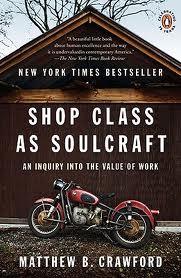
[LISTENED: April 15, 2013] Shop Class as Soulcraft

shopcraftMy sister-in-law Karen got me this audio book for Christmas.  Now that I have a daily commute I had a chance to listen to it.  And it has really stayed with me.  I think about things from it nearly every day.

Think of the book as “Western Philosophy and the art of Motorcycle Maintenance.”  Crawford studied philosophy in college.  He later went to work for a think tank.  But underneath all of that learning was a kid who worked as an electrician and a man who was always a gearhead.  So after working in a knowledge job, he quit the life and opened a motorcycle repair shop in Virginia (Shockoe Moto).  This is very likely the only book that quotes Heidegger and Hannah Arendt and also liberally uses the words shit and motherfucker (until I write my novel, of course).

My initial reaction to this book was not great.  I didn’t especially like the reader, Max Bloomquist (although I see he is a frequent audiobook voice).  His voice reminded me a lot of old filmstrips from grade school–a little stilted (which made the cursing even more surprising).  But I got used to it after an hour or so.  I also didn’t like the introduction/first chapter.  There was something about the tone of the Introduction that was either snooty or pedantic which I found off-putting.  The first chapter was a lengthy summary/example of what the book was supposed to be about–so much so that it felt like he wouldn’t need the rest of the book.  By the end of the chapter I didn’t understand why there was so much left.  So I’m actually pleased with myself for sticking with it, as I really didn’t enjoy the first two hours or so.  It was an uncomfortable mix of fifty cent words and a comparable dismissal of people who use them, or at least that’s how it felt.

But then he seemed to loosen up and that’s when it got really interesting.  His story is a fascinating one.  I think he grew up on a commune (although I feel like he only started talking about that about midway through the book).  His scholarship, his abandonment of it, his love of motorcycles and his work as an electrician and an apprentice mechanic all led to where he is now–a well-rounded individual. (more…)

Read Full Post »

heartSOUNDTRACK: CHELSEA LIGHT MOVING-“The Ecstasy” (2013).

clmWhen Chelsea Light Moving played at KEXP, they went out for a break before playing live on air.  One of the DJs had a chocolate bar.  And Thurston was inspired.  According to the NPR [page:

The Sonic Youth veteran and his bandmates in Chelsea Light Moving had been jamming off-air in the KEXP studios. When they stepped outside to get some fresh air, KEXP’s DJ Sharlese followed, offering them some of her chocolate bar. At first, Moore politely declined, but as the candy got eaten away, piece by piece, a poem (John Donne’s “The Ecstasy”) was revealed underneath, printed on the candy wrapper.

“Can I have that?” he asked, and the next thing we knew, he was sprinting back into the studio, taping the tattered wrapper to a mic stand, and belting out his own version of the poem against discordant guitar chords.

The music is great.  It works perfectly with the meter of Donne’s poem and, the way Thurston delivers it, it sounds like he could have written it.  There’s some great screaming guitars, a very cool discordant chord or two and wailing solo.  I really enjoyed that Thurston doesn’t play guitar through much of the song (he leaves that to the other guitarist), he just comes in when some wildness is needed.  Awesome.

It’s a great song and hard to believe it was tossed off so easily.

Check it out here.

The lyrics are indeed from Donne’s poem, which begins:

WHERE, like a pillow on a bed,
A pregnant bank swell’d up, to rest
The violet’s reclining head,
Sat we two, one another’s best.

[You can read the rest here].

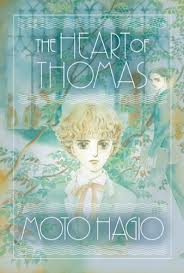
[READ: April 14, 2013] The Heart of Thomas

I brought this home from work because Sarah loves boarding school books.  But this is a manga book, and it is set up to be read right to left.  Sarah admitted that she can’t easily get her mind to work that way.  Which I understand. So I gave it a go.  I found it rough going, but after about 20 pages it became pretty natural.

The Heart of Thomas is an early example of Shōjo manga (少女漫画) which is manga marketed to a female audience roughly between the ages of 10 and 18. The name romanizes the Japanese 少女 (shōjo), literally “little female”. Shōjo manga covers many subjects with a strong focus on human and romantic relationships and emotions.   Shōjo manga does not comprise a style or a genre per se, but rather indicates a target demographic.  shōnen-ai.  The stories were published mostly in magazines targeted at girls–which had a huge audience.  And that is where The Heart of Thomas was originally published in 1974.

The Heart of Thomas is a fascinating story—it’s set in a German boys boarding school (written by a Japanese woman!). The story opens with the death of a character named Thomas.  He falls off a bridge and the story is predicated upon wondering whether he jumped or he fell.  There are a lot of clues that he committed suicide because of his unrequited love for Juli, the prefect of boys at the school.  Juli is quite different from the other boys, he has dark hair and Greek features, he is not golden haired and blue eyed like so many of the other boys.  This makes him stand out.  Indeed, he even stands out in his own home, where he lives with his mother and grandmother.  His grandmother is disgusted by his coloring and believes him to have impure genes (yikes!).  She even tells him as much!  But Juli is a serious student and a hard worker, with no time for nonsense from his grandmother or his classmates.  He also has no time for farce.

The farce refers to a game that Thomas and Ante created in which they would both vie for Juli’s love.  Thomas pursued this heavily but was never successful.  And that may be why he killed himself (if indeed he did). (more…)

Read Full Post »

cpatain 10 SOUNDTRACK: “WEIRD AL” YANKOVIC-Bad Hair Day (1996).

bad hair dayBad Hair Day is an uninspired album title, especially given how great of an album it is.  As I posted last week, “Amish Paradise” is great, (I forget to mention the funny Gilligan’s Island verse in the middle.  “Everything You Know is Wrong” is just a magnificent They Might be Giants parody.  Now, TMBG and Weird Al are pretty kindred spirits (they both use accordions and sing silly songs).  In that respect, this song isn’t that different from a typical Al song, but there are so many great musical nods to TMBG that the song is just awesome.  And it’s very funny too.

“Cavity Search” is a parody of U2’s “Hold Me Touch Me Kiss Me Kill Me” and it works very well, both as a great soundalike (Al’s vocal tricks get better with each album) and the way he plays with the original (the drill solo is great) are really clever.  “Calling in Sick” is a kind of Nirvana parody, although I don’t hear it as well as other band parodies.  It’s certainly a grunge song and, as such it works.  But it was “The Alternative Polka” that proved to be my favorite of his medleys so far.  “Loser,” “Sex Type Thing” “All I Wanna Do” “Closer” (hearing him do Nine Inch Nails is hilarious–especially this song!), “Bang Bang Blame” (so much R.E.M. lately), “You Oughta Know,” “Bullet with Butterfly Wings” (Weezer’s song was supposed to be included here but they asked it to be removed and he did at the last minute–see the video below).  “I’ll Stick Around,” “Black Hole Sun” and “Basket Case”–a great mix of songs that I loved at the time and still do, this song is like reliving the mid 90s.

“Since You’ve Been Gone” is a fun a capella band version of a funny break up song.  He gets better and better at this kind of lyric (“a red hot cactus up my nose” is particularly wonderful).  “Gump” is a very funny parody of “Lump” by Presidents of the United States of America.  Evidently they liked his parody so much they used some of his lyrics in the final verse when they played it live.

“Sick of You” has a fun bass line (reminiscent of Elvis Costello) and a great chorus.  And “Syndicated, Inc.” is a very funny parody of that overplayed Soul Asylum song “Misery.”  It’s a very funny song about syndicated TV shows.  “I Remember Larry” is a pretty funny original about a prankster, although it’s the weakest song on the album.  “Phony Calls” is a parody of TLC’s “Waterfalls” and it’s pretty funny (especially hearing Al do TLC vocals).  The parody works pretty well, and it’s certainly helped by the sample of Bart and Moe on the Simpsons.  “The Night Santa Went Crazy” is a pretty funny twisted take on Santa.

This album is definitely one of his best.  Just about every song is a winner.  And it’s his best-selling album too.

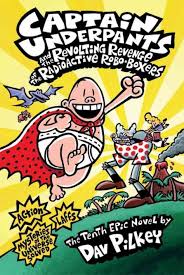
[READ: February 22, 2013] Captain Underpants and the Revolting Revenge of the Radioactive Robo-Boxers

Clark was pretty excited when this book came out.  He had just finished up book #7 or 8 when the book was published.  And so it didn’t take too long for him to get caught up with the series.  I was also pretty lucky to have just finished book nine so this “last” book (although not really) was very well timed.

When we left off in Book Nine, Tippy Tinkletrousers had inadvertently destroyed the earth and the giant zombie George and Harold were stomping through the town.  And, shockingly, they had just crushed Tippy in his robo-pants.   But as this book opens, Pilkey gives us the truth about zombies.  They are really slow.  So slow that Tippy was able to get out of the way of the giant foot (and do lots of other things) and put a giant ketchup packet under the foot so it got squished instead of him.

The rest of the book is simply chock full of time travel, overlapping people and all kinds of paradoxes.  I have to wonder if Clark got it, but he just read it again and he did seem to have decent understanding of what happened. (more…)

Read Full Post »

[LISTENED TO: March 30, 2013] Knucklehead

knuckleheadWe were looking for a good audio book for the kids and I stumbled upon this, an autobiography from Jon Scieszka.  We love Scieszka’s books (Stinky Cheese Man and the Time Warp Trio among others) and figured that this autobiography had to be good for a few laughs too.  And we were very much correct.

This is a funny book about what it was like to grow up as the second oldest of six brothers in Flint, Michigan.  It’s not really about being an author (although he does talk about where he gets ideas), it’s really about his childhood.  Most of the anecdotes in the book are things that he and his brothers got up to and how his father used to affectionately call all six of them knuckleheads.

The book has almost 40 chapters, all of them very short (as befitting the author of books for reluctant readers).  And each one has a pretty good set up and punchline.  Like how the older brothers used to tease the youngest ones or how Jon and his brother burnt a dry cleaning bag because it dropped little plastic bombs onto a battlefield–in the basement.  Or how he and his brother peed on the space heater because they thought that would put it out (that seems suspect, but it could have happened. (more…)

Read Full Post »

highlySOUNDTRACK: FAMILY GUY-“Everything is Better with a Bag of Weed” (2009).

familyguyI recently posted about the song “Me Ol’ Bamboo” from Chitty Chitty Bang Bang.  When I was looking it up, I discovered that Family Guy had created a song called “Everything is Better with a Bag of Weed” that is sung to the tune of “Me Ol’ Bamboo.”  And holy crap I nearly busted a gut laughing when I watched it.

Of all the weird songs to parody, this was a brilliant choice.  The song is catchy and fast paced and absurd and just adding these new lyrics has made it funnier and more absurd.  There’s even the same odd instrumental break which they animate as playing glass bottle with drumsticks and as far as I can tell that’s really what it is.

My o my, this is very funny indeed.

I can’t seem to embed the video here which is a shame, but by all means check it out here.

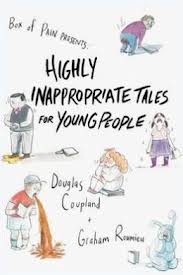
[READ: April 9, 2013] Highly Inappropriate Tales for Young People

I have read most of Douglas Coupland’s work and I like him quite a bit.  But I have discovered from re-reading his books recently that he’s not exactly the author I thought he was.  And one thing is that he’s really not very funny.  Existential? Yes. Comically absurd?  Yes.  Funny?  Not so much.  So I was surprised to see that he made this book with the rather funny title.

I assume this book is supposed to be funny since the inside flap says “Seven pants-peeingly funny stories featuring seven evil characters you can’t help but love.”  And indeed, the premise is funny, the title is funny.  But the stories are really not funny at all.  Here’s the list of the seven stories: Donald the Incredibly Hostile Juice Box; Sandra, the Truly Dreadful Babysitter; Hans, the Weird Exchange Student; Brandon, the Action Figure with Issues; Cindy, the Terrible Role Model; Kevin, the Hobo Minivan with Extremely Low Morals; Mr. Fraser, the Undead Substitute Teacher.  Judging from the titles of the tales you may think there’s humor in them…a juice box as a main character?  But there’s something about them that falls flat. (more…)

Read Full Post »

circleSOUNDTRACK: BOB MOULD-Black Sheets of Rain (1990).

I blacksheetstend to think of this as a very dark and claustrophobic album, which it is.  And yet it is also unavoidably Bob Mould, meaning that there are pop elements all over it.  There’s also some very cool, simple bass lines that tend to spruce up some moments of the album making it a bit more fun than it would be without them.

Even if the title track is over seven minutes long, with some really blistering guitar solos, there are still really poppy elements to the chorus.  As for claustrophobic, the title and cover make this seem like it would be really quiet and insular.  But a song like “Black Guard” is quite inviting.  And the third song, “It’s Too Late” is one of the poppiest songs that Mould has written.  The opening chords are so obvious and recall so many classic rock songs that it’s almost too pop for its own good.

“One Good Reason” is another longer song and it, too, has a catchy chorus.  “Stop Your Crying” is one of Mould’s great songs–a nasty-seeming minor chord structure with Mould’s screamed lyrics.  And yet he still manages to make you want to sing along.

The largely acoustic (with disconcerting organ) “The Last Night” is a breakup song.  A major downer with the odd lyric: “Tonight’s the last night that I will ever spend with you.  Please don’t ask me why cause I don’t know, yea.”  A similar kind of breakup song is “Out of Your Life.”  The difference is that “Out of Your Life” is incredibly poppy.  A major key with bouncy bass and super sing along chorus.  It’s two sides of an idea.  “Disappointed” sounds very much like earlier Hüsker Dü with that buzzy guitar that is unmistakably Mould.  The album ends with “Sacrifice/Let There be Peace” in which the dichotomy of Mould’s sounds are in full evidence.  Mould’s voice sounds completely shot by the end as she screams and growls (it’s amazing he could even speak after recording some of these songs).  The lyrics are practically impossible to understand and yet in the background Mould is chanting/singing a very steady chorus of “Sacrifice” and there’s a very melodic guitar line going on.

It’s an interesting ending to a very schizophrenic album.  It’s nowhere near as dark as I remember, but not exactly a cheery walk in the park either.

[READ: April 10, 2013] The Circle Game

It’s funny that I’m reading so much poetry, as I don’t typically enjoy it.  Well, April is National Poetry Month after all, so why not.  I received this Atwood book at work.  I really like Margaret Atwood a lot and I hope to delve into her oeuvre more.  So why not take the opportunity to scan this brief volume of poetry (which I thought was new, although I now see is from the sixties).

I’ve read a lot of different types of poetry this month and I found that I really enjoyed Atwood’s work a lot.  Could it be because it’s 40 some years old and not “new” poetry?  I don’t know.  Could it be that she uses parentheses a lot (could be).  Or is it just that she is a great writer.

Her poems actually made me think about the nature of poetry itself.  Why does a fiction writer write poetry?  It seems like some of these poems are simply very short stories.  Is that all a poem is?  A very short story (I mentioned how flash fiction has arisen as a genre, and some of these pieces feel like they could be rendered as flash fiction.  I often find flash fiction unsatisfying and I think it’s because poetry is even tighter and more effective than a flash fiction piece.

I’m also intrigued by Atwood’s poetry because she is writing about atypical stuff (as is Atwood’ wont).  So there’s not a lot of “love” here, except under the guise of something else. (more…)

Read Full Post »

« Newer Posts - Older Posts »