 SOUNDTRACK: BOB MOULD-Black Sheets of Rain (1990).
I  tend to think of this as a very dark and claustrophobic album, which it is. And yet it is also unavoidably Bob Mould, meaning that there are pop elements all over it. There’s also some very cool, simple bass lines that tend to spruce up some moments of the album making it a bit more fun than it would be without them.
Even if the title track is over seven minutes long, with some really blistering guitar solos, there are still really poppy elements to the chorus. As for claustrophobic, the title and cover make this seem like it would be really quiet and insular. But a song like “Black Guard” is quite inviting. And the third song, “It’s Too Late” is one of the poppiest songs that Mould has written. The opening chords are so obvious and recall so many classic rock songs that it’s almost too pop for its own good.
“One Good Reason” is another longer song and it, too, has a catchy chorus. “Stop Your Crying” is one of Mould’s great songs–a nasty-seeming minor chord structure with Mould’s screamed lyrics. And yet he still manages to make you want to sing along.
The largely acoustic (with disconcerting organ) “The Last Night” is a breakup song. A major downer with the odd lyric: “Tonight’s the last night that I will ever spend with you. Please don’t ask me why cause I don’t know, yea.” A similar kind of breakup song is “Out of Your Life.” The difference is that “Out of Your Life” is incredibly poppy. A major key with bouncy bass and super sing along chorus. It’s two sides of an idea. “Disappointed” sounds very much like earlier Hüsker Dü with that buzzy guitar that is unmistakably Mould. The album ends with “Sacrifice/Let There be Peace” in which the dichotomy of Mould’s sounds are in full evidence. Mould’s voice sounds completely shot by the end as she screams and growls (it’s amazing he could even speak after recording some of these songs). The lyrics are practically impossible to understand and yet in the background Mould is chanting/singing a very steady chorus of “Sacrifice” and there’s a very melodic guitar line going on.
It’s an interesting ending to a very schizophrenic album. It’s nowhere near as dark as I remember, but not exactly a cheery walk in the park either.
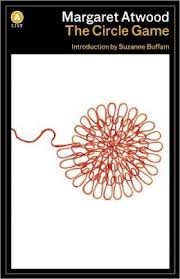
[READ: April 10, 2013] The Circle Game
It’s funny that I’m reading so much poetry, as I don’t typically enjoy it. Well, April is National Poetry Month after all, so why not. I received this Atwood book at work. I really like Margaret Atwood a lot and I hope to delve into her oeuvre more. So why not take the opportunity to scan this brief volume of poetry (which I thought was new, although I now see is from the sixties).
I’ve read a lot of different types of poetry this month and I found that I really enjoyed Atwood’s work a lot. Could it be because it’s 40 some years old and not “new” poetry? I don’t know. Could it be that she uses parentheses a lot (could be). Or is it just that she is a great writer.
Her poems actually made me think about the nature of poetry itself. Why does a fiction writer write poetry? It seems like some of these poems are simply very short stories. Is that all a poem is? A very short story (I mentioned how flash fiction has arisen as a genre, and some of these pieces feel like they could be rendered as flash fiction. I often find flash fiction unsatisfying and I think it’s because poetry is even tighter and more effective than a flash fiction piece.
I’m also intrigued by Atwood’s poetry because she is writing about atypical stuff (as is Atwood’ wont). So there’s not a lot of “love” here, except under the guise of something else.
Take “There is a photograph of me” which talks about, yes a photograph. It’s a beautiful poem, very descriptive and powerful. And then you notice that the bottom half of the poem, which is completely in parentheses, begins:
(The photograph was taken the day after I drowned.
I am in the lake in the centre
of the picture, just under the surface
Woah. Now THAT’s how you open a book of poetry!
Her use of parentheticals is very powerful, as in “A Messenger”
Shouting at me
(specific) me
Or even more powerfully in “Evening Trainstation, Before Departure”:
Moving
(and in front of me the man
standing in a white room
three flights up, a razor
(or is the evening
a razor) poised in his hand
considering
what it is for)Move with me.
She also has poems about more mundane subjects: like chess or playing cards:
There’s a queen.
Or rather two of them
joined at the waist, or near
(you can’t tell where
exactly, under the thick brocaded costume)
or is it one
woman with two heads?
She also has a surprisingly beautiful poem about a man with a hook (he blew his hand off making bombs).
Another photographic piece is called “Camera” which ends
That small black speck
travelling towards the horizon
at almost the speed of lightIs me
“The Explorers” ends the book with this amazing parenthetical which utterly changes what you see.
But they will be surprised
(we can’t see them yet;
we know they must be
coming, because they always come
several minutes too late)(they won’t be able
to tell how long
we were cast away, or why,
or, from these
gnawed bones,Which was the survivor)
At the two skeletons.
There were a few poems in the book that had multiple parts. I feel like I used to like longer pieces, but I find that I can’t seem to stay focused on the idea in the poem when there are twelve numbered stanzas. So I didn’t enjoy these longer ones as much. But overall, I found Atwood’s poems to be the most powerful and effective of all the poems I’ve read this month.

 I Just Read About That...
Leave a comment