 SOUNDTRACK: HAIM-“Falling” (Live at SXSW, March 17, 2013).

Haim are three sisters and a drummer. The sisters play guitar and sing, play bass and percussion and play keyboards. And yes, they look a lot alike (an a lot like Alanis Morrissette). But they sound very classic rock–kind of like Heart, with a more modern, noisy twist.
I didn’t really care much for the sound of this song–it seems kind of anemic to me. The sisters are all quite talented and when the lead singer/guitarist started wailing they were really good. But the overall feel of the song seemed more high school than rock show–like they couldn’t get the mix right, like the keyboards (which were little bopping notes, rather than waves of music) were the main force behind the song–which I don’t think is true.
Maybe they’d sound better on record, or if they had a better mix on stage.
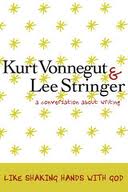
[READ: March 26, 2013] Like Shaking Hands with God
I had been reading a lot of Vonnegut, but I got a little burnt out by him. However, when I was checking his bibliography all those months ago, I found that Princeton University had a book that I couldn’t find anywhere else. Well, given my new employment situation, it was time to take advantage of that connection. So I went to the Firestone library and grabbed this book (and a few others that I didn’t see elsewhere).
It’s a lot of fuss over an 80 page book, but I’m glad I read it and it did get me back in the mood to read more Vonnegut (I have five books of his left to read, although I believe more posthumous stuff seems to come out all the time).
This book is essentially a transcription of two conversations that Vonnegut had (one public and one private) with the author Lee Stringer and the moderator Ross Klavan. The first conversation occurred on October 1, 1998 at a bookstore in Manhattan. The second was a private affair in January 1999 (which was of course, recorded), in which they followed up on some of the same ideas.
Stringer had written one book (Grand Central Winter) when the first conversation took place (he has written two more since). Stringer says he always admired Vonnegut and Vonnegut talks about how much he liked Grand Central Winter (which Vonnegut wrote a forward to). GCW is nothing like Vonnegut’s books, it is a serious book about being homeless (Stringer himself was homeless for a long time) and it is real and gritty. It sounds good, although maybe a little too gritty and real for me.
Vonnegut’s then recent (and last) novel, Timequake had also just come out. And so the conversation is about their books and their writing philosophies and their similarities (given how very different they are). What’s cool about the conversation is just how very interested Vonnegut is in Stringer–in promoting him and really encouraging him and being genuinely interested in what he has to say. At this point, Vonnegut is basically done with writing himself, and as he is passing the mantle he is a gracious and funny elder statesman.
Vonnegut talks about the importance of making things–art, music, stories, anything. That making things makes your soul grow. There’s some shocking moments (like when Vonnegut says he’d like to put a bounty on Bill Gates because Gates says “don’t worry about making your soul grow. I’ll sell you a new program….”
Vonnegut also talks about how talented a reader has to be to be able to read fiction (which is nice to hear).
In the second conversation, the pair seem to be a little less guarded. Stringer admits to having a hard time writing since GCW was published. And Vonnegut says something that seems insulting…but isn’t. He says that Lee doesn’t have to write any thing else. It’s the HAVE to, that is the important part, once that pressure of having to is gone, it should take the pressure off. Vonnegut also says about authors, “Nobody gives a fuck about you. They care a bout the book.” Which is mostly true, but obviously not entirely.
And Vonnegut recommends Mark Twain (anything by him) but especially “Captain Stormfield’s Visit to Heaven” which I had never heard of.
The book isn’t mind-blowing but it’s very enjoyable–hearing an old author and a young author compare stories. Interestingly, the title of the book comes from a comment that Stringer makes. Even if you don’t know or like either author, there’s stuff to take away for writers and for readers. Track it down if you can.

 I Just Read About That...
Leave a comment