 SOUNDTRACK: THE DOUBLECLICKS-“The Internet National Anthem” (2012).
 The Doubleclicks are a sister duo from Portland, Oregon. They are nerdy and fun (perhaps we can think of them as non-accordion, female They Might be Giants?). Take “The Internet National Anthem”,” a song with a steady four/four beat, cellos and a suitably anthemic chorus, that’s all about the internet.
I was introduced to this band from Kid’s Corner, although I feel that perhaps their songs aren’t really for kids (not that they’re inappropriate but they seem more sophisticated than a typical kids song. Like this song has big words and it is quite funny. Although in all honesty it’s not laugh out loud funny, just mildly funny. It’s got the vibe of Garfunkel and Oates, but not the big guffaws.
Check out their albums here .
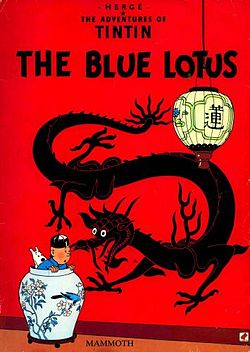
[READ: February 8, 2013] The Blue Lotus
This third (technically fifth) Tintin book is the continuation of Cigars of the Pharaoh. One of the characters from Pharaoh returns in this book, despite the fact that it is set in China. This book also continues with Hergé’s having it both way in terms of other races. His drawings are caricaturey and depending on your sensibilities/appreciation for drawing skills/tolerance are either really racist or simply in poor taste (although it does seem to be that the bad characters of other races are the most offensive–the good people are less crazy).
But despite the visual insensitivity, there are several section where Hergé explicitly talks about tolerance and understanding between races. Like when Tintin saves the young Chinese boy, Chang, who says he thought all white devils were wicked. Tintin explains that white people believe stupid things about Chinese people too (eating rotten eggs, tons of unwanted babies in their rivers, etc.). Chang says “They must be crazy people in your country). As it turns out (quoting Wikipedia ), “The Blue Lotus is a pivotal work in Hergé’s career, moving away from the stereotype and loosely connected stories and marking a new-found commitment to geographical and cultural accuracy. The book is also amongst the most highly regarded of the entire Tintin series, and was the 18th greatest book on Le Monde’s 100 Books of the Century list.” It’s quite progressive for the 1930s.
The plotlines from the previous book are continued: there is the poison that makes you crazy, the Pharaoh’s logo shows up and there are Indian characters returning as well. And by the end Thompson and Thompson, the twin policeman who complicate each others sentences and prove to be more bumbling than we originally thought arrive to capture Tintin (although they believe in Tintin’s goodness–they’re only following orders, you see).
This story is very well structured, feeling more complete and shall we say sophisticated than the earlier ones. It is less manic with the action being a lot more local and contained. Rather than running all over the place, the action and “confusion” comes because there are good Chinese and bad Chinese and good Japanese and bad Japanese and it’s not always clear who is telling the truth. I assume that having them dressed in more traditional costume allows us to distinguish which country the men are from at a glance, so maybe rather than caricature, they are just shortcuts. There are also some confusing doubling crosses, like when a Chinese character appears to be out to harm Tintin but he proves to be rescuing him instead. Appearances can be deceiving after all.
Tintin ends up in Shanghai talking to leaders of the resistance which is out to get rid of the opium in the country (again, not really a plot designed for kids–especially since some of the action takes places in the opium dens). After several near escapes (and one capture that proves to be beneficial in the end), Tintin is almost poisoned by the madness potion. But the people watching out for him protect him and he finally winds up with a sample of the poison. (But not until after a funny scene in which he pretends to be crazy). He determines who can analyze and create an antidote.
The book concludes with the return of Rastapopoulos, the film producer from the previous book (early in the book we saw part of the film that Tintin interrupted in the previous book). He proves to be nothing that he seemed. The ending is very satisfying with a good double cross. This book ends with no cliffhanger, neatly wrapping up the stories and getting us ready for the next Volume of Tintin Adventures.
As with the other books, this one was translated by Leslie Lonsdale-Cooper and Michael Turner.
For ease of searching, I include: Herge.

 I Just Read About That...
Leave a comment