 SOUNDTRACK: FUCKED UP-David Comes to Life (2011).
F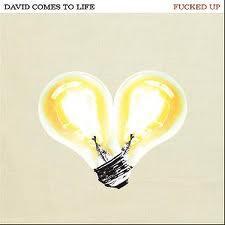 or a band named Fucked Up, they make music that is surprisingly catchy. Of course, as befits their name, they also have a pretty aggressive punk sound with lots of drums and loud guitars. But many of the guitar lines and choruses are surprisingly melodic. And then comes singer Pink Eyes. He screams in a gravelly, rough, cookie-monster type voice (although he is mixed lowish in the mix so he doesn’t often overpower the music). Despite the fact that most of the words are indecipherable, he also have a good sense of melody.
So how does a band that plays distorted hardcore punk with a barely comprehensible singer decide to make a 78 minute concept album? Beats me. But guitarist 10,000 Marbles has written a pretty solid collection of songs. Of course, it also beats me exactly what the concept is. According to allmusic the plot is: In the fictional town of Byrdesdale Spa UK, David has a humdrum life working at a light bulb factory, and finds an escape by falling in love with a communist rebel rouser, only to find out later that she has died in a terrorist bombing and that he has a lot of emotional turmoil to face.
I’ve listened to the disc a dozen or so times and never got that plot. I even followed along with the lyric sheet and never got that plot. Part of the reason may be that Pink Eyes sings all of the parts in the same way, so it’s really hard to notice that there are different characters (like Veronica) in the story. While it is fascinating to hear a really catchy choruses sung by someone who is kind of scary, it doesn’t do a lot for the story. The other odd thing is when Mustard Gas provides female backing vocals–they are sweet and pretty–a drastic counterpoint to the noise that Pink Eyes makes. But she only comes in on a few songs. I wish she did more.
There are some really great songs on this disc. Song two, “Queen of Hearts” has some incredibly catchy sections. And the “dying on the inside” harmony in “The Other Shoe” compliments the grizzly “It can’t be comfortable when you know the whole thing is about to fall” very nicely. The b vox are also great in “Turn the Season.” I find myself singing the “Hello my name is David, your name is Veronica. Let’s be together. Let’s fall in love” section over and over. It’s surprisingly sweet when sung by such a voice.
Since this is a concept album (or rock opera I suppose), there’s things like the nearly two-minute instrumental intro to “Remember My Name” which doesn’t fit with the rest of the song but is really catchy. There’s also a kind of introductory “theme” that crops up in the album. Fucked Up confound you at ever turn with beautiful melodies that morph into noisy punk.
By the middle of the disc (where I gather David is a low point), there’s some really loud heavy songs. Amid the pummeling noise, there’s some nice acoustic guitar in “A Slanted Tone” and some very cool rumbling drums and bass that propel “Serve Me Right.” These songs help to break up the flow nicely. “Life in Paper” which is near the half way point opens with the same staccato notes as the disc itself, and it proves to be a very catchy song in which David asks “Who can I trust?”
The second half of the disc continues with the more catchy style with “Ship of Fools.” But as the story nears the end, it starts to feel very samey. There’s a few breaks, but it’s a hard row to hoe. There is redemption in the end, but you still feel exhausted. Perhaps 78 minutes of Fucked Up is too much. For some listeners even 5 minutes will be too much. Despite the accolades (and they received a lot), you won’t be hearing this one the radio (and not because the DJs couldn’t say their name).
And yet amid all of the noise, there are some really shiny gems. They have even released four music videos for the album! The first one, “Queen of Hearts” is especially cool as the video is set in a classroom and the kids sing all the parts (after a nearly two-minute spoken intro of the song. I admit to not having any idea what’s actually happening in the video, but it’s still cool.
[READ: January 26, 2013] An Extraordinary Theory of Objects
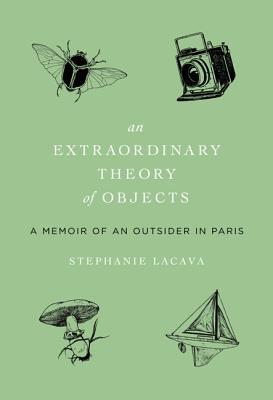
This is a strange little book. It was another one that I saw while waiting online at the library. I was attracted to the cover (I know, don’t judge… but honestly, you can tell a little bit about a book by the way it is marketed. And this was marketed at me.) It’s a small book with a stark cover and interesting drawings on it. And then there’s the unusual title.
The book was only 180 pages (plus notes and a bibliography) and it was chock full of pictures. I mean, this thing can be polished off in an afternoon.
And here’s what it’s about. Well, let me modify that. Here’s what’s in the book. Stephanie is a young girl when her family moves to France (for her father’s work). She has always felt like an outsider and now feels even more so in France. She is introverted and spends a lot of her time in books. Then she moves back to America and reflects on her childhood.
Yeah, that’s about it. For here’s the thing, Lacava isn’t famous and she hasn’t done anything that you might have heard of. She’s just a person who went to France as a kid. The introduction kind of gives you some reason as to why you should read the book. Lacava was a sad and miserable child and she took refuge in objects–not as a collector so much as an admirer. On her windowsill she has collected various geegaws that she treasured (and which she brought from America in her carry on, they were so precious). And she has this interesting relationship with objects. Although, as with many things in the book, that relationship is not really delved into very much.
Now, the one thing that sets this book apart from a typical memoir is that every page or two she has an asterisk beside a word and then she gives a kind of history lesson about the item or person. Like poison dart frogs and mustache (a bit about Dali’s Mustache that I found interesting) or a history of the sarcophagus or a brief biography of Nancy Cunard. And most of these words have a (beautiful) illustration on the facing page. (The illustrations are by Matthew Nelson, and he has a very delicate and elegant style).
So we get little history lessons about random things that were important to her (and the notes indicate that she has done research for each item, so in addition to having footnotes, this memoir also has citations–like a research memoir).
It’s all sort of vaguely interesting. But it would likely be more interesting is Lacava were more interesting herself. What we know about her is that she is mopey and miserable. The introduction says that she never expected to live past 20. And she’s got a few moments of existential dread and woe is me angst that seem very much like what many people who grew up in the 90s experienced as part of their daily life (she mentions Kurt Cobain twice, once in a footnote for cardigan, and talks about My So Called Life, which she missed because she was in France). It’s hard to be sympathetic to her condition because we get very little detail about it.
There just seems to be a lot of surface in the book and her life. Like the weird distancing from her Father. She speaks only of his mustache and how she would watch it as he spoke–sort of get his tone from his mustache Which I like as an idea, but not really as a character development. There’s a cool scene where they go antique shopping and the mustache explains exactly what he is looking for (an armoir with fish but no other sea creatures on it). If one of them finds it they can buy anything in the flea market. So we never find out why he wanted that particular design and we never find out what she gets (she found it). Indeed, we never rally learn anything about her parents. She says they value their privacy in the Introduction, which I respect, but give us something.
I think what I also found so odd about the book is that she writes and describes her life like some kind of weird olde type story. She has this tone that makes her seem so cut off, so remote–she walks to the park by herself and acts like she can’t communicate with the natives as if none of them know any English. That bit with her father and the mustache makes me think of stories in the late 19th/early 20th century when men didn’t talk to their children or like she’s a waif locked in her house while Father is off in the Boer War or something. All of this is leading to me having to keep reminding myself that this happened only twenty years ago–pre Internet, yes, but not exactly the dark ages.
And then as for the momentum of the book, it ends with her maybe sorta dating this guy who is disconcerted by her (and vice versa). I suspect there’s a lot to be read between the lines, but I never really wanted to do that.
So I guess all in all it was a disappointing book. I enjoyed the little definitions of the words and the details were cool, but I’m left with a profound lack of caring. It’s weird to read a memoir and have no idea about the subject at all. The story probably would have worked better as fiction, the narrator seemed so divorced from the character (which I guess someone will say was the point).

 I Just Read About That...
Leave a comment