 SOUNDTRACK: THE DIGGITY DUDES-“My Science Project” (2012).
 The Diggity Dudes are getting a lot of airplay on Kids’ Corner on WXPN. I like them in theory but I don’t really like the style of music they play–it’s a little too generic. That being said, I do rather like the lyrics of this song.
It’s all about doing, yes, a science project. “Measure twice or you’ll have a disaster.” The problem is that the verses are done in a rap style that’s not very good. And the rhymes are awful.
I give them credit for writing about cool subjects for kids (like “To the Library” which I would have reviewed but they didn’t have it playing on their site). But if they weren’t a kid’s band, I wouldn’t like them at all. Despite that, I imagine they put on a great live show–they seem like they’d be a lot of fun.
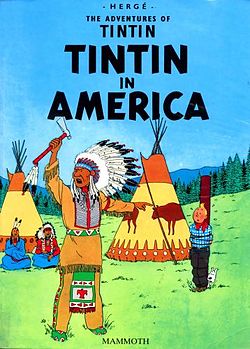
[READ: Jauary 10, 2013] Tintin in America
I have known of Tintin for years (Sarah and I even have an inside joke about the boy journalist). When we went to Brussels, we went to the art museum and saw the history of Hergé’s works (Hergé’s real name is Georges Prosper Remi) and the tons of souvenir Tintin things that are for sale. And yet I’d never read any of his stories.
I saw some in the library and decided to check out volume one. Interestingly, this volume starts with Tintin in America. While reading it I quickly determined that this was not the first book in the series. Indeed, America is the third book after Tintin in the Land of the Soviets and Tintin in the Congo (neither of these two are readily available in the US–the first because Hergé later felt it was too crude to redo for collections and the second because the depiction of Africans was deemed offensive). So, most collections begin with this book (which is only a little odd because he is already well-known and the story seems to start in the middle because he dealt with some of these thugs in book 2).
But on to America.
The year is 1931 and Tintin (and his talking dog, Snowy–I’m unclear if others can hear him talk) is sent to America to clean up Al Capone’s gangland (seriously). Tintin gets in many scraps (not graphically violent) and is captured a number of times. He usually escapes by some luck or another (or through the help of Snowy). Although he doesn’t capture Capone himself (Hergé didn’t want him to capture a criminal who was on the loose in real life), he does take on the rest of the gangsters in Chicago who belong to the Gangsters Syndicate of Chicago (the door is labelled that way, tee hee). He meets Capone’s rival, Bobby Smiles, and the bulk of the story involves Tintin trying to capture Smiles.
The story takes on an air of a Curious George story here, in which he runs from one location to the next, getting into trouble and then escaping. The most fascinating part is when he goes to Redskin City and is captured by the Blackfoot tribe. There’s a really interesting political attitude here. The Indians are rather reduced to stereotypes (peace pipe, war hatchet, they all say How), and yet they are drawn sympathetically: when oil is discovered on their land, they are forced off the land for the oil. Pointedly, the businessmen offered Tintin thousands of dollars for the oil filled land (somehow he made the geyser erupt). But when Tintin says that it belongs to the natives, they offer the tribe $25 and then kick them out as the land is rapidly developed.
As that plotline runs down, Snowy is captured by another syndicate. Tintin tracks them down (and there’s a great sequence in which Tintin is in a suit of armor). Tintin captures some of them men and is then almost killed in a cannery (with a very lucky event sparing his life).
The last sequence sees Tintin celebrated for all of his good work. But during the party, he is kidnapped and almost killed by being thrown into Lake Michigan (the way he gets out of that is delightful).
When the story ends, Tintin is celebrated again and then returns back to Europe, wishing that he could spend more time in the States since all of his time was spent chasing or being chased.
I don’t know who the book was originally directed at. The story is not really violent and yet there are funny “adult” jokes, like the drunken sheriff (and how you can be arrested for public drunkenness). I just wonder how many kids thought drunk jokes were funny in the 30s. Anyhow, the story was quite clever and rather inventive, I really enjoyed the way that Tintin got out of all of his predicaments–far-fetched but very entertaining. I’m lookinmg forward to the next 20 books or so.
This book was translated by Leslie Lonsdale-Cooper and Michael Turner.
For ease of searching, I include: Herge.

 I Just Read About That...
[…] second (technically fourth) Tintin book was a lot more focused than In America, which, although excellent, tended to ramble all over the […]
Paul, Thanks for your insights and comments regarding The Diggity Dudes! I am in fact one of the Dudes, and enjoyed reading your opinions on our material. Please let me know if you would like me to send you complimentary CD’s of our work.
mike@thediggitydudes.com
Have a great day!