 SOUNDTRACK: PHINEAS AND FERB-“We Wish You a Merry Christmas” (2010).
 This song takes the music of We Wish You a Merry Christmas and modifies it to fit the show. Several characters get a verse, with my favorite coming from Isabella:
Oh, come tell me what’cha doin’ / All my relatives just flew in /From Mexico and Jerusalem / For the holidays
Both Christmas trees and menorahs / It can be confusing for us / When we break into a chorus / Of “olé” (¡Olé!) and “oy vey” (¡Oy vey!)
Although I usually find Doofensmirtz’ lines to be the best, I don’t care for his verse–it is forced and not terribly funny. But that is more than made up for with the end as it revisited the beloved figgy pudding:
All: We wish your every endeavor
Makes this the best Christmas ever
And we’re all so glad that we will never
Mention figgy pudding…Dr. Doofenshmirtz: Oh, great. Well now we’ve mentioned it.
Major Monogram: You know, no one would have noticed if you’d have just kept your mouth shut.
We recently added the entire Phineas and Ferb Holiday Favorites album to our Christmas music collection. Thanks, Swampy.
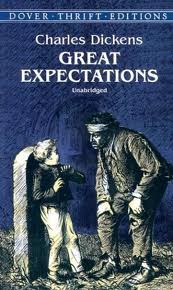
[READ: end of 2011-beginning of 2012] Great Expectations
I started this book over a year ago–Christmastime 2011 and I finished it in January of this year. And I imagined writing a grand, eloquent post about the book, so I bided my time, and have now delayed for almost a year and have basically forgotten everything significant I thought about saying about it. Never put anything off in the hopes that genius will strike.
So I read this book because my former coworker Stephanie talked about how much she liked it. I had never read any Dickens before (possibly Tale of Two Cities but that would have been in High School and doesn’t count). And Nick Hornby raves about Dickens in the pages of The Believer, so it seemed like a time to try him out. Back when I was in college I joined a book club and received The Oxford Illustrated Dickens–30-some volumes of all of Dickens’ work in beautiful hardcover editions. And I have lugged them with me to all my homes. And now I have finally read one.
I was as surprised by how surprised I was by the story. I knew the very basic outline and character names (thanks South Park), and from what I knew of Dickens, I thought I had the whole story figured out pretty early on. But no, there was more afoot than I would have ever guessed.
So, the story: Phillip ‘Pip’ Pirrip is a blaksmith’s apprentice. He was orphaned as a young babe and is currently living with his (terribly mean) older sister and her husband, a kindly blacksmith named Joe Gargery. One dark and spooky night (as only existed in 19th century England), Pip is out in the swampy foggy graveyard visiting his parents’ graves when he hears a fight. Two convicts have escaped from a prison ship and are fighting amidst the marshes. The “winner,” spies Pip and threatens him–unless he brings a nail file and food, he will kill the young boy. Pip is freaked and runs home to steal one of Joe’s files and a piece of pie that his sister has baked. The next day the police capture the criminals, and the one whom Pip helped gives Pip a long look and says that he stole the pie, which lets Pip off the hook from his sister’s wrath.
Meanwhile, up the road a piece, there’s an old dilapidated house with an old dilapidated woman living in it. She is Miss Havisham. The delightful thing about Dickens is that Miss Havisham is crazily over the top and yet, because of the time it was written, she is totally believable. (She may indeed have been based on someone Dickens knew). No one like Miss Havisham could exist now–she would be institutionalized in a heartbeat, but back then, this woman could be head of a household and have servants and simply be spoken of as a bit odd. For odd she is.
Miss Havisham was stood up on her wedding day. She had totally fallen for a man named Compeyson, but he was just after her money. He swindled her big time and left her at the altar. Now she lives day in and day out in her wedding dress. The room that her banquet was supposed to be in has remained unchanged since that day–clocks have not moved, food has not been cleared. Indeed, nothing has changed since the day that her marriage did not happen. She has money, so she is unbothered by authorities, but she has clearly slipped a gasket.
She has adopted a daughter Estella, and she is teaching her to be a cold, heartless woman–disdaining love and wanting nothing from anyone. Initially she just wanted Estella to be safe from harm, but that has morphed as they have gotten older. She seeks a boy to play with Estella (with the seeming intention of Estella ultimately scorning said boy although it’s unclear if that’s what she intended from the start). That boy is Pip (Miss Havisham knows his uncle). And so, Pip is spruced up and brought to Miss Havisham’s. He is taught some breeding and manners (Miss Havisham won’t have a ruffian in her house). Estella is very cold to him–she even makes him cry at some point. And this seems to make Pip desire her more.
Later, on one visit (in which Joe accompanies Pip), Pip’s sister is brutally attacked and is rendered mute (and actually becomes somewhat nice).
Pip returns with Joe and works with him for a time. Joe has also hired another helper, Orlick, who is really a prick. Just a nasty piece of work. He gives Pip a hard time and is just an ass. He devilishness is comparable to Pip’s sister’s bitchiness–Dickens really did see the worst in people!
Then one day, Mr Jaggers, a lawyer, approaches Pip and informs him that he has a benefactor–he is to go immediately to live in London as a gentleman. Pip doesn’t know if he can leave Joe, but Joe tells him that he can’t pass up this opportunity and so off Pip goes to the big city.
The big middle section of the book is all about the now-gentlemanly Pip getting around in the city. He makes friends, he studies, he spends money, he goes to gentlemen’s parlors, he spends more money. He winds up overspending and having to talk to Jaggers. He ignores Joe (and acts very uncomfortably around Joe when Joe comes to London). He thinks a lot about Estella and is crushed when he hears other men speak of her as well. Basically he is in limbo. And until he reaches age (which is what? 16? 18? Dickens doesn’t say presumably because everyone at the time knew) he can’t have his lump sum, he just receives a monthly stipend. He has some friends, inclduig a roommate, but most of his dealings are with Mr Jaggers and Mr Wemmick.
Wemmick is a fun character–he is the clerk for Mr Jaggers and while Jaggers is a scary, intimidating man, Wemmick proves to be more complex. He is precise and fastidious when “on the clock” but when he is casual, he is very fun–friendly and helpful. Wemmick lives in a bucolic mansion far from the grime of the city. He even invites Pip over to his house to meet his father whom he calls “The Aged.”
And it was here that I basically assumed that Pip would be waiting out his time until he turned the proper age and received his money–which I assumed was coming from Miss Havisham, as why wouldn’t it be? And since this is about half way through the book, I thought–geez how is he going to drag this out for another 200 pages or whatever.
But here’s the thing–Pip is never told who the benefactor is. Indeed, part of the deal is that he is not to be told who the benefactor is. But it has to be Miss Havisham, right? I mean, who else could it possibly be? But indeed it is not she (minor spoiler there). And the rest of the book turns on that misinformation. Miss Havisham has denied that she was giving him anything–there’s no secrets. But the revelation of who the benefactor is is stunning.
The rest of the book is a shockingly exciting story about the benefactor and the troubles that they all encounter in the city. Hint: Orlick returns. There are so many unexpected plot point–plot points that didn’t even need to be tied up–that are wonderfully tied together. Not a single character is extraneous and things that couldn’t possible have a follow up get one. I was genuinely surprised and delighted by the way the book turned out–shocking moments, heartbreaking moments and moments of joy as well.
What’s interesting is that the original novel ended on something of a downer. But after some comments from Edward Bulwer-Lytton, Dickens revised the story to be happier (and that is the published version). The verdict is out among critics about which ending is better, but I liked this one.
Even if this story was originally meant to be utterly tragic (which it is), there are still a lot of funny moments in it. Indeed, I laughed a lot throughout the book. I agree that it could have been shorter (of course, I mostly thought that when I assumed it was just going t be about Pip being a gentleman in London), but some trimming might have been okay. Nevertheless, the book was really enjoyable. And I will certainly read another Dickens in 2013. (I’m just daunted at the prospect of reading another huge book right now!)

 I Just Read About That...
Leave a comment