 SOUNDTRACK: BELLE AND SEBASTIAN-Live at KEXP, April 13, 2006 (2006).
T his four song set samples a broad swath of Belle & Sebastian’s career. It takes place after The Life Pursuit‘s release, but they only play one song from it “To Be Myself Completely” (with Stevie on vocals).
It’s amazing how quiet and shy the band seems i the interviews (or is that bored and petulant) especially after being through the mad swings of success. Indeed, the interviews are almost embarrassing how unresponsive the band is (but not rude unresponsive, just unresponsive). Like “where did the soul influence on this album come from?” “Probably black America.” “Did the new producer have any influence on the soulfulness?” “Not really.”
But they do let the music speak for them. And they don’t just do the horn songs or the strings songs. They play “She’s Losing It” from Tigermilk (with lots of horns–it sounds great), they play “A Century of Fakers” with strings (although the female vocals seem a little too subdued on this track). They also play a rollicking cover of Badfinger’s “No Matter What.” It’s a delightfully poppy song which I didn’t know but which Sarah did (and I thought was the Beatles, and the DJ guessed Paul McCartney wrote it–he didn’t). It’s when discussing this song that the band finally gets animated, perhaps they just don’t want to talk about themselves.
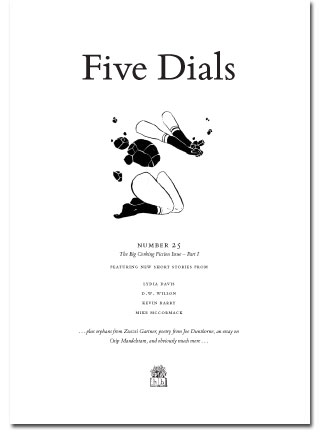
[READ: October 15, 2012] Five Dials #25
The issue is all about the short story. Five stories from Lydia Davis, a short story contest from Zsuzsi Gardner, and a couple longer stories as well. But there’s also some poetry and an essay. And I fear I have to say I didn’t enjoy this issue as much as some of the other ones. I love short stories, but I didn’t really love these very much. And, the essay at the end was a lot of fury about very little. I have to assume Part Two will simply kick ass.
CRAIG TAYLOR-A Letter from the Editors: On Orphans and Cork
Taylor name-checks the Cork International Short-Story Festival and mentions how this issue is a sort of tie in to the festival (and just how many writers wanted to be in this Cork issue). Taylor says that many readers wanted more short stories in the Five Dials issues, and that Noel O’Regan, short story editor says that the short story is always alive–witness the great success of the Cork Festival. Writers flock to it (and a hefty prize is given). This issue is only Part I of the fiction issue because they simply had to break it into two parts.
ZSUZSI GARTNER-“Eleven Orphaned Short-Story Openings (circa 1996-2012) Looking for a Loving Home”
Gartner provides these eleven orphaned openings and encourages you, the reader, to finish them. Zsuzsi includes her mailing address. If you choose to adopt one, she’ll send you adoption papers and it’s all yours!
KEVIN BARRY-“The Lovely Miss What’s-Her-Face”
This is the story of cooking and women. Well, one woman, anyhow. The narrator remembers his last date–thirty years ago. He was neurotic about the date and spent most of his time wondering what to cook for her. He can’t remember her name but he does remember cooking her spaghetti Bolognese. He can also remember that Fun Boy Three were on the radio that night, and that she wasn’t a small girl. He even still sees her in the park. But he seems more able with his cooking and most of the story shows how he makes the spag bol (canned tomatoes are better than fresh, a little chianti for the chef). It’s an odd but enjoyably odd story.
LYDIA DAVIS-“A Story of Stolen Salamis,” “A Story Told to Me by a Friend,” “Notes During Long Phone Conversation with Mother,” “On the Train,” “Susie Brown Will Be in Town”
Lydia Davis is the master of the super short story. And she has received massive accolades for her recent collection of stories. As with most flash fiction writers, I have some respect for the art but mostly just a lot of “huh?” about the stories. Like take “Notes During Long Phone Conversation with Mother,” which I am including here in its entirety:
for summer–she needs
pretty dress–cottoncotton nottoc
coontt
tcoont
toonct
tocnot tocont
tocton
contot
I mean, really? I know this is a free magazine, but come on.
“Susie Brown” is similarly unimpressive, more of an idea than a story. “Salamis” is an amusing anecdote, not really a story either (this is my problem with most flash fiction). Although “On the Train” paints a great picture in very few words. When Davis is on, she’s really strong.
NUALA NÍ CHONCHÚIR-“Room 313”
This is a fascinating and slightly disturbing story about a housekeeper in a hotel. You (the housekeeper) certainly appreciate the business traveler for their “hardly there-ness, their generosity” and while some of your coworkers hate families, you know they leave behind toys that you can keep for your daughter. It’s the lovers that are the worst–staining sheets, too distracted to tip. But Room 313 is the best–you got a $100 tip there once and the current business woman (whom you call Coco) is pretty amazing–her clothes, he sense of style. And when she comes back while you are cleaning and offers to let you try on her necklace, who knows what will come of it.
JOE DUNTHORNE-“On glimpsing non-modern at through closing doors,” “King Vulture at Trivandrum Zoo,” “Dinner”
I like Dunthorne’s poems quite a lot.
MIKE McCORMACK-“How I Met Welger Holland”
Ten years ago, the narrator was presented with a job he couldn’t refuse, but it would require a trip to D-Wing. But the trip itself is not important, this story is about the guide he needed to persuade to take him to D-Wing: Welger Holland. He was hard to find and harder to work with, but he was the man. The narrator hunted down Holland to ask him to come along. Holland (who was making his dinner when the narrator showed up) discouraged him outright from going to D-Wing. Holland checked him out by giving him a stiff drink. The narrator’s drinking of it is quite funny “Many’s the man has had the legs swept under him by that stuff”. But Holland warms to him, and they have worked together many times since. Even if Holland says he regrets the day they met.
PATRICK COTTER-“from 1001 Estonian Nights I.M. Andres Ehin”
This long poem was lost on me.
D.W. WILSON-“Liftoff”
The narrator says that her husband “has this thing about witnessing a murder.” Not many people believed him, not even his dad, who was there. Adding to the narrator’s cadre of peculiar relations–her brother lost an eye in fifth grade. The kids made fun of him, and he became reclusive until he moved away.
But this story is about the husband, Dom. When Dom’s parents divorced, he and his Dad went fishing every weekend. On the occasion of the aforementioned murder, Dom and his father saw two men hurl something heavy into the lake in the dark. This was around the Summer of Sam, so everyone was suspicious those days (even in Invermere, Canada) . But Dom’s father said it was just a deer. And indeed later that night the men showed up at Dom’s father’s cabin for beers. Nevertheless, Dom sought for clues around the lake, and he naturally assumed that a scrap of fabric was the evidence he needed. But no one believed him. Which seemed to turn Dom into an aggressive kid–getting into fights often.
Eventually a family came forward and said that their son had been missing for four years. People wondered why it took them four years to come forward. Dom read about the disappearance in the paper and made his conviction stronger that that was the dead body he saw.
The narrator is Dom’s wife, who seems disturbed by Dom’s obsession and violent streak (it’s a wonder to me why she married him in the first place, frankly). She says their bond is that she’s the only one who saw her brother peeping on the kids in town with a telescope (after he lost he eye) and Dom is the only one who believes he saw a murder–they are codependent in their beliefs. The story ends with yet another body, but I find the connected like those between the narrator and Dom to be tenuous at best.
ILYA KAMINSKY-Essay: “Osip Mandelshtam”
This is an essay about the lyric voice of Osip Mandelshtam. I’d never heard of him, and I found this lengthy essay to be confusing and a little dull.
For ease of searching I include: Nuala Ni Chonchuir

 I Just Read About That...
[…] Issue #24) and the acknowledgement of Zsuzsi Gartner’s first adoptees of her story ideas (Issue #25 Pt 1). There’s also the amusing story of a guy who got nailed at work for printing the color […]