 SOUNDTRACK: JENS LEKMAN-Tiny Desk Concert #173 (November 7, 2011).
 I have enjoyed Jens’ skewed take on pop folk for some time. He plays great folk music and there’s wonderful backing vocals by Addison Rogers. What’s funny about this Tiny Desk concert is that he talks a lot about the song before singing it. But he pretty much gives away everything in the song (especially if there is a punch line). For the first song, “I Want A Pair Of Cowboy Boots,” the explanation is pretty good, he says that if you have the same dream for two years you may want a new one…with cowboy boots. The song explains that the boots will help him walk back to the girl of his dreams. Sweet.
What’s cool about the second song, “The End Of The World Is Bigger Than Love” (in addition to the song) is that you can hear a car driving away before it starts, just showing how intimate the Tiny Desk shows are.
But it’s the final song in which Jens gives away so much about the origin of the story that the song itself is almost redundant (although it’s still great). When you finally get to the punchline of “Waiting For Kirsten,” you’re charmed and smiling. Jens explains that Kirsten Dunst once said that she likes his music. So when she was filming with Lars von Trier in Scotland, he couldn’t help but stalk her day and night.
He’s a charming guy. You can check it out here.
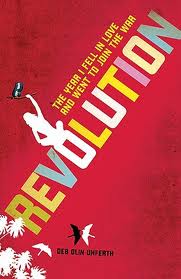
[READ: November 7, 2012] Revolution
Deb Olin Unferth has now published three books and I’ve read them all, even though I’m not a huge huge fan. I enjoyed her novel Vacation, which was delightfully peculiar. Her other book was a collection of flash fiction, a genre I’m really on the fence about, although Unferth’s is really quite good.
This book is a memoir. And, as the subtitle indicates, it’s about the year that Unferth spent looking for a revolution in Central America. The book proves to be about much more than Central America and revolutions–she talks about religion, family, morality, relationships, youth, idealism and reality. Not bad for 200 pages.
It’s also about the man she fell in love with, George, who encouraged them to go to Central America and vive the revolution. George is a Christian, Deb was an atheist Jew. But she falls for him and his Christian ways and “converts” (much to the detriment of her younger sibling who had the family’s faux Jewishness now thrust upon her to avoid a similar thing happening. (Poor Deb’s younger sister really is the victim in this saga). George and Deb flee the comforts of home and all 80s capitalism and head to Central America.
As with Unferth’s short stories, these chapters are almost all very short. And they often feel as unfinished as some of her flash fiction. They are also mostly jumbled up in an utterly non-narrative way. It’s entirely possible that you could shuffle some of these chapters and it wouldn’t matter at all (that’s not entirely true, as some do flow one in to the other, but many are jarringly out of sequence).
In some respects, a memoir about two kids trying to join a Communist revolution in 1987 sounds like it could be interesting Although what we find out from the memoir is that for the most part it wasn’t–they couldn’t seem to find a revolution that wanted them. In fact, they were fired from two separate jobs while trying to help out. Then they drifted around Central America looking for solidarity with Sandinistas but finding (mostly) that most of their troubles were with each other (at least that’s what Deb found out, we don’t really get George’s perspective).
So the narrative flips back and forth between Unferth’s feelings for George, her dissolute travels through Central America, and what her family thought both while she was there and after she came back. It’s written in a very matter of fact, unaffected style. And this aspect of the story is rather compelling–her total lack of passion in her writing lends a very strange effect to this story. There are many moments of potential death and rape, of guerrillas and dysentery of having no money and yet not actually being poor and Unferth conveys them all as if she doesn’t really care too much what happens to the protagonists.
At times, though, the tone is maddening because you want to care, you want something to be excited about, and yet she doesn’t give it to you. By the end of the book it’s not even clear when it will end or how it will end–Unferth flits back to Central America (with her poor beleaguered sister), visiting the old haunts looking for something, seemingly just as lost an uncommitted as she was twenty-some years earlier. Even her final quest–to see what George is up to now–doesn’t really come to fruition–she catches glimpses of him but no real revelation.
It’s a very unusual angle to take about a memoir–typically a genre that is rife with ego and show-offiness–but it is kind of effective–even if I don’t remember many of the details of the story (indeed, she doesn’t seem to either) the tone and overall impact of the story will stay with me.

 I Just Read About That...
Leave a comment