 SOUNDTRACK: KISHI BASHI-Live at the 9:30 Club May 1, 2012 (2012).
 I had never heard of Kishi Bashi before this concert. Kishi Bashi is a one man band headed by K. Ishibashi. He plays violin and sings and, as is the trend it seems, he records and loops his own beats and melodies. Whether or not this is overdone by others, Kishi Bashi does an amazing job. His songs are powerful and his soaring falsetto is fantastic.
I find myself singing lines from “Atticus in the Dessert” all the time. And who could resist the title “I am the Antichrist to You.” Hearing him pull this stuff off live is really impressive. When he’s not sampling and beatboxing, his violin is gorgeous–I never really understood the folks who could violin and sing at the same time, but he does it wonderfully. He’s got a funny, charming stage presence and this whole brief set is really enjoyable. Check it out (audio and video!).
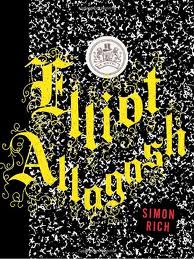
[READ: September 1, 2012] Elliot Allagash
I really enjoy Simon Rich’s humorous pieces. But somehow I totally missed that he had written a novel (or two–the second one came out in August).
This novel eschews Rich’s humor style–there’s no absurdist takes on life–and focuses on a plot. The plot is pretty straightforward. Seymour Herson is a middle school loser–everyone picks on him. In a nice twist on the high school loser, Seymour’s family is pretty cool. They play Monopoly every Friday night, they eat together and are generally supportive of each other. While they might be somewhat geeky, they are not played as straw men for Seymour’s problems.
At his school there are three rows of lunch tables. The popular kids sit at the first row. The rest of the kids sit at the second row. And Seymour sits in the final row. By himself. In part that is his plan, so he can score a minimum of 5 chocolate milks at lunchtime without the other kids seeing. Then one day Elliot Allagash sits next to him.
The Allagash family is the richest family ever. The way they made their fortune is hilarious. Anyhow, suffice it to say that every time a person blows his nose or throws away a newspaper, the Allagash family make some money. Elliot doesn’t sit next to Seymour out of any kind of kindness. He is just as interested in being along as Seymour is–although his motives are very different. So every day at lunch Elliot sits next to Seymour and says nothing to him. He just writes in his black book. And chuckles to himself.
After a week of this, they finally have a conversation. Elliot has been observing everyone and wants to know why Seymour is behaving differently–he only got 3 milks today. As the conversation continues, he wants to know why Seymour is such a target–he’s only mildly overweight, he’s not the poorest kid in school, he’s not the smartest or the dumbest. What gives?
In this high school world, Elliot fills the role of outsider–he’s been kicked out of schools all around the world (usually pricey private schools), so he’s unfamiliar with the public school world. Seymour of course lusts after a pretty girl who of course is dating a mean jock.
Seymour doesn’t really have an answer, not one he’ll say out loud, anyhow. But Seymour tries to explain to Elliot the way the school coolness rating works. Elliot assumed it would be based on the amount of money people had. But Seymour explains the varying levels of coolness, that have to do with athletics, sex appeal and other intangibles. But Elliot decides that Seymour will be his next project–an attempt to show that money will buy Elliot popularity. And Elliot will stop at nothing to win this challenge with himself.
And thus begins a kind of perverse Pygmalion, in which Elliot makes Seymour popular not through actual achievement (well, there are some) but through cheating, lying and buying everything they need.
The story is quite funny (again, just not in the Simon Rich way that I know from say Ant Farm). There are several inevitable that occur (I mean, the story is not all that original), but Rich pulls it all off nicely. Elliot is suitably obnoxious (and it’s not entirely clear that his father is worse). And what’s kind of refreshing in a book of this kind is that there are actual consequences to his behavior–nice people do get hurt, which is sad, but surprising–a nice twist.
Of course as you’re reading the book you assume that–if this were real–Seymour would have bailed much sooner (like before he went on national TV), but what’s the fun of that? The ending is nicely pulled off.
I finished the book very quickly and then Sarah read it right after me. I had to ask her if she thought that this was a YA book (it has all the trappings) and she said yes. I wonder why it wasn’t marketed as such. Sarah got her review up first. It’s right here.
***
UPDATE
I have been going through Simon Rich’s un-anthologized pieces in the New Yorker. I found this one called “On Book-Writing” from May 18, 2010 which is a very funny plug for this book.
He says that in 2007 he published a short collection of comedy pieces called Ant Farm (including a link to the book on Amazon). Since its publication “several critics, friends, and family members have commented on its brevity. “Why is it so short?” some of them have asked. Or “How could it be so short?”
He said that it was quality over quantity. And that 139 pages isn’t that short.
In 2008 he published a second book called Free Range Chickens (with a link to Amazon). It was 129 pages long. “Oh my God,” my mote hr said, “This one’s even shorter than the other one.”
About a year later he saw that a friend was reading a tiny book called The Diving Bell and the Butterfly. The friend said it was amazing–it was written by a stroke victim, Jean-Dominique Bauby. He was paralyzed and used a complicated system of eye-blinks to dictate his memoirs. Sentences took hours and an involuntary blink would throw off everything. It took several months to finish the book in this way.
I love how this gets very serious, and then Rich completely undermines it:
“How long is it?”
“Well, it’s short, obviously.”
“But how short?”
“144 pages.:”
He ends by saying that Elliot Allagash is 224 pages. It is shorter than an average novel but longer “than a memoir written in agony by a dying man who had to use his eyeballs.”

 I Just Read About That...
Leave a comment