 SOUNDTRACK: DAN DEACON-“Call Me Maybe Acapella 147 Times Exponentially Layered” (2012).
 Dan Deacon (whose twitter handle is “ebaynetflix” ha!), created a cover of Carly Rae Jepsen’s “Call Me Maybe,” for a digital album with 43 artists covering the pop delicacy. I listened to a few samples from the album and they span the gamut from kind of serious to kind of crazy to mocking to Deacon.
Stereogum describes Deacon’s version this way: “Dan Deacon piles “Call Me Maybe” on itself over and over again, creating the most dissonant, harrowing take on Carli Rae Jepsen’s [sic] hit known to man.”
He begins with a sample from the verse, then he adds some lines from the chorus (while the verse is playing). You can hear “here’s my number, so call me maybe” a few times, but the background is growing in intensity and menace. By 90 seconds in, you can still hear her a little bit, but she is almost entirely consumed by noise. Then around 2 minutes, things seems to calm down a bit (she’s still plugging away at the chorus). By 4 minutes the whole thing has seemingly collapsed in on itself. And the whole time, there seems to be a steady beat that you can dance to. This track may indeed produce insanity.
You can listen to Deacon’s monstrosity below, or go to the original site.
To see the lineup for the whole album, go here.
[READ: August 22, 2012] 3 Book Reviews
I don’t quite understand how Cohen pulled this off, but in the July issue of Harper‘s right after his story, “The College Borough,” which I mentioned yesterday, he also had three book reviews. How does one get two bylines in Harper’s? Has that ever happened before?
Because I liked the story so much, I decided I would read these reviews too. Cohen sets up the reviews with the idea of political gestation periods (12 months for donkeys, 22 months for elephants) and how novelists work even slower when it comes to writing about events. Norman Mailer’s The Naked and the Dead came out 32 months after V-J Day, John Steinbeck wrote about the depression from 1937-1945. So now in 2012 we see the “spawn of Bush’s two terms of excruciating contractions.” Books that fictionalize the realities of post-9/11 life: “that the canniest distraction from class war is war-war.”
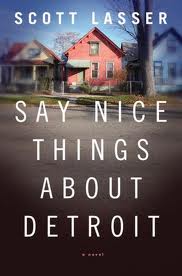 The first books he reviews is Scott Lasser’s Say Nice Things About Detroit. I found Cohen’s review of this to be simultaneously confusing and possibly spoiler-y. He summarizes the relationships of all the characters (and there are a few and it’s complicated) in one paragraph, making it seem like a novel of poor coincidence. But he also gives away a romance and a redemption. Even the quote he provides (which he says he tried to resist) seems to give away a lot. If the quote is representative of the story, it sounds pretty dreadful.
But this ends up being a review in which I’m unsure whether he thought the book was any good. [The New Yorker In Brief review was very negative].
I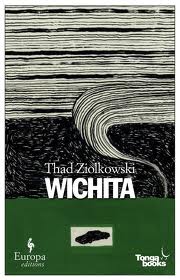 t’s followed by an incredibly awkward transition about driving from Detroit to Wichita to get to the next story. Why would you extend a forced metaphor like that? Anyhow, the second book is Thad Ziolkowski’s Wichita.
Again, Cohen summarizes the characters pretty quickly including a characterization of a boy named Seth which would have been more powerful had he included Seth’s last name so we knew the point he was making was applicable.
Cohen seems dismissive of this story, but I don’t know what he means by this:
“Ziolkowski’s untrustworthy over-forty cast has aged out of the better Kerouac; they’re the grown up dopers of Pynchon’s Vineland relocated inland because the waters are rising and hey, ain’t it 2012?” That’s like a Dennis Miller joke. [The NY Times and Kirkus give this mixed reviews].
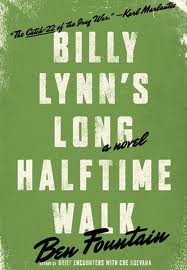 The final book, which he says is the best of the three, is Ben Fountain’s Bily Lynn’s Long Halftime Walk. This book is set in Dallas and is about the eight surviving members of Bravo Company. This story sounds utterly chaotic–a single day that “climaxes in a Thanksgiving Day game at Texas Stadium–Does It Truly Matter v. America’s Team, the Cowboys.” (After three reads I think what he means by “Does It Truly matter” is that it doesn’t matter who the Cowboys are playing?) Bravo Company try to sell their story to the media and also get in a fight with the security for Destiny’s Child. And of course, there’s the question of love or war.
Cohen’s last comment on the book, is further confusing:
Fountain converts every culture clash to extra points advancing major yardage of bone-crunching writing…in sentences and paragraphs as red-skinned as any paleface has dared against the discredited defenses of Faulkner and Bellow.
I have no idea what that means. And, man, I hate feeling too ignorant to understand a book review.
At least I understood the final line of the review: “This is the brush-clearing Bush book we’ve been waiting for.”
Although I have to say that given the summary and the quote he includes, it’s not what I was looking for. [The New Yorker says this last book is excellent, and their summary was much more comprehensible. Although i still don’t tin kit’s for me]. Indeed, none of these books sounds very interesting to me.

 I Just Read About That...
Leave a comment