 SOUNDTRACK: DEER TICK-“Main Street” (Field Recordings, July 18, 2012).
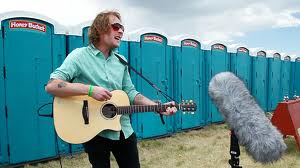 NPR created a bunch of Field Recordings at Sasquatch Music Festival. I picked this one [Deer Tick Among the Honey Buckets] primarily because it featured Deer Tick front man John McCauley singing front of a bunch of porta potties.
I actually don’t know much about Deer Tick, so I don’t know if they normally sound folky or what. But this song, in its acoustic setting is very good. John McCauley’s voice works great here. There’s even a nice shout out to MCA.
There’s not a ton to it, and this alone won’t make me a fan, but I’ll certainly check out more by them. It’s also a nice video to watch, especially for the amusing encore.
[READ: August 1, 2012] “The Use of Myth in History”
Most of the articles in Colonial Williamsburg have to do with, well, Colonial Williamsburg. This one, however, talks about myths that we as Americans have created and continue to believe, from colonial times to more days.
The article opens by explaining that Patrick Henry’s famous “give me liberty or give me death” speech was written down forty-two years after the fact by William Wirt. And he wrote it down from memory, so who knows what words Henry actually spoke. But no doubt Wird got the gist right. So the Henry speech is a myth–not necessarily wrong but not exactly true either.
Klein explains that some historians would like to remove the myths from history and focus only on the facts, but stories like Henry’s are so popular, so ingrained in our memories, that removing them would do more damage than the beloved myths do. Indeed, some historians believe that myths are very important. Micheal Gerson wrote, “We know that myths are not the same as lies” and John Thorn said “Historians have an obligation to embrace myth as the people’s history”
Klein writes that America’s mythology was largely created by writers from the early 1800s. Pressure was building towards the War of 1812 and they needed support. The mythology was designed to get people to forget about the ugly Revolutionary War. And so stories were created just in time for the birth of public education in America to disseminate the stories. And so mythological stories like George Washington and the cherry tree or the midnight ride of Paul Revere or Plymouth Rock or even Pocahontas became enshrined in textbooks. Now, most myths are based on facts, but the truths were embellished and made more romantic and given a moral. So, yes Patrick Henry did give a speech, the Pilgrims settled in Plymouth and Paul Revere did ride into the countryside to warn of the British invasion. but probably not exactly as we think they did. So nineteenth century writers made George Washington the symbol of our country–a unifying power to embody a nation.
Klein also mentions the myth of Chief Seattle who in 1854 spoke “I have seen a thousand rotting buffaloes on the prairie, left by the white man who shot them from a passing train. I am a savage and do not understand how the smoking iron horse can be made more import than the buffalo that we kill only to stay alive.” This was a very moving passage and showed the noble savage fighting against modernism. The problem with this moving passage is that the massacre of the buffalo had not yet happened in 1854. And Seattle likely never actually saw a train.
The story of Ethan Allen is also mythologized. He never said “In the name of the Great Jehovah and the Continental Congress I am taking this fort.” But he created his own myth–he claimed that’s what he said in his memoirs. In point of fact, however, the Continental Congress had not met yet, and first hand accounts say that his real quote was “Bring the old rat out, or I’ll run him through” [speaking of the second-in-command at the fort].
Even something more recent like Gone with the Wind has impacted Americans. Most American today see the civil war more through the lens of the book and the movie than any historically accurate articles..
Klein then moves on to a myth that was completely made up. The myth of Abner Doubleday as the inventor of baseball. Prepare,casual baseball fans, to have your minds blow. Doubleday was a real person, but he was hardly the inventor of baseball. Indeed, no evidence exists that he even played baseball. Albert G Spalding, a former player and National League official desperately wanted to prove that baseball was an American invention. He wanted to counter claims that it was created in England. He created a commission to explore the origin of baseball. The commission found a letter by a “demented mining engineer” who claimed he was in Cooperstown and played with Doubleday–who invented the sport in 1839. But here’s the problem. Doubleday was at West Point in 1839. In his own memoirs, Doubleday never mentioned baseball. The Baseball Hall of Fame acknowledges this on the third floor, but on the first floor the museum says it owns the baseball used by Doubleday when he invented the game.
Interestingly, Doubleday fired the first shot in reply to Confederate bombardment at Fort Sumter. Klein concludes, “In a sense, he invented the Civil War.”
But that is less interesting and as we know, myths are more powerful than facts. This was a really interesting article, and is full of just the kind of details that will get you in trouble if you bring them up at parties.

 I Just Read About That...
Leave a comment