 SOUNDTRACK: KISS-Revenge (1992).
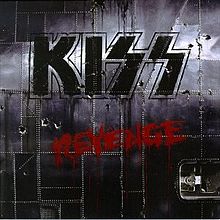 Having not learned from Creatures of the Night, this time when I blew off Kiss for a few years, they came out with Revenge, a very heavy, very aggressive album. It’s certainly one of their best post-70s albums. I didn’t pick it up until many years later, so I never got to appreciate it to its fullest extent. And I really like it. But in typical Kiss fashion it is marred by a few truly ghastly songs. Ghastly in and of themselves, but also ghastly because they do not belong anywhere near this album.
The band was having a hard time by 1992. Eric Carr died in 1991, and that had to be pretty rough (even for the businessmen of Kiss). Nevertheless, they regrouped with a new drummer, Eric Singer (who is blond, for god’s sake!) and came up with an album that fit in more with the aggressive alt sound of the early 90s. It opens with “Unholy” a heavy dark song, very much like early Kiss (and interestingly co written with Vinnie Vincent, although he doesn’t play on the record). This is the kind of aggressive song that Gene is meant to sing. “Take It Off” is a cheesy song about going to strip clubs. Kiss seems to live in the world of metaphor, so this very explicit song is quite shocking from them—even if the content is no surprise at all. And Paul’s voice doesn’t seem to work with the music very well. Although in a rare twist for Kiss, the slow middle section is actually pretty good. “Tough Love” sounds like a very different style of Kiss–it’s all minor key and menacing. This is especially odd for a Paul song. It’s a respectable change of style.
“Spit” is another really weird Kiss song. The guitar is very rough and raw—almost industrial. But having Gene sing “It don’t mean spit to me” seems like a total cop out. Of course, when the bridge comes in and Paul actually sings “the bigger the cushion the better the pushing” which is literally a Spinal Tap lyric (and given all the groupie photos I’ve ever seen, completely untrue) the song hits rock bottom. The chorus “I need a whole lotta woman” actually makes it worse. Although the odd solo section in which Gene scat-sings along with the solo is pretty wild.
“God Gave Rock and Roll to You II” may be an anthem and may have been Kiss’ biggest hit in years, but I think it’s pretty awful. Kiss doesn’t need yet another song about rock n roll being awesome. Although they sound very good in the little Beatles-esque breakdown near the end.
“Domino” is a popular song still, and it’s got that old school swagger. I happen to dislike Gene’s lascivious opening and frankly, the lyrics are really, really gross. I mean, sure, he wants to sleep with young girls, but you’re 43 and she “ain’t old enough to vote.” Couldn’t you just make her 22 and make us all feel a lot less queasy? I mean in “Goin’ Blind,” you were 93 and she was 16, but somehow that doesn’t seem as gross. “Heart of Chrome” (also co written by Vinnie Vincent) is a fast rocker—another odd one for Paul (this whole album feels like it should be sung by Gene), but Paul works it very well. “Thou Shalt Not” is mildly blasphemous and kind of interesting (Gene was born in the promised land!).
“Every Time I Look at You” is the obligatory ballad. It sounds so crazily out of place on this heavy disc. And it’s a pretty typical metal ballad of the time. “Paralyzed” is an example of how Kulick’s wild soloing fits with the heavy sound of the album—it’s noisy and rough like the songs themselves. Of course the actual song, a near the end of the album track by gene, is pretty much filler. But it’s good filler.
The end of the album has the stupid, but fun “I Just Wanna.” I hate that the vocal melody is ripped straight out of “Summertime Blues.” And it’s got a “naughty” chorus straight out of 7th grade—”I just wanna Fuh I just wanna Fuh I just wanna Forget you.” Okay, it is kind of fun to sing that part. “Carr Jam 1981” is an instrumental jam that is dominated by Eric Carr’s drum solo. It’s nice tribute to Eric (even if they did have Bruce record over Ace’s original guitar work).
I hadn’t really listened to this album all that much, but I found that when I listened to it again recently (aside from those three or four bad songs) it was a really good, rocking album.
[READ: August 13, 2012] “After Ellen”
This is a story about an asshole. And that is deliberate.
The title is “After Ellen” and the first 8 or so paragraphs are all about what a cowardly shit Scott is. He doesn’t want to get too serious with Ellen. They have already picked up stakes from Long Island and moved to Portland together. But he knew an evil seed was planted when they got there. And so, on the day after they talked about adopting a dog, he packed all of his things into their shared car and just left. While she was at work. Giving her no warning. And now, leaving her with no ride home.
How is it possible that one would want to read any more about this guy? Perhaps to see if he gets a comeuppance or to see if he changes his mind (although one hopes that Ellen would never take him back after that). But Taylor is a good writer and I want to read on.
He heads south to stay with his sister in Los Angeles–unannounced of course. But he stops in San Francisco to rest for the night. He checks his phone for the first time in two days. Ellen called 16 times and has gone from pleading to rage. There’s also messages from his parents (who are going to cut him off if he doesn’t call) and from Andy, a college friend from Portland who says he is a shit for taking the car–how is Ellen supposed to get to work? He texts Alan who immediate writes back and says to never even think about Ellen again.
After he settles in, he had deliberately avoided checking his past life, but when he finally logs into Facebook he sees that Ellen has not unfriended him (she was always a lazy Facebooker). And her most recent post is Fffrrryyydddaaayyy (and five people “like It). But Andy has unfriended him and Andy’s new profile picture is of him and Ellen.
And here’s where I say the asshole part of the story is deliberate.
Scott settles in San Francisco. He gets an apartment. He meets a woman named Olivia who is half black and half Jewish (on her mother’s side). Since Ellen wasn’t Jewish, Scot rationalized that Olvia is an improvement for his parents (except for their narrow-minded Long Island racism of course). He gets a gig (he’s a good DJ, so gigs are easy to find). He asks his sister to talk to their parents for him. And things seem to be settling down somewhat. He and Olivia are getting along very well and spending a lot of time together.
And then he sees a sign which says “I Found Your Dog.” He drives out to where the man has the dog, gives the man $100 and brings the dog home. Whenever he walks the dog, he’s always on guard for her real owners but he never encounters them. And when he takes the dog to the vet he tells Scott that the dog is healthy and pregnant. Olivia is pretty excited about this and proves to be very helpful. Things seems to be moving along nicely with them.
So you see, without that intro, this is a nice story about a guy moving to a strange city, meeting a woman and settling down. With that intro, here’s a scumbag who has left his girlfriend and started a new life in a new city with a new girl–is he really going to settle down with this one? It’s an interesting writing choice, and creates real mixed feelings about the main character.
I really enjoyed the story. Although I saw the other day that Karen at A Just Recompense hated this story. Karen and I often agree about stories, but I’ve noticed that we tend to differ on stories like this. She holds authors to a higher test than I do and I find her to be a much more discerning judge than I am. Karen wants her stories to do something for her, whereas I am a bit more lax in my demands. I don’t mind a story that’s just enjoyable–sometimes it’s a relief! So with a lot of contemporary lit, especially by young writers, Karen and I diverge. I think it’s because I always wanted to write stories but was never really that good at it, so I’m impressed when a story has a satisfying conclusion.

 I Just Read About That...
I like your take on this. I wasn’t that impressed – I was downright disdainful, in fact – so I’m glad to see an alternate view that makes sense to me. I hadn’t thought of how the story would read without the lead-in. It also eliminates the whole here-we-go-again thing. I still don’t think it’s much of a story with just that – there’s no there there – but I feel better about it just realizing there might have been a concept behind it. Thanks!
I read your review the other day and wasn’t sure if I had posted mine yet. I totally see your point of view on it…it’s totally a young person, write what you know story and there really isn’t that much to it. I have no idea if the author intended it the way I read it (given the interview you excerpted, I’d suspect not, actually), but as I was reading the beginning I just kept thinking what an asshole he was and I wanted to know how he might change my opinion of him. He didn’t really, but I was kind of impressed at how my feelings towards him softened.
[…] The Mookse and the Gripes contains a comment by Jon that the story seems to be “hipster-lit,” a category designed to bring in young subscribers to TNY. I’m of two minds about that. First: Am I really that old, to be condescending and snide about the youngest generation? Have I become my parents and those old-fart teachers who said things like, “Is this what passes for literature these days?” about… well, about just about everyone since Shakespeare, actually. But on the other hand… I’m thinking: “Is this what passes for literature these days?” Addendum: Paul Debrasky has a different, and very interesting, take on this story at I Just Read About That. […]