 SOUNDTRACK: KISS-Crazy Nights (1987).
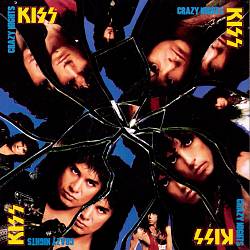 I’m going to make a bold statement here—Crazy Nights is worse than The Elder. Whereas The Elder was a mistake–weird songs, a bizarre concept, it showed some pretty ballsy moves. Crazy Nights on the other hand is just a pandering mess. There’s keyboards. Keyboards! The band has always been money makers (Gene Simmons’ face could be on the $100), but at least usually their music would find its own version of poppiness. But this album sounds like any generic metal album from the late 80s.
“Crazy Crazy Nights” is an obnoxiously poppy sell-out of a song (although it is at least catchy, but man…). “Fight Hell to Hold You” is the exception to the disc, a solid song from Paul with a good chorus. But “Bang Bang You” is as dumb as it sounds. It has cheesy keyboards, a lame riff and even has the audacity to reference “Love Gun.” It’s hard to fault Bruce Kulick for his wild playing, but it seems so out of place on this disc–as if his crazy solos will make the album heavier. Much like on Asylum, he gets a song to wail on the opening: “No No No” which is sort of winning by virtue of its non-stop propulsion (like say, “Hot for Teacher”). But it’s not really a song so much as a series of connected sounds.
“Come Hell or High Water” is pretty close to being a good song, perhaps the rest of the album taints this one too. What’s especially crazy about the keyboards on “My Way” is that they sounds straight out of Van Halen’s 1984. [None of this is to imply I don’t like Van Halen, I just don’t want Kiss sounding like them]. “When Your Walls Come Down” feels heavy in comparison to the rest of the disc, especially when followed by the super-ballad “Reason to Live” (which despite myself I kind of like). “Good Girl Gone Bad” is generic lyrically and musically. “Turn on the Night” brings more cheese and more keyboards. And “Thief in the Night” ends the disc on a reasonably high note. But the problem is that the music is such generic pop metal that it’s hard to be inspired by any of it.
I’m kind of surprised Kulick stuck around during this–two albums in a row!. Although he did get to show off his squealing chops, so maybe he was happy.
[READ: August 10, 2012] “Rainy Season”
This story came in second place in the Narrative Magazine Fall contest. I had been putting off reading it because it was quite long and I didn’t really have enough time to devote to it. When that time finally arrived, I was glad I waited.
This is a story about Jill and Maizie. Their father works at the Thailand consulate (something to do with drugs). And so the girls have been living in a gated compound for three months in Chaing Mai, Thailand. They are bored out of their minds. They are not permitted to leave the compound, they are the only Americans around and all they can really do is watch Gone with the Wind (which they have memorized). The girls have been trying to make the best of things, although it’s not always easy. Especially given the way their father is.
Their parents got divorced some time ago and the girls have never lived in the same place for more than two years. What’s worse is that their father is working all the time. So when he is around, he’s not really around for them. He is very strict about arbitrary things but is completely blind to others: “Maizie and Jill aren’t allowed to pierce their ears until they’re sixteen, he says. But he goes on trips to the Golden Triangle and leaves them alone in the house.”
Maizie is younger and she is super cute with comment-worthy blonde hair. She gets away with a lot. Jill is older. She is no longer cute and she is resentful of both her father and her sister. Of course, they only have each other, which Jill resents a bit too.
The action of the story takes place on yet another boring night. The girls decide to hang out with “Moon-Face” one of the guards who is nice to them. While they are in the booth, a group of three drunken tourists come to the gate. They are clearly looking for the brothel a few miles up the road–also gated. There is much confusions the tourists–Korean workers on their last day of vacation–are loud and boisterous and do not speak Thai. They speak some English, so Maizie and Jill try to help. The men think the girls are prostitutes.
“Hooker?” he asks Jill.
“No” –Maizie hesitates–“Pussy.”
“Maizie!”
“What? He gets it.” She speaks loudly and distinctly, sweeping her arms in a broad arc. “Pussy down the street!”
After a few minutes of confusion, the men invite the girls with them and Jill, sick of the boredom, says “okay!” Maizie is scandalized, but Jill, feeling angry at her sister mocks her and asks if she’s going to tell and calls her a baby. Jill relishes the pain she is causing, but at the same time she can’t look at the pain she is causing. Moon-Face runs after the songtao that is pulling away, but Maizie sneaks past him and hops in. Maizie says they will get in trouble, but Jill says that their dad is so far away he can’t do anything now anyhow. Maizie wisely points out that the men think they are hookers, but Jill says it will be okay, they’ll just have some fun.
The taxi stops up the road at another house, where a woman comes out. She is an adult but she is the same size as Maizie. She has a a golden gibbon around her neck and speaks in German.
Their first stop is a sacred grove where there is a statue of skinny Buddha (something I’d never heard of and which I found really fascinating). Buddha is skeletal, his ribs stand out, his expression is weariness and pity, but very tender. Buddha would not eat until a young girl gave him ice cream. He did not want to hurt her feelings so he ate. The girls want to know why he was starving himself but none of the adults understand the question.
And then they are back off to a karaoke bar. The men order the girls Long Island Ice Teas, and the girls are quickly drunk. Things do not go well from there, but fortunately they don’t go horribly horribly wrong either. Nonetheless, Jill is violated by the evening and Maizie never really sobers up to know what happened. They are rescued–near a riverbank–by an American junkie. He is benevolent and brings them back to his room. Jill–the only one capable of making decisions–feels that he is trustworthy if only because she can understand his language.
When they get back to his room his intentions towards the girls are good, although his intentions towards himself are not–he is exactly the kind of smuggler their dad is looking for. And Jill watches him swallow balloons full of the powder–which will net him considerable cash when he gets back to the States.
The junkie gives them some baht and they catch a cab for home. But even the simple act of getting home proves difficult when they are kicked out of the taxi. They are forced to walk home hoping for a purifying rain. And the final image is otherworldly and somewhat beautiful.
This was an emotional story–you grow very nervous for these girls–innocents in a land that spits out innocents. The interesting thing is that it seems to confirm stereotypes and yet it doesn’t feel like a racist story at all. It reads very real (of course, what do I know?). I was comforted that the worst didn’t happen to these girls, but I am very curious to know what will happen to them when their father gets home. And the unanswered question of what will happen to Moon-Face.
You can read it here.

 I Just Read About That...
Leave a comment