 SOUNDTRACK: BILL CALLAHAN-“Santa Maria” from Score! 20 Years of Merge Records: The Covers(2009).

I don’t often listen to songs that are as simple and straightforward as this one. It’s an acoustic guitar with occasional piano and Callahan’s deep voice. The melody is enjoyable and the vocals are crystal clear. (Callahan is from Smog, a band I know of, but whom I don’t really know).
The original of this song is by Versus on their Afterglow EP. I’ve liked Versus for a long time–their mix of male/female vocals and rockin’ guitars is always exciting. But I didn’t remember this song at all. It turns out that it’s kind of a slow, brooding number, something I probably wouldn’t have paid a ton of attention to back when I was rocking out more.
I prefer the Versus version as there’s more interesting tricks afoot, although Callahan does some cool subtleties by the end of the song that really bring out some interesting twists to the song.
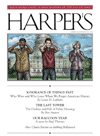
[READ: April 16, 2012] “Our Raccoon Year”
I’ve read a few pieces from Paul Theroux, and I’ll say that this piece really surprised me. While I wouldn’t try to categorize all of Theroux’s writing, I would say that a domestic story about raccoons is one that I would not have expected.
The story opens with the narrator, a young boy, telling us that his Ma decided to go away. Their Pa explained that she was where she wanted to be “with her friend.” Given the circumstances, and the fact that Pa was a well-respected citizen (and attorney), Pa was given custody of the narrator and his brother. He was the first man to be given custody of children after a divorce in their region and it only upped people’s opinions of him.
That’s a neat conceit for a story. So it’s surpising when he says that it also began their “raccoon year” which means it was their year of dealing with raccoons.
Their father, as sole provider, acquires several parenting skills, including becoming something of a gourmand. He began cooking wonderful meals (although as the boy points out, leftover gourmet is pretty gross). He also built the boys a little house of their own, with bedrooms and a bathroom. This way the each have privacy when they need it, but of course, they all eat together in the main house.
And then they started noticing things–twisted pieces of scat in the yard, food left out on the porch was eaten and other evidence of animal life–scratched earth, nibbled wood, etc. Finally, they spy a mother raccoon walking, confidently, with two babies to a water source and then back under the porch.
Pa seemed touched by the raccoons–clearly relating to the tenderness of the mother. And so he began feeding them some extra nice leftovers which gave him a good feeling. Until, that is, they turned up their nose at one of his specially prepared tomatoes. That they could turn up their nose at his offering, was unthinkable (even though later the game commissioner tells him that tomatoes are rough on raccoon stomachs).
And then when they see that there are about 18 of them, well, Pa kind of loses it.
First he trapped one and released it, only to see it come back the next day. So he went to the Fish and Game Commission and was informed that moving raccoons has a fine of $200. Pa is outraged, especially when he finds out that destroying the animal is perfectly okay, it’s just moving it that incurs the fine.
Pa becomes more and more determined to get rid of the vermin. And, as in any story of man against nature, Pa starts to go a little nutty. And as with every good man vs nature story, Pa has to think like a raccoon and so starts to act like one as well. He begins to think the raccoons are plotting against him. Theroux has no trouble depicting animal cruelty, so there’s some gruesome deaths for these raccoons.
This story was interesting while reading it, but the more I thought about it the more it seemed to fit the mold of every man vs nature story I could think of, including the fact that nature always wins in the end.
The key may be in the details, though. Theroux has some wonderfully written details in this story and, provided you’re not squeamish, it’s pretty gripping.

 I Just Read About That...
What fo you think are the main themes in this story?