 SOUNDTRACK: BRIGHT EYES-“Papa was a Rodeo” from Score! 20 Years of Merge Records: The Covers (2009).
I d on’t especially like Bright Eyes. But, as with Ryan Adams, his covers are quite good. The Magnetic Fields are pretty distinctive when it comes to lyric and melody. I’ve enjoyed a lot of their recordings, and once you get into The Magnetic Field’s mindset it’s hard to imagine anyone else singing his songs (that voice!). But if you haven’t heard a song for a while, it’s fun to hear a new interpretation.
And I really like what Bright Eyes does with this song–especially the backing vocals and harmonies at the end of “one night stand.” And–personal preference–the covers is paced a little faster, which I like, too.
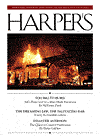
[READ: April 2, 2012] “Disaster Aversion”
This is the final article by Rivka Galchen in Harper’s. One would never expect an article with that title to be as personal as this one was–but I think Harper’s has a way of bringing that aspect out of writers]. For instance, the opening line is, “Like many a girl with a long-dead father I refer to myself as a girl rather than as a woman, and I gravitate to place I suspect my father, dead fifteen years now, might haunt.” Her father wa sa professor–which means that Rivka needed to go see the Whitney’s Buckminster Fuller Retrospective (which sounds awesome, frankly). I love this comment, which feel so true: “My father either admired Buckminster Fuller tremendously or thought he was a tremendous fool. I can’t remember which.”
Rivka doesn’t know all of the details of her father’s work, but she knows the basics, so when she started doing some investigation into storm and weather modification, she was right in her father’s area. Her research led to a Project STORMFURY from the 1960s. And she grew interested in modifying hurricanes.
The article basically details her attempts to speak to weather scientists and to ask them questions about current and future opportunities for reducing the damages done by hurricanes. As with much non-fiction, it doesn’t seem worth it for me to summarize her research–just read the article, its quite enjoyable.
But the fun part comes from the scientist she had a really hard time interviewing. She spends most of the article puzzling about why this renowned scientist won’t speak to her–won’t even see her. She has many reasons at her disposal for why the man won’t speak to her–the man knew her father and maybe his eccentric and at times confrontational behavior put him off of her family. The true is far more amusing.
The article ends on a mixed note–it turns out that practical solutions, like better infrastructure, saves many more lives during a hurricane, at a fraction of the cost than any of the weather modification plans. And yet, she doesn’t want to see science-fiction-like projects defunded either:
funding far-fetched projects can be justified for reasons other than the practical, for reasons that are closer to why it makes sense to fund, say, art. These grand weather-control ideas, charted in mathematical detail, are works of the scientific imagination. I myself think of them as poems. They are constrained not by meter or rhyme or genre but by the stuff of our real world.
Her final lines are probably the most truthful of the article–there will be disasters regardless of what we do. Even the most fantastic solution can’t help all disasters from happening. And yet despite the darkness of such a sentiment it is ultimately a positive message–don’t spend too much time worrying about them, just enjoy what you have.

 I Just Read About That...
Leave a comment