 SOUNDTRACK: STEREOLAB-Chemical Chords (2008).
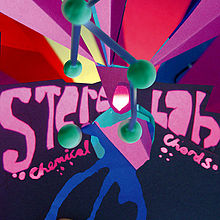 You never really know what you’re going to get with Stereolab. Well, that’s not entirely true, you know you’re going to get some unusual sounding loungey keyboard songs with lyrics that are either in French or in highly accented English. But beyond that each Stereolab album tends to go in its own direction.
Chemical Chords creates its own poppy bouncy bliss, making it one of their most approachable albums. “Neon Beanbag” even features the chorus: “there’s nothing to be sad about” over a set of the bounciest keyboard riffs around. “Three Women” has a brisk pace and some bright horns. “One Finger Symphony” has a minor key and as lightly sinister tone (but it’s only 2 minutes long).
The title track has some cool echoed vocals and a wonderful break in the song that allows a sweet little string section to sneak through. “The Ecstatic Static” is another pulsing song that seems alive somehow and “Valley Hi!” is a short darker piece with cool sound effects.
“Silver Sands” is a wonderfully bubbly pop song–the kind that Stereolab does so well, with vocals that seem like they might belong to another song. “Pop Molecule” is a great minor key instrumental, which is a nice introduction to the super pop of “Self Portrait with ‘Electric Brain'” another bubbly song with a cool break in it. “Nous Vous Demandons Pardon” opens with a martial beat before it settles down into a groovy song with French lyrics.
“Daisy Click Clack” shows off Stereolab’s totally unexpected lyrics: “Snap snap snap snap with your fingers/Off beat on time make it linger/Enriching the rhythm/Do away with skepticism/Come and join the hymn, tap/Sensing the symbiotic force.” From nonsense to the sublime in just a few short lines.
The final song “Vortial Phonotheque” reminds me of “I am the Walrus” in the music, but the gentle lyrics change the tone completely. It’s a wonderful disc full of all of the bright sounds Stereolab does so well. This would be their second to last disc before they went on a hiatus.
[READ: February 28, 2012] “How I Met My Daughter”
Two baby stories in a row!
Those following closely think that I was done with Max Barry last week. But there was one final piece for me to read. Technically this doesn’t make the last post wrong because although this story was on his website, it was also published in a magazine called The Bulletin.
If I thought that last week’s “Cement” story was dark, it’s nothing compared to this one! Barry, while a somewhat violent writer (his last book was all about surgical procedures), is usually quite funny as well. But this story eschews all humor for a walk through the dark side of man’s nature.
It opens with this incredibly dark couple of sentences:
They dragged this bloody, howling thing from my wife’s abdomen, its limbs twitching and clawing, its face like an angry pumpkin, and asked me, “Do you want to take a photo?”
Yes. I want to take a photo, so I can look back on the end of my life.
This story explores the feeling that men apparently have when their baby is born–jealousy at the lack of attention they will now receive. I didn’t experience this at all and frankly it seems like a fictional thing to me, because I don’t know of any men who felt real jealousy of their babies. But it makes for an interesting story. (more…)


 I Just Read About That...