 SOUNDTRACK: UNDER BYEN-“Samme Stof Som Stof” from Viva Piñata! (2008).
 Under Byen is a Danish band and has only one song on Viva Piñata.
I had originally written a review under the impression that it was different song (the CD and even iTunes confuses this song with “Kiss ME” by Uncut. And you can see my initial impression below). Now, knowing that this band is not singing in English changes a lot about my perception of what the sounds actually are.
This is one of the few remixes on the disc where I listened to the original first (to make sure I had the right song). The original is an interesting mix of peculiar instruments and some cool soundscapes. This remix chops it up into pieces and puts it back together. It’s an interesting twist on the song but man, the original is so much better.
[Here’s my original thoughts, when I read a bit about the song when I thought it was by the band Uncut and I thought that it was not a remix. And I saw that they were described as a poppy fuzzy band.
this song comes from one of their official releases. “Kiss Me” is not a remix but it sure sounds like one. It is kind of warped and the sounds feel manipulated in crazy ways. The vocals are mostly moans and noises. But it has a catchy beat and some interesting sounds. This is a weird song, and I’m not sure how it fits in with the rest of the album. I do kind of like it, but I wouldn’t hunt them down for more.
Of course, now that I know it’s supposed to sound like that, I change my tune completely. And I will hunt down some other songs for comparison.
[READ: March 23, 2012] An Episode in the Life of a Landscape Painter
This is the third novel from Aira that New Directions has released (translated wonderfully by Chris Andrews). It’s the first one they published and the first one of his that I had heard of. I actually heard of it long before I knew of Aira because the Preface is by Roberto Bolaño. And if you do a search for Bolaño, this title always comes up.
And so now I finally got to read this mythical essay. Sadly, it turns out to be an essay called, “The Incredible César Aira” which was recently published (2011) in Between Parentheses–bad timing for me. It also has nothing to do with this novel specifically
But on to the novel itself.
This short book is about the German painter Johann Moritz Rugendas. Little did I know that he was real. He was a landscape painter (a profession which became obsolete with the invention of cameras) and he was very well-regarded. Twice during his career he went to the Americas to paint the land. On his second journey (from 1831-1847) he went to Mexico, Chile, Peru, Brazil and Argentina, which resulted in thousands of paintings.
The opening of the book is rather philosophical (and a little dry). But after about ten pages, the book picks up with the titular episode. Rugendas and a German painter named Robert Krause set off in 1837 from Chile. They got on well. Rugendas was far superior technically and Krause, although also quite talented, was always respectful. Rugendas had sold prints and books and his Picturesque Voyage through Brazil was printed on wallpaper and China.
 After traveling through the mountains they found themselves in Mendoza where they rested for a time
 They were to set off across the pampas for Buenos Aires. Rugendas hoped to witness an earthquake and an Indian raid while he was there (both of things were likely but impossible to predict). Of course, he never voiced these desires to the locals.
On their journey he was absolutely taken with the large carts they use to cross the pampas. They are monstrous and cover distances that are easily measurable by day or week. Since they have only two wheels most of the time they were static and rested at a forty-five degree angle.
Obviously there is much written about the landscape. And most of the writing is beautiful, descriptive and evocative. before they reach the pampas, when they are convinced they are in the pampas, their guide informs them that they are not. The Germans think that everything is so flat, how could it not be the pampas? Once they get to San Luis, they experience the real flatness.
But the vastness of the plains coupled with a plague of locusts (which wiped out everything green for miles) made the horses exhausted, dehydrated and panicky. The painters couldn’t decide what to do so Rugendas suggested they split up. Krause thought it was a bad idea, but Rugendas wouldn’t hear of it. So he hopped on his horse and took off. But when he cleared the mountain, the already spooked horse was further spooked by a lightning storm. A lightning storm which struck Rugendas while on his horse.
When Krause and his team finally found Rugendas, they were sure he was dead. But he had survived despite some brutal damage to his face (the details are astonishing).
The remainder of the story shows Rugendas’ determination in the face of excruciating pain and physical torment. He manages to continue painting and even gets to paint a scene of something that he really wished for.
The story doesn’t end with Rugendas’ death, just as it didn’t open with his birth. This is just one episode. And it is remarkably told.
What I think is especially wonderful about this story is that before I knew that Rugendas has actually done this, I thought it was a clever way for Aira to write about his native country from the perspective of an outsider. The fact the it is based on a real person who had actually been there makes it all the more interesting.
I love that Aira’s books explore a subject in great detail but are never terribly long. The stories aren’t exhaustive (this one is called “an episode” after all), but they investigate things that are natural and supernatural at the same time. It’s a good trick.
Here’s a painting from Rugendas which I think is called Two Riders Waiting. 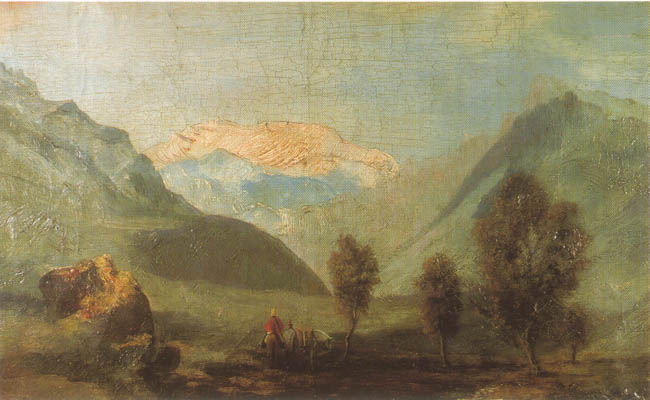
For ease of searching, I include: Cesar Aira, Roberto Bolano

 I Just Read About That...
[…] Comments « César Aira–An Episode in the Life of a Landscape Painter (2000) [Translated 2006] […]