Feeds:
Posts
Comments

Archive for February, 2012

SOUNDTRACKKHÔRA’s-Silent Your Body Is Endless [CST071] (2011).

This is the third and final disc from Constellation’s MUSIQUE FRAGILE 01 collection.  Khôra is Matthew Ramolo doing solo work on the guitar.  But unlike any other guitar album you may have heard, this one is processed and manipulated so that much of the album sounds nothing like a guitar.

Most of the sounds on the disc are washes and waves of guitars that grow and fade.  Although the opening track “Natura Naturans” has a recognizable acoustic guitar melody, the washes are all processed guitar sounds.  This sound also has an echoing church bell, the kind of sound that would bot be out of place on a black metal album although this is as far from black metal as you can get.

The church bell, by the way is a field recording, and in addition to the guitars there are plenty of field recordings on the disc.

He generates a wonderfully expansive amount of moods as well.  There are haunting melodies like on “Body Aperbut also beautifully upbeat ones like on “Hushed Pulse of the Universe”

I find the artwork that accompanies the Khora album to be the most satisfying of all three.

[READ: February 15, 2012] Tres

Another month, another posthumous Roberto Bolaño release.  Tres is so-called because there are three pieces in it.  They are described as poems, although I have a hard time seeing them as such.  It has the Spanish title because it was originally published as Tres and the English version is actually a bilingual version with facing Spanish and English pages (translated by Laura Healy–I guess if Laura Healy translated it, it must be poetry as she is Bolaño’s poetry translator).

Tres is also amusing to me because it is so clearly a way to make a very small book seem bigger.  In addition to the facing pages of the text, most pages have a paragraph or two at most (short ones at that).  So it’s total 173 pages is really half that and then, given how much white space there is, it’s easily half that as well.  None of this is a complaint, it’s just an observation.

The reason I’m confused about calling it poetry is because of the three pieces only one “looks” like poetry (with line breaks and what not).  Indeed, the first piece, “Prosa del otoño en Gerona” literally translates as “Prose from Autumn in Gerona.”  The second piece (the one that looks like poetry) is called “Los neochilenos” or “The Neochileans” and the final one is a series of numbered paragraphs (again, with no poetry conventions) called “Un paseo por la literatura” or “A Stroll through Literature.”  I read each of these pieces three times primarily because I found them hard to follow and wondered what I was missing.  Multiple readings did help, although I find with Bolaño’s longer short pieces, the details are exquisite while the overall picture is a bit confused. (more…)

Read Full Post »

SOUNDTRACK: THE FEELIES-Crazy Rhythms (bonus downloads) (2010).

The other day when I was playing Crazy Rhythms I noticed a little card that I had never noticed before.  It said that if I went to the label’s website, I could download bonus tracks.  That was pretty cool, so I did.

The are five tracks.  “Fa Cé-La” says it is a single version although it sounds even more spare and underproduced than the album version (and it’s a tad slower). “The Boy with the Perpetual Nervousness” and Moscow Nights” are demos.  “Boy” really sounds like a demo (the wood blocks are almost piercing!).  It’s interesting that the guitar solo, which sounds random on record was planned that way.  On “Moscow” the singer’s channeling Lou Reed pretty intently.

The next two tracks are live from a reunion tour in 2009.  I’m not exactly sure who was in the band, but that’s okay, the songs sound good.   “Crazy Rhythms” has a (simple) drum solo in the middle (more of a beat-keeping than a solo per se), and an extended jam towards the end song.  And the final song is a cover of Jonathan Richman’s “I Wanna Sleep in Your Arms,” at a frenetic two-minute pace.

Not bad for free downloads, eh?

[READ: December 31, 2011] “A Shade Less Perfect”

After reading all of those Max Barry blog posts, getting to read a real story is a real treat.

This is a very simple story of one-upmanship (a common trope of sitcoms–in fact just the other night Up All Night ran the “two brothers who must compete against each other at everything and never admit that they have failed at something” script).  And this story falls into the same general area, but Barry puts a surprising twist on the end.

Jonathan and Elizabeth are going to house of Jonathan’s boss, Dave.  Elizabeth likes Dave’s wife Julie.  They both had babies around the same time and met in birthing classes, so they are excited to catch up (it’s been about ten months since they’ve all seen each other).

Dave tends to lord everything over Jonathan at work.  Jonathan says he’s okay with this at work–Dave is his boss after all, but he doesn’t want to deal with it out side of work, too.  Naturally, Dave has a huge house and a convertible and every other material joy.  Even a nanny. (more…)

Read Full Post »

[ATTENDED: February 11, 2012] Aga-Boom

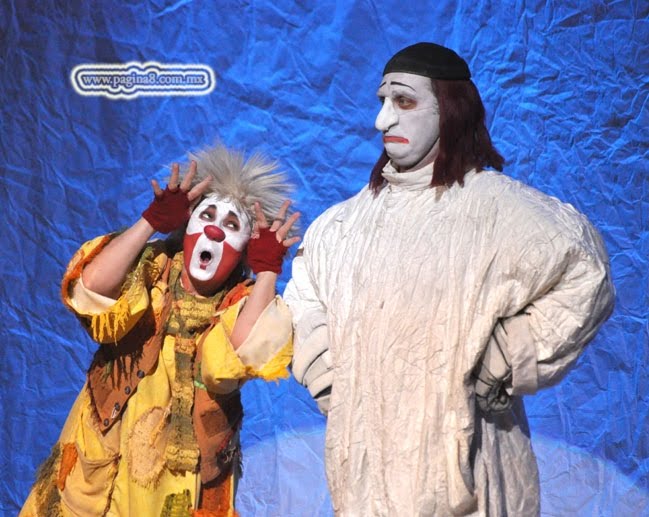
This past weekend, my family attended Aga-Boom, a “theatre of physical comedy and circus arts.”  It was incredible, and it was hard to believe that this was performed at the Raritan Valley Community College theater, which is nice and all, but seems small potatoes for a troupe that was part of Cirque de Soleil and which has been in Vegas and on Broadway.

Aga-Boom‘s show is perfect for all ages–my kids loved it, but I may have laughed more than they did.  There are three clowns, an older woman, a goofy “large” clown and a kind of morose alien-looking clown.  None of these are you typical “clown make-up” type of clowns.  In fact, I found the lady clown’s make up to be amazing–astonishingly emotive and expressive.  And the morose clown was all white face with a completely fake nose and a simple red frown line for a mouth and yet wow, they could convey everything.

There are several set pieces.  The first is a joke about paper getting stuck to the lady clown.  It’s a good introduction to the paper conceit that runs through the show (the stage “curtain” is a large sheet of paper!  It morphs into this amusing/intimidating section where the morose clown (dressed like an astronaut with (a wonderful detail) a water cooler bottle on his head as a space helmet–is mad because the woman clown accidentally launched his ship into space.

Then comes the goofy clown who does some amazing juggling with a suitcase.  I’ve never seen anything like it.  (more…)

Read Full Post »

SOUNDTRACK: ALEC BALDWIN reading “Lost and Found” (Selected Shorts September 10, 2011) (2011).

Alec Baldwin’s reading of Whitehead’s “Lost and Found” is really great.  His delivery is perfect and he strikes the ideal balance of humor and pathos, even if his inner-Boston peeks through this New York tale once in a while.  You can hear it for free at soundcloud.

[READ: February 12, 2012] “The Way We Live Now: 11-11-01; Lost and Found”

I didn’t know who Colson Whitehead was in 2001 (at the time of this piece, he had written two novels, neither of which have I read even now).  I read a lot of things about 9/11 after the attacks; however, I didn’t read everything (and really I didn’t want to try).

Strangely, the only way I found out about this is because my brother-in-law’s wife linked to the soundcloud page on Facebook the other day.   (I’m not sure what made her link to it now, either).

The amazing thing about this essay is that it was written less than a month after the attacks and yet it is it is humorous and wise (but not silly or light-hearted).  It strikes a perfect balance.  And in fact, doesn’t even mention the attacks by name.

The piece is more of an ode to New York City and how “No matter how long you have been here, you are a New Yorker the first time you say, ”That used to be Munsey’s’ or ‘That used to be the Tic Toc Lounge.'”  Your first memory of the City is how you will always think of the City.  Whether you were dragged there at Christmas time as child or to help a friend move. (more…)

Read Full Post »

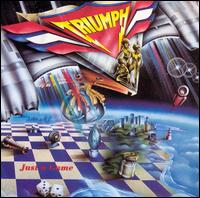
SOUNDTRACK: TRIUMPH-Just a Game (1979).

When I was a kid, my love of Rush was followed closely by my love of Triumph (I had a thing for Canadian power trios).  I’ve recently read a bunch about Triumph and was surprised to hear how acrimonious the band was.  Of course, I didn’t care about any of that back in the 80s.

This album was my favorite (even though Allied Forces was their major breakthrough).  In my gate-fold album the inner foldout was an actual board game.  How thoughtful!

It’s funny listening now, how much I liked this album back then because there is definitely some cheese here.  And I could never decide if I liked drummer Gil Moore’s songs or Rik Emmet’s songs best.  “Movin On” is a great hit but the backing vocals and “on and on” parts are kind of wimpy 70s rock–I must have blocked it out while jamming to the guitar solo.

Rik Emmet has since gone on to a successful solo career.  But on “Lay It On the Line,” the song that got me into them (thanks MTV) Rik rocks like he loves this band and this music.  The song features some serious guitar workouts and some impressive vocal acrobatics.

Perhaps, in hindsight, I like Rik’s songs better, as “Yong Enough to Cry” is pretty cheesy (it was fun to sing along to when I was 13 though–even if I never understood Gil’s pain, man).  But all of that was forgiven for the majesty of “American Girls.”  Sure, it’s also a cheesy song, but man it rocks.  As a young kid, I loved hearing the national anthem in the middle of the song.  And that solo is non-stop.

“Just a Game” is a powerhouse of a song although it’s a little long for what it is.  But then there’s the amazing “Fantasy Serenade” just over 90 second of beautiful classical guitar (a direction he’s go in much more after leaving Triumph).  It’s wonderful as a solo and it works as an amazing intro to the majestic “Hold On” (a song about music that doesn’t suck).  Although admittedly, the single version is better without the weird disco instrumental in the middle that really kind of puts a kibosh on the flow of the song.

The album ends with the strange (and quite long for what is it) “Suitcase Blues,” a 3 minute slow blues about touring.  But hey it showcases diversity, eh?

Even though many people compare Triumph to Rush, I think the more likely comparison is actually Kiss.  “American Girls” has a real Kiss vibe towards the end, and the opening chords of “Movin’ On” have a real Kiss feel.  Regardless, they played great metal/rock/prog and I’ll always love them for it.

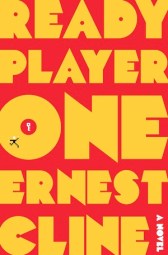
[READ: February 12, 2012] Ready Player One

Do you like Rush? Do you like Monty Python?  Do you like the 80s?  (not those 80s, but cool 80s like Blade Runner, coin op video games, Family Ties, Square Pegs?)  Then you absolutely must read this book.  Especially if you like Rush, because how often does Rush form a plot point in a book?

Sarah was reading this book and she insisted that I read it (she has really been passing on the good suggestions lately!).  And when I heard her playing Rush a few days after reading this book (and she doesn’t like Rush), I knew I had to read it.

But what is it?  Well, It is basically the story of an online quest to find a secret egg and win a massive fortune.  The egg was placed in a virtual world by its creator, James Halliday.  Halliday was “a nerd uber-deity on the level of Gygax, Garriott, and Gates.”  He created amazing video games and ultimately the most amazing virtual reality space ever: OASIS.  (For Atari geeks, his inspiration for getting into creating video games in the first place was the Atari game Adventure).  Halliday was obsessed with the 19080s (the decade he grew up in), with technology and with geeky movies.  The only way to find this egg in OASIS is to know a thing or two (or 1,000,000) about the man who created it and the decade he loved.

If you were hooked by the first paragraph, you’ve already put this book on hold.  If you were hooked by the third paragraph, you know you have to put this book on hold.  If you’re not convinced yet let me back up.

It is the year 2044.  The earth is in a hellish state–there’s no fuel, there’s no jobs, people live in trailers that are stacked on top of each other.  Life sucks.  Except for OASIS.  OASIS is the virtual world created by Halliday.  At this stage in the world, OASIS is where most people go to school (cheaper and easier to do virtual teaching) and where many people spend most of their lives.  It’s depressing and horrible (and I actually didn’t enjoy the opening chapters all that much because it was really horrible and at a times a bit more caustic than I was expecting–but that changes quite a lot).

So Halliday invented OASIS as an idealized pace.  It was originally a multi-player game but soon became a new place to live, a kind of Eden.  It was free to join and you didn’t have to pay to play.  Although you needed credits to travel (or to build your own buildings or planets or whatnot), you could stay on the main world (which looks a whole hell of a lot nicer than the real world) and just hang out for free.  You can earn points through various achievements which would let you travel (or you could always hitch a ride with a friend) around the worlds.

Anyhow, when Halliday died, as his last will, he created a contest in OASIS.  Anyone who could find the three keys and unlock the three gates would win his entire fortune (billions of dollars) and total control of OASIS.

The protagonist (Wade in the real world, Perzival in the OASIS world) is telling his tale because he was the first avatar to find the first key to Halliday’s Hunt (it took over five years to find the first key).  If you played D&D, this section will make you smile.

When Perzival found the key he was suddenly famous because everyone on OASIS knew it was found.  Prior to this moment, the “leader board” which previously listed only Halliday, now suddenly lit up with Perzival’s name.  (Good thing OASIS avatars are anonymous, right?) (more…)

Read Full Post »
SOUNDTRACKDALLAS GREEN-“The Gift” on CBC Kids’ Mamma Yamma (2012).

I have no idea what Mamma Yamma is (well, obviously it’s a kids’ show on CBC–Wikipedia tells me, “Mamma Yamma, who is played by puppeteer Ali Eisner, is a yam who represents Ontario as the owner of a fruit and vegetable stand in Toronto’s Kensington Market” so now we know).  It’s pretty low budget and quaint and actually rather funny.  Also, (given the few links I’ve seen on YouTube) it must host some pretty hip Canadians.

On this episode Dallas Green (who is City and Colour) sings a little tribute to Mamma.  here’s a brief intro and then he starts singing.  As one of the comments says, “Dallas Green: Phenomenal musician, terrible actor.”  And that’s pretty accurate.  If you can get through the awkward introduction (although I have to say Mamma Yamma is pretty funny…check out the clip with Jian Ghomeshi!), the song is really nice.

Dallas has a great voice.  Usually his songs are kind of angsty, but this one is really nice.  Not too many Dallas Green songs have the lyrics, “with jelly beans and sprinkles from front to back.”  I just hope that the kids aren’t running out to buy his proper album based on this.  It’s a rare treat for City and Colour fans.

[READ: November and December 2011 and January 2012] The Secrets of Droon, Books 13-SE#1

Even though I waited 12 books to talk about Droon the first time, this next section of books seems to have a definitive “arc” with SE #1 serving as a kind of transition. Book 13 introduces a new bad guy.  And although he doesn’t last all the way through to Book 16, Sparr is noticeably absent for this arc.  But just because Sparr is still missing, that doesn’t mean there’s a lack of trouble in Droon.

With this book, the series grows more magic based.  One of the first reviews I’d read of the series negatively compared it to Harry Potter.  I didn’t quite understand that since (in Books 1-12) the only magic came from the people who lived in Droon; the Upper World heroes didn’t have any.  Well, since book 12, Eric has gained magic and there is a bit more of a Harry Potter element now (remember HP was published in 1997, and really hit its stride around 2000).  I have no idea if Tony Abbott intended to give his main character magical powers from the beginning.  It’s possible, as there was magic in Droon, but Eric’s magic does add a new element to things.  He doesn’t use it often, it just seems to supplement things.  And remember, it’s not like wizardry is the point of Droon, the point has always been that the kids can work together to solve their problems (notice just how often Galen has to go away and can’t help any of them).  And, of course, this series is aimed at a younger group of kids.  Consider it a gateway book. (more…)

Read Full Post »

SOUNDTRACK: THE FEELIES-Crazy Rhythms (1980).

Not too many albums start out with clicking blocks and quiet guitars that build for a minute before the actual song kicks in.  Not too many albums sound like early Cure sung by Lou Reed and not too many albums are called Crazy Rhythms when the thing that’s crazy about them is their vocals and guitars.  But that’s what you get with The Feelies debut.

In addition to the blocks, the opening song also features some sh sh sh sounds as a rhythm (techniques used by The Cure on Seventeen Seconds, also 1980).  There’s two guitar solos, each one vying for top spot in different speakers and, yes, the rhythms are a little crazy.

The album feels like it is experimenting with tension–there’s two vocalists often singing at the same time, but not in harmony.  There are oftentimes two guitars solos at the same time, also not in harmony.  The snare drum is very sharp and there’s all manner of weird percussion (all four members are credited with playing percussion).

That early-Cure sound reigns on “Loveless Love” as well, a slow builder with that trebly guitar.  There’s a lot of tension, especially with the interesting percussion that plays in the background.  And there’s that whole Lou Reed vibe in some of the vocals.

But not every song sounds like that, “Fa Cé-La” is a punky upbeat song with two singers trying to out sing the other.  “Original Love” is another short song, it’s fast and frenetic and fairly simple. It’s as if they couldn’t decide if they were going to be The Velvet Underground or New Wave punks.

The next surprise comes from their choice of covers: “Everybody’s Got Something to Hide (Except for Me and My Monkey”).  It goes at breakneck speed with some surprising pace changes after the chorus.  And a wonderful ringing percussion that makes the song sound even more tense than it is.  “Moscow Nights” is a more traditional song (although the backing vocals seem very spartan.

“Raised Eyebrows” is almost an instrumental, until the last-minute when the seemingly random vocals kick in.  And the final track, “Crazy Rhythms” seems to combine the speed of the faster tracks with the insanity of the other tracks.  It’s a pretty amazing debut, really heralding an age of music.

  It’s a shame it took them 6 years to make another (very different sounding) record.

[READ: February 8, 2012] “To Reach Japan”

I love Alice Munro’s stories, but I found this one a bit confusing.  Now, I admit that i read this under poor circumstances (while I was supposed to be attending a company-wide presentation), so that may have led to my confusion. But it felt like there was some questionable juxtapositions of the timeline in this story.

It opens simply enough with Greta and her daughter Katy waving goodbye to Peter (the husband and father) as they pull away from the train station.

The story immediately jumps back to Peter’s mother and how she fled on foot from Soviet Czechoslovakia into Western Europe with baby Peter in tow.  Peter’s mother eventually landed in British Columbia,where she got a job teaching.

The second time jump comes a few paragraphs later.  It seems like we’re back in the present, but the section opens, “It’s hard to explain it to anybody now–the life of women at that time.”  This describes how it was easier for a woman if she was a “poetess” rather than a “poet.”  But I’m not exactly sure when that was.  Presumably when Greta (who is the poet) was younger, but how long ago was that?  In Toronto, even?

The story jumps back to the present to say why Greta and Katy are on the train and Peter isn’t.  They are going to housesit for a month in Toronto while Peter goes to Lund for a summer job.

Then it jumps back to when Greta was a poetess and actually had poems published.  The journal was based in Toronto, but there was a party in Vancouver for the editor.  So she went.  And she had a lousy  time among the local literati.  She gets drunk and sits in a room by herself, but soon enough a man approaches her and offers to take her home. There is the potential for something more to come of it but it never materializes.  But she never forgot the man’s name: Harris Bennett, journalist. (more…)

Read Full Post »

SOUNDTRACK: LOS CAMPESINOS!-Romance is Boring (2009).

Even though I had heard good things about Los Campesinos! before I got this album, this was the first one I bought.  I see that it gets less high marks than previous discs but I think it is fantastic.  It is frantic and catchy, it is intense and mellow, it is loud and soft and most of the time that’s in the same song.  And, as you’ll see below, lyrically I think it’s fantastic.

The disc begins slowly.  Then the vocals come in and you can tell that Gareth Campesinos!’ voice is somewhat abrasive, but well enunciated. When at the 2 minute mark the song more or less stops and turns into little twinkling bells you’re not prepared for the next bit–the guitars are noisy and the drums are loud and the lyrics are even stranger (sung in a slightly off-key style): “I’m leaving my body to science, not medical but physics.”  By the end, the song has mellowed almost completely and we have an almost a capella ending, “Would this interest you at all?”  But before you have a chance to answer that, the next song, “There are Listed Building” ratchets forth in both speakers with loud and quiet sections, group vocals and the lead singer’s more shouting style.

“Romance is Boring” has some super catchy shouted vocals as well as the first real exposure to the co-vocalist Aleksandra Campesinos!’ beautiful gentle female voice. “We’ve Got Your Back” is primarily sung by the female vocalist until the male voice come back with “and so fucking on and so fucking forth” and my favorite shouted chorus: “What would you do?  I do not know.”  “(PLAN A)” is a screaming punk blast of discord.  Until, of course, the much more palatable group sung chorus kicks in.

One of the best songs they do is “Straight in at 101” a wonderful song about breakups that is catchy and funny. It opens with, “I think we need more post-coital and less post rock.”  And then after some great alt rock, the song comes to an end with an a capella section that is quietly sung:

I phone my friends and family to gather round the television;
The talking heads count down the most heart-wrenching break ups of all time
Imagine the great sense of waste, the indignity, the embarrassment
When not a single one of that whole century was… mine

“I Warned You: Do Not Make an Enemy of Me”  has frenetic guitar and the wonderful line, “if this changed your life, did you have one before?”  And the wonderfully titled “A Heat Rash in the Shape of the Show-Me State” opens with this lyrical stanza:

She’d a bruise so black they watched it fade through the full spectrum of colours.
They kept it like a pet; a private joke they told no others.
And how the tissue repaired, and how it turned to yellow
And she found it disgusting, ’cause it didn’t match her clothing.
He said “that’s not yellow, it’s golden”.

Also lyrically interesting is “The Sea Is A Good Place To Think Of The Future,” because how can you make this couplet work in a rhythmic way.  But he does! “At fourteen her mother died in a routine operation from allergic reaction to a general anesthetic.”

There are fast songs and slow songs and pretty sections and harsh sections.  I think they meld it all together wonderfully.

[READ: February 6, 2012] “Los Gigantes”

I think I begin every T. Coraghessan Boyle story with some trepidation.  I liked Boyle because of The Road to Wellville, but I find that most of his other stories are very Southwestern, a region I really don’t know very well.  And yet for all my trepidation, I find I do enjoy his stories.

This one has a very simple premise.  All of the largest men in the area have been offered jobs by the President (I’m not sure where this is set but I assume, if it’s not entirely fictional, that it’s meant to be in Central America).  Although the men have some freedom during the day, at night they are locked into cages.  But their job is a simple one–eat, sleep and have sex with very large women.  That’s all.  It’s kind of boring, but  they are provided entertainments.  And it could certainly be worse (wait until you see what conditions the women love in!).

Discontentment begins to settle in as they realize that they are little more than stud animals (the President is breeding them for their size for a secret army in several generations).  And so one night two of los gigantes escape (it’s fairly easy, they are very strong men).  But they basically get as far as town where the pleasures of the  town’s bar keep them from returning home.  They are caught and punished, but the punishment is not that bad because the President really wants their offspring.

The men issue demands–a nicer living situation mostly–which are met, and they are contented once more. (more…)

Read Full Post »

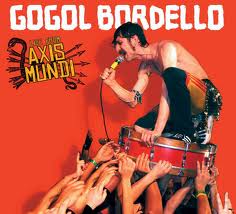
SOUNDTRACK: GOGOL BORDELLO-Live from Axis Mundi (2009).

This is a strangely-named disc collection.  The CD is actually live shows from the BBC as well as a few demos and other sessions.  The DVD that comes with it is actually a 2007 show live from Axis Mundi (Irving Plaza NYC).  For this review I’m only talking about the CD.

The BBC Sessions, as always, sound great.  The band is wild and spirited although a little less than in a typical concert setting.  They plays “Ultimate,” “Wanderlust King,” “Mishto”, “Alcohol,” “American Wedding,” and “You Gave Up (Roumania)” (all of which come from Super Taranta except “Mishto!” (from Gypsy Punks Underdog World Strike) and “You Gave Up (Roumania)” which I believe is exclusive to this disc.

The band is clearly having a lot of fun with the songs (the nine minute “You Gave Up” is a great jam) and they are perfectly in sync with each other.  At the end they even do a couple of promos shout outs for Radio One.

“Stivali E Colbacco” comes from something called the “Super Taranta Sessions” and was recorded by Steve Albini (his presence isn’t really evident, except maybe when the aggro guitar kicks in, but the song sounds great).

“Troubled Friends” comes from the “Gypsy Punk Sessions” and was recorded by Victor Van Vugt (who did the Super Taranta album).  It’s the first thing that slows the album down and feels like a B-side or a tack-on.  Mostly because the music is too minimal and meandering (and at 6 minutes is too long).

“60 Revolutions” makes up for the previous song with some solid songcraft.  At 6 minutes this is also a bit too long.  But it’s good exploration of Gogol Bordello’s flirtation with Spanish lyrics.

The last two tracks are a demo of “Immigrant Punk” which sounds different but not radically so (the lyrics seem clearer) and probably the least essential track of all, an instrumental version of “Immigrant Punk.”

The BBC stuff certainly makes this worth tracking down.  The rest is filler; but it’s pretty good filler.

[READ: December 31, 2011] “Blog This”

This is the final blog post from Max Barry’s website that I’ll be talking about (yaaay)–there’s two short stories left after this.

Like all good blog posts, this one is about the creator of the blog.  Barry was searching the web when he found a post called “Writers Who Blog.”  Barry posted a link to the article but the link is now dead and a very cursory websearch came up empty, so alas, there will be no confirmation of sources here.

So Barry says that this article about Writers who Blog totally trashes him.  He was going to let it go until he saw that a) the author was the same guy who wrote the worst review ever of his book Jennifer Government (this link is also down…I guess Barry really got to him!) and b) the critic was going by a lame pseudonym for the review but now he has revealed himself.

This post revealed to me that Barry created something called NationStates, a nation simulation game (which I would love to explore but don’t have time, which appears to be thriving).

Anyhow, the critic, Todd Bunker criticizes Barry’s blog posts, claims barry lies about his number of visitors and calls his readers sycophants.  Harsh cries indeed.  I think some of the many comments for this post include deliberately sycophantic comments.

Bunker also looked at Neal Pollack and Wil Wheaton’s blogs.  I happen to like Pollack, although I’ve never seen his blog.  But I have to say I have been following Wil Wheaton on G+ for a while now and he is a delight. I’ve never seen his blog, but I am never not amused by him (little shout out to the guy who inspired Wesley Crusher.die.die.die).  (more…)

Read Full Post »

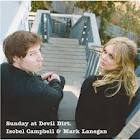
SOUNDTRACK: ISOBEL CAMPBELL & MARK LANEGAN-Sunday at Devil Dirt (2010).

Sarah bought this disc for me for my birthday a few years ago.  I had a hard time getting into it even thought it was supposed to be amazing.  It turns out that it is amazing, but only when I’m in the right mood.

The is a disc of slow, moody songs.  The closest comparison I can think of is Leonard Cohen (even though all of the songs are actually written by Isolbel Campbell)–this disc is at times more and at times less ponderous than Cohen.

The main reason I couldn’t get into it is because the first two songs are really really slow.  “The Seafaring Song” is almost comically slow–as slow as Lanegan’s voice is deep.  And yet there is a very nice melody (and beautiful accompaniment from Campbell).  “The Raven” sounds like an old Western movie.  Indeed, a lot of the disc sounds like an old Western.

“Salvation” introduces the first real up-front melody. “Back Burner” has a very old school chanting chorus which is quite a change for this album (although at 7 minutes, it does drag a bit).

“Who Built the Road” is very much like a Leonard Cohen duet (especially the La la part) while “Come On Over (Turn Me On)” is like a sexy Serge Gainsbourg duet (the album really picks up around here).  “Shotgun Blues” is a big sexy blues (surprising for Campbell who sings lead) while “Keep Me in Mind, Sweetheart” is a country-style ballad.

By the time that “Sally, Don’t You Cry” comes on, I find that I have more or less had enough of the disc.  But that is the last official song.  My copy has five bonus tracks after two minutes of silence. But the bonus songs mix things up a bit more.  “Fight Fire with Fire” is a jaunty piano based song (although it’s still pretty slow-paced).  It’s funny to hear them talking about AC/DC albums in this slow piano song.

“Violin Tango” is just what the title says while “Rambling Rose, Clinging Vine” is probably the most upbeat song on the disc. Finally “Hang On” feels the most like a song from her old band Belle and Sebastian (by way of The Velvet Underground).  It’s also the only one she sings solo.

So yes, I do like this album quite a lot. Lanegan is a perfect foil for Campbell’s sweet voice and songwriting. They made another disc together, maybe I’ll get that in another couple of years, too.

[READ: February 5, 2012] The Scrapbook of Frankie Pratt

This was a wonderful book that Sarah brought home and told me I had to read.  And I’m so glad I did.

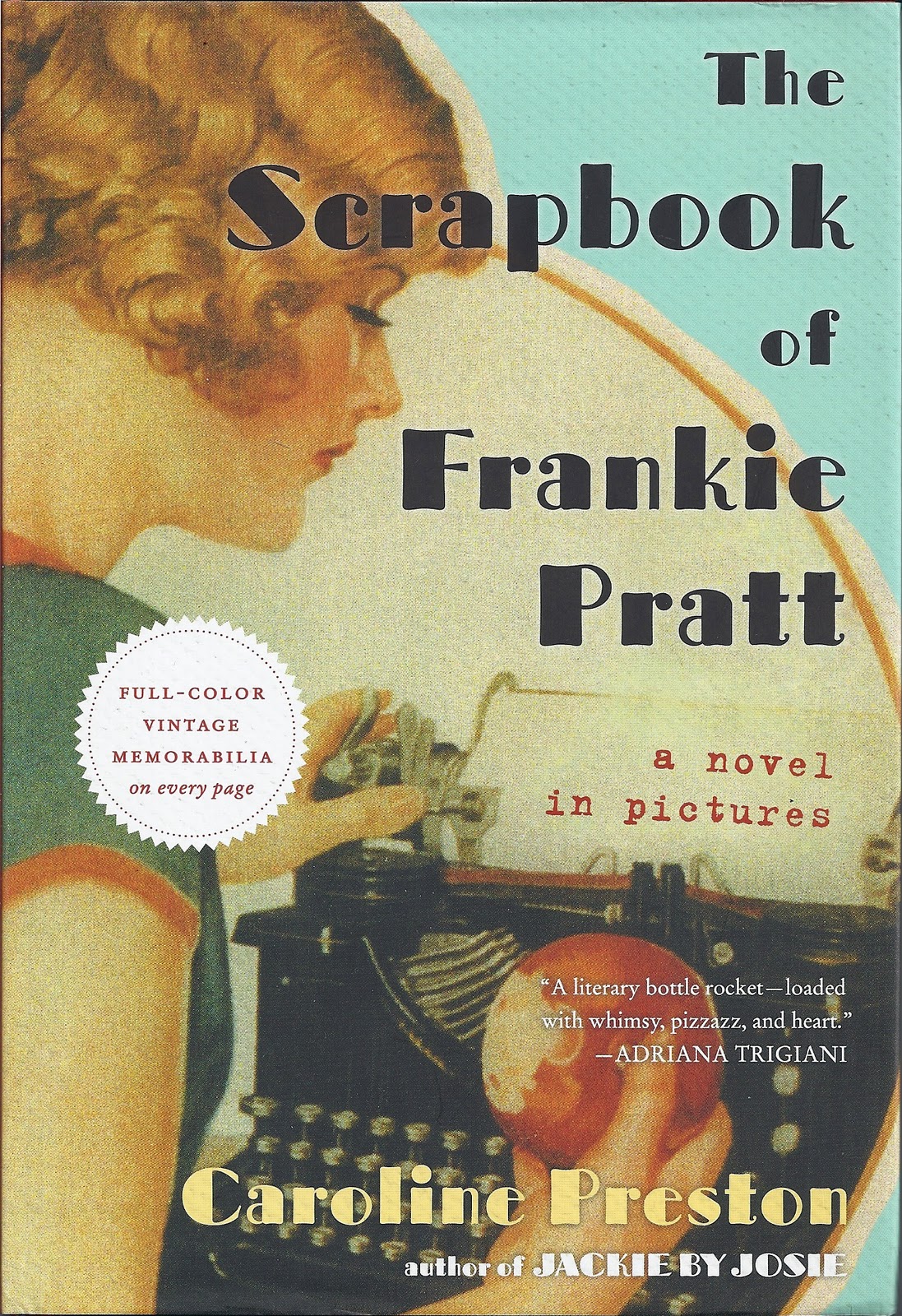
The Scrapbook is a very simple story–it’s a biography of a lady named Frankie Pratt from the ten or so years after she gets out of high school.  She went to high school in Cornish, New Hampshire in the early 1920s; that’s when this scrapbook starts.  Over the decade, Frankie goes to college, gets a job in New York City, travels to Paris and then returns home.  That is the basic plot, but that simple summary does a grave, grave injustice to this book.

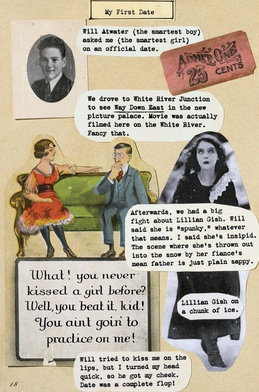
For Preston has created a wondrous scrapbook.  Each page has several images of vintage cutouts which not only accentuate the scene, they often move the action along.  It feels like a genuine scrapbook of a young romantic girl in the 1920s.

Check out the picture on the right.  Every page is like that–full of old photographs or ticket stubs, candy wrappers or advertisements.  And a few words here and there that Frankie has typed to move the story along.  It is a wondrous trip down vintage lane.

Now, as I said, the story is pretty simple (but it is befitting a scrapbook).  It showcases the highlights of Frankie Pratt’s life.  How she meets a man who wines her and dines her and treats her fine, until he reveals a shocking secret.  How she got out of Cornish, New Hampshire and went to Vassar (I admit I found this first section a little slow, but I was so absorbed in the look of the book that I didn’t really mind).

Once she gets to Vassar though, things are much more interesting because Frankie, small town girl with no money, is introduced to the rich sophisticates who attend Vassar–New York and Boston socialites.  She even rooms with one woman (who sends her down a path of debauchery and potential loss of scholarship).

Frankie longs  to be a writer, and she heads to New York to work on a magazine.  There she meets a man who wines her and dines her and treats her fine, until he reveals a shocking secret. (more…)

Read Full Post »

« Newer Posts - Older Posts »