 SOUNDTRACK: THE SWORD-Warp Riders (2010).
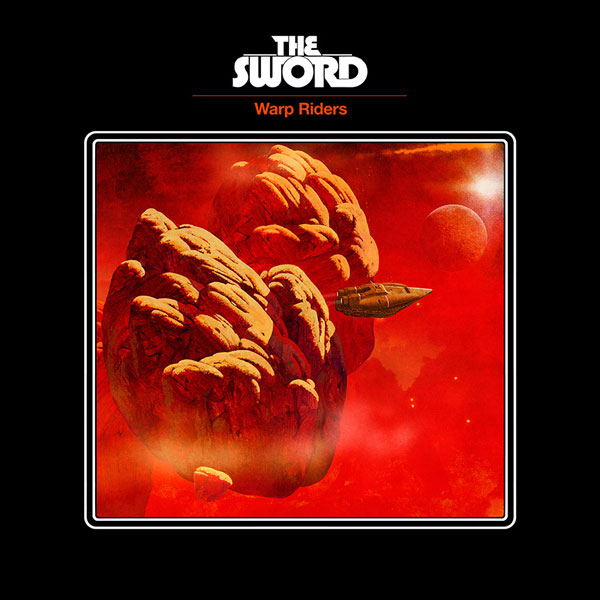 I have heard some great things about this disc from The Sword–that it was old school metal who usually sang about swords (duh) and sorcery but were warping into the future on this disc. I put the disc on and was blown away by the opening track, the instrumental “Acheron/Unearthing The Orb.” It sounds very 80s metal: heavy guitars, and great riffs coupled with tremendous solos. The second song opens just as strong but then something weird happened. I hated the lead singer’s voice (my discussion of their previous disc came to the same conclusion). It doesn’t do ANYTHING that 80s metal should do–it’s neither growling nor yelly nor operatic. In fact, once the vocals kick in, the song takes on a distinctly non-metal feel. More specifically, it feels like heavy classic rock from the 70s. The guitars are still heavy as anything, but the melody and vocals change things.
I really didn’t like the album all of a sudden, until I listened a few times and accepted that this blend actually worked. Once I acknowledged that it wasn’t what I thought it would be, I wasn’t disappointed by it anymore, and I was able to really enjoy it. “Tres Brujas” has a simply wonderful sing along chorus that I can’t get out of my head. And it continues in this vein–heavy riffs (the guitars on “The Chromancer 1: Hubris” and “The Chromancer II: Nemesis” (love the names!) are really heavy) and surprisingly catchy choruses.
The biggest surprise comes with the song “Night City” which sounds like, well, like Thin Lizzy. The macho riffs, the swagger, the lyrics, it’s all Lynott. And once I realized that, I really understood what The Sword was all about, and the disc has been in heavy rotation ever since. I don’t mean to say that I had to analyze the disc to “get” it, but once it all clicked, it clicked really well.
[READ: December 13, 2011] “The Pharmacist from Jena”
This is my first story from Michael Dahlie and I have to say that I was hooked from the start.
The story is set in 1912, when the narrator was sent from his home in Stockholm to Winslow, Indiana. He was sent to work with his uncle as a pharmacist’s assistant.
It’s in the second paragraph, after the exposition, that things take off: “My uncle was a passionate lover of cocaine and had situated himself in such a way that he supplied nearly all the nearby interested parties.” He was also renowned as a great “voluptuary and eroticist.”
There is a real plot, which gets established late in the story, but in the beginning, the story is all about the narrator’s adjustment to this life. How his aunt seemed to believe he was a girl and decorated the room accordingly. How his uncle had a fight with a bear (long story) in that very girl-themed room (long story) and how the room was soon, no longer girl-themed.
One thing I really liked about the story was the narration. Like: “At the time I was living in Winslow, it was fashionable for wives of wealthy men to suffer from mental disorders.”
His uncle experimented with shock therapy, but he mostly used it for erotic experimentation. The end of the shock experiments occurred when a local husband found out what the good doctor was doing (from the burns that his wife received at the doctors hands).
We also learn a little about the social life of the narrator (he joined a string quartet and played at the Hungarian Social Club). The quartet was quite a social highlight for the community and the men intermingled with various women, until one got pregnant. The father of the baby didn’t want the “operation” performed (by the Uncle of course) and charged in wielding a knife, only to have acid thrown in his face (it’s quite a violent story).
Several other events cause the police to come in. While the narrator’s uncle could handle the local police (he had dirt on everyone), there was no way his troubles could hold up to larger scrutiny. As such, his uncle does the “noble” thing and blames all the trouble on his nephew. The story is pretty far from over at this point, and the ending is a wonderfully exciting conclusion that adds more intrigue (and violence) to this fascinating story.
It felt like the story could have been excerpted from a much longer piece–so much potential for more details–but it worked perfectly as a short story too. I’ll be wanting to read more by this writer.

 I Just Read About That...
Leave a comment