 SOUNDTRACK: MIRANDA JULY-10 Million Hours a Mile (1997).
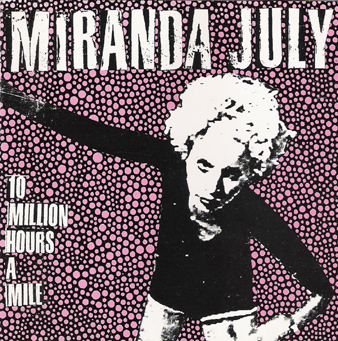 I only listened to this again after mentioning it below (I wrote about the book before the CD). I vaguely recalled this CD, but I recall buying it mostly because it came from the unquestionable Kill Rock Starts and must have gotten a good write up in some alternative rag that I read.
Basically, this is a series of performance pieces, most of which are set to music (the music is spare and basic if it’s there at all). She has multiple characters, most of whom are having a rough time.
The one thing that is overwhelmingly noticeable to me is that just about all of her characters seems to have some kind of stutter or vocal tic, which I have to say may bring verisimilitude but is also rather irritating to listen to.
Indeed, I think this is where my opinion of July stems from (see below). These are artsy pieces that were kind of the rage back in the late 90s– riot grrl takes of one-woman shows. They were interesting and maybe good for one listen, but not much else.
In hindsight, and seeing the kind of work that July has done since, it is easy to see that this is a collection of character studies like the ones that would inform her later work.
The rather strange thing is that the titles of the songs don’t match up to the performances (at least on Spotify or allmusic), I wonder what’s up with that.
There are some interesting scenes laid out here, although I find July’s delivery to be off-putting–it’s in that sPOKEn WOrd styLE where THINGS are inFLECted in a TERRibly deLIBerate MANneR. I KNOW that that KIND of emPHASis is meant to be…
….draMATic, but I’m rather glad that people have stopped doing it.
The eleven minute “How’s My Driving” is a decent example of the kind of things she does (although most of the pieces are more like 3-4 minutes). In this piece, a man (July’s voice) goes to a peep show and talks to “Penny.” Their plot line is a bizarre story in which the details of each reveal disturbing similarities until the ending is a Twilight Zone twist. This is interspersed with a girl named Penny who talks about how she first started lying, although she says driving. It’s an interesting although somewhat forced metaphor, but it’s enjoyable. The stories intertwine, growing more and more intense. Although it could probably be a bit shorter.
In “Hotel Voulez-Vous” a young girl (or boy) goes back in time to the titular hotel to convince her parents not to have her. The execution is interesting but flawed.
“The F-A-T-E” is a cool story about letting fate be your guide, but the crazy voice-noises she makes are very off-putting and kind of take away from what could be a cool twisted tale.
I guess my opinion of this album work hasn’t changed all that much. It’s got moments of interest but seems to be a little too coffee shop/navel gazing and being weird rather than good. But hey, she was young then, right?
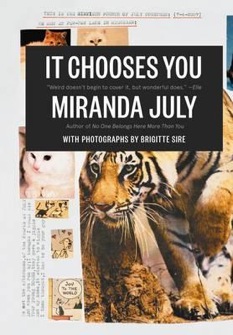
[READ: December 6, 2011] It Chooses You
I have this weird kind of relationship with Miranda July’s works. I am hesitant to read/view something, but I seem to enjoy it in the end. I’m not sure why I am so hesitant, there just seems something off-putting about, if not her, then maybe the “fame” that surrounds her. Like if she hadn’t earned her accolades.
I first found her back in 1997 when her 10 Million Hours a Mile CD was released on Kill Rock Stars. So she was kind of indie cool. And I guess she still is indie cool, but I guess it was the quality of the CD–it seems goofy at best, that makes me question the quality of her art.
But that may have finally changed with this book.
I began reading this book with that same sense of trepidation about her art–that I wouldn’t really like it. Why? Because, as with the CD, it’s seems to be all about her. And I feel like a lot of her work is about her. Nothing wrong with that, but sometimes you think, aw who cares.
What she’s talking about is her upcoming film, The Future (which has since been released). She is stuck in massive writer’s block . She hates her script and doesn’t want to look at it anymore. So, as many people do, she starts flipping through the PennySaver.
She calls up a man who is selling a leather jacket for $10. By the end of the phone call she asks him if she can come to see the jacket and maybe interview him for an extra $50. He says why not, and invites her over.
Turns out that Michael, the jacket seller, is a pre-op transsexual and his story (which she tells in small but captivating detail) is fascinating. This inspires Miranda to keep flipping through the PennySaver to meet people and interview them. It’s a weird (and potentially dangerous) way to procrastinate (she brings a friend to take pictures so at least there is some safety).
Many people refuse to meet with her (understandably) but several do. The next is Primila who is selling saris from India. She reveals herself to be strong and powerful and belies a woman who is selling saris for $5 each.
Miranda reflects on the state of the PennySaver (each one is an individual entity–the name is not copyrighted so anyone can start one) and how in the age of computers it can’t be long for this world (although most of the people she visits do not have computers). But at the same time, during a recession is when the PennySaver thrives.
The next people she meets are Pauline and her grandson Raymond. Raymond is a mannequin deliverer and he talks about meeting famous people on his deliveries. His story is fascinating but not as fascinating as Andrew’s. Andrew sells tadpoles for $2.50 each. And as Miranda talks to him, he reveals that he has been in special ed for years. Although he longs to go to college and get a degree, it becomes apparent that he likely never will. But she’s a stranger, and feels that she cannot give him any advice so she just lets him talk.
Beverly gives Miranda an inspiration. She is a woman selling baby leopards. She is so thrilled to have Miranda (and her team) over that she sets up many things for them–like a bowl of fruit to go. But it’s the intensity of the baby cats that inspires Miranda to keep the monologue from her cat in her movie.
Pam is a woman selling other people’s photo albums (which must be pretty wild). But Ron proves to be more interesting still. He prepares for her visit by laying out all of his wares and by talking to her nonstop. But when he shows off his secret, she fears that her instincts about this being a bad idea where correct. Of course, she has a film crew, so what can this guy do to her? It’s just hard to tell if his need to talk to her is from intimidation or desperation.
This leads to Miranda interviewing Don Johnson for a role in The Future. It doesn’t go well.
Matilda is selling Care Bears, but it’s her grandson who proves to be far more interesting. He has manila folders full of pictures of women and kids and jail cells and police cars and all manner of things. He creates collages of them and puts them on his wall as a kind of inspiration for his life. It’s creepy, but maybe it’s more sad than creepy. And as Miranda points out, he’s making a blog without having a computer.
Dina is selling a hair dryer, but she proves to be far more fascinating than anything she is selling. And when her daughter comes in and sings a Miley Crus song, Miranda believes she has her new actors for her movie. She makes another visit this time with a moving camera. But Dina is no longer herself and her daughter has now made up a rap of her own. The moment is lost.
Then she meets Joe. Joe is selling Fifty Christmas card fronts for $1. I’m still not sure what that’s supposed to mean, but it turns out that Joe is quite a character. He writes dirty limericks to his wife, he buries his pets in the backyard (after they die) and he has been married over sixty years. He is fascinating.
So fascinating, in fact that Miranda decided not only to use him as an inspiration for her movie (she changes plenty to now work with Joe) but to cast him in her movie.
This whole ending is amazingly touching. And feeling Miranda’s honest emotional reaction to her work is so much more interesting than her moaning about not enjoying her work (even she admits, who cares if she doesn’t finish her new movie), or her somewhat stilted performances from her CD it really packs emotional strength.
Indeed, it makes me want to see the movie now (the fact that Hamish Linklater is in it doesn’t hurt).
I thought this would be a trifle of a book but it proved to be surprisingly emotional and very powerful. I think it’s time to forgive Miranda for her earlier output.

 I Just Read About That...
Leave a comment