 SOUNDTRACK: MOGWAI-Batcat (2008).
 “Batcat” is one of my favorite Mogwai songs. The melody is intense and the drumming is wonderful. I picked up this single for the B sides (which will undoubtedly be collected somewhere one of these days anyhow, but that’s okay.
It was very hard to pass up a song called “Stupid Prick Gets Chased by the Police and Loses His Slut Girlfriend” Given that the song has “Chased” in the title, this is a surprisingly slow tune. It builds slowly over a series of keyboard waves. There’s also a slow guitar melody that keeps the piece grounded. It’s one of their more subtle songs, which again, is rather surprising given the title.
“Devil Rides” is quite jarring in that it features vocals by Roky Erickson. I don’t really know anything about Roky. I picture him as a large, unkempt man with crazy hair and a beard. His voice is otherworldly and seems to be maybe just a wee bit off from what the music is playing. It’s a strange track and works very well with Mogwai’s history of slightly off-kilter vocalists.
[READ: November 3, 2011] The Discomfort Zone
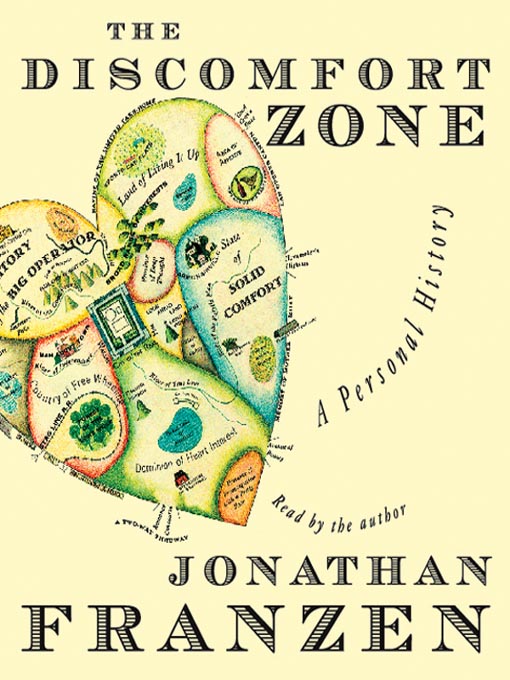
After reading The Corrections, I planned to read one of Franzen’s earlier novels. But they were all quite long (even his debut!) and I wasn’t ready to get so immersed yet. Then I found The Discomfort Zone in the biography section of the library. It was less than 200 pages and seemed like just the thing. It turns out, however, that I had read most of it already. Three of the pieces were published in slightly different form in the New Yorker: “The Retreat,” (here as “Then Joy Breaks Through”) “The Comfort Zone,” (here as “Two Ponies”) “Caught” (Here as “Centrally Located”) and one “My Bird Problem” (here as “My Bird Problem”) which appears to be unchanged.
That leaves two essays that were new to me: “House for Sale” and “The Foreign Language.”
The collection works as something of a biography, although really it’s not–it’s a collection of essays about his life, but I don’t think I would go so far as to say biography. The book also doesn’t follow a chronological order.
In many ways this is a book that addresses his relationship with his mother–she has always been a difficult figure in his life. Indeed, as “My Bird Problem” shows, for most of his life Franzen and his mother were at loggerheads–she had very strict beliefs that she expected others to share. But by the time of her death, he had finally resolved some issues with her.
The book opens with the reasonably current event (“House for Sale”) of Franzen’s mother’s death and Franzen’s task of getting her house (the house he grew up in) ready to be sold. She also stands as a figure in many of his adventures in the other stories, although it’s fair to say that she is not the focus of all of the essays. While he’s afraid of what she’ll think of him during “The Retreat” and while she sets some things in motion in other stories, those essays aren’t about her.
And in some ways that makes this collection more of an unrelated series of essays with some threads that connect them. “House for Sale” was a little slow, I felt. Possibly because it was a lot of talk about realtors (which I loathed when I had to deal with it myself). Although by the end, when it is more personal, the essay flows better.
After “House for Sale,” we flash back to “Joy Breaks Through.” This is one of my favorite pieces of his. It deals with a hippie church group called Fellowship (the kind of thing I was a bout five years to young to ever experience). It covers his pre-high school life as a major dork. His pronunciation of “dope” as “duip” will make me laugh every time I think of it.
Next comes “Two Ponies” which is about his young self’s love of Peanuts. I enjoyed this one as well. And the way he was able to tie Charles Shultz to his father’s compulsion to have the air conditioner temperature set in the “comfort zone” was pretty amazing. The title of the essay refers to a Peanuts joke.
“Centrally Located” is another favorite, although this one is tinged with more sadness. In it, Franzen and some high school friends start playing pranks. They even name their “group” DIOTI (anagram that baby). They play a few harmless pranks on the school. The best one comes attached to the title: DIOTI decided to put all of the desks in the various classrooms into one room. But in order to assuage the teacher whose room it was from thinking that she was the butt of the joke, he wrote “centrally located” on her board. (He also taped the desks’ original classroom to the bottom, which made the maintenance guy praise the behavior of kids these days).
The other new article, “The Foreign Language” was quite strange for Franzen. The article is about his time in college when he studied abroad in Germany. (Well, first it was about the German foreign exchange student who tried to teach him German when he was 10…and he was too immature to appreciate her “affections”). But when he was in Germany he did a lot if studying of old texts. And so some parts of this essay have blocks of German (translations provided). It’s a strangely intellectual aspect to Franzen that he has always shown glimpses of (his vocabulary is superb) but which we’ve never witnessed quite so explicitly before.
This essay was probably the slowest in many ways (how could it not be when he’s trying to comprehend German and see how it relates to his adolescent life?). But it was also rather satisfying once you were done. Especially since at the end, he writes a “story” about an incident that happened to him with a girl. Where fear and a new location trump passion.
The final essay is “My Bird Problem.” It take place after his mother’s death, so the book more or less comes full circle. In many ways his mother’s death is a catalyst for his new love: bird watching. As the article ends, and he ties it all back to his family, you can see the loose thread getting knotted.
It’s a very good collection of non-fiction. Franzen is not afraid to make himself look like the bad guy even as he tenaciously holds on to his principles. And, although I may not have said it, there’s a lot of humor in these incidents. It amazes me that Franzen can create so many stories out of events where not much happens–in “Then Joly Breaks Through: he’s not even a witness to the offending event, and yet the whole story is compelling. I enjoyed all of the essays, even the ones that I have now read twice (there were certainly things that were slightly different–minor things that I couldn’t pinpoint but which I think made the collection more cohesive).
These essays don’t have much to do with his fiction (except of course that his fiction is based loosely on his life)–even hs writing style is different: more matter of fact. It’s a good place to get to know Franzen before trying to tackle his 500 page books.
Clark, my six-year-old, also thought the cover was really cool.

 I Just Read About That...
Leave a comment