 SOUNDTRACK: PHISH-Live Phish Downloads 07.06.98 Lucerna Theatre, Prague Czech Republic (2008).
 This live release is fascinating to me because there’s some major mistakes during the show. It’s interesting to me that when I read other people talking about this show, they rarely speak of the mistakes. I know that any band that plays as often and for as long as Phish does is bound to make mistakes, and of course, mistakes are part of the live experience. Nevertheless, they are often jarring.
And there are three pretty big ones in this show. The first comes in “AC/DC Bag.” This one is particularly noticeable because it comes after a brief pause in the song. The band comes back in after the break and whonk–wrong chord. A similar thing happens in their cover of “Cities,” it’s a staggered musical section and whonk–they’ve missed it. But by far the most egregious is in one of my favorite songs, “Golgi Apparatus.” There’s a really wonderful musical interlude in the middle of the song. And in this version, holy cow. Trey misses the notes to start the instrumental and he just cannot find them again, so the wrongness continues for almost a full minute. It’s incredible. Trey is a pretty mellow guy, I’d love to see his reaction during all of that.
But aside from these errors, the set is otherwise really good. They come to a dead halt in the middle of a jamming, really blistering guitar solo section of “Maze” to thank the audience for coming and to apologize for not thanking them last night. It’s a weird, quirky thing to do, but it’s amazing that they then pick up the song right where they left off, blistering away to the end.
The version of “Ghost” is really fantastic with an amazing solo in the jam. There’s a funny interlude near the end of “Makisupa Policeman” in which there are John Fishman, the drummer takes a solo audience is invited to whistle when the solo has gone on too long. Amusingly, the solo is very simply a high hat and snare–no indulgences at all. The crowd starts whistling and the song ends. But the two highlights for me are the amazing 20 minute version of “Piper” with, again, an absolutely ripping guitar solo and “David Bowie, ” another great song with a cool guitar riff.
When live albums used to come out, they were polished and perfect–sometimes fixed up, or entirely recorded in the studio. In these days when bands release full concerts all the time, it’s more common to hear mistakes. But this was an offical release, one of but a handful of CD live releases, and I applaud Phish for not shying a way from a concert with some incredible highs and some major lows.
[READ: September 25, 2011] 4 books reviewed
 I’m including this other book review because I like William H. Gass and I labor under the mistaken belief that I will read all of his books some day. In the case of this review I was totally fascinated by its construct and its length (Gass is not afraid to be long-winded). The subject is Elizabeth Bishop, an author whom I know nothing about. He talks about four books by or about her, her two collections: Prose and Poems, as well as Elizabeth Bishop and the New Yorker: The Complete Correspondence and Words in Air: The Complete Correspondence Between Elizabeth Bishop and Robert Lowell.
The review opens with Gass’ serious criticism of one of Bishop’s poems (he really seems to be laying into it). He proceeds to say that back in the day (when Wallace Shawn was editor and earlier) that the New Yorker was quite different about the kind of things it accepted (wonderful examples include them not wanting to publish a poem at a certain time of year because it didn’t fit the season (!) or that the editors were uneasy about printing a poem that contained a clause about dirty underpants (!!–they published the poem but removed the clause). The prissy nature of the rejections is hilarious, especially given the kind of explicit stuff they publish now.
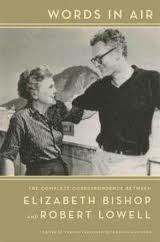 So the whole correspondence between her and the New Yorker comes in at 421 pages. While the compilations in Words in Air comes in at 875! (it is co-edited by Saskia Hamilton, who Ben Folds fans as the object of his affection in “Saskia Hamilton”). It certainly appears that she liked to communicate a lot with the editors. And some of the quotes show the casual natures of her writings. It’s fascinating the friendship they developed.
Anyhow, this review is fascinating in so many ways both for the actual correspondence and for Gass’s tone which seems like he’s put off by what he’s reading, but it’s unclear whether he is put off by the stodginess of the New Yorker or the poor quality of her poems (he really spends a lot of time dissecting that one poem, “In the Waiting Room” in particular–a really long time).
It’s a strange book review, and very enjoyable for its pecularity.
Heh, silly me. It turns out that Elizabeth Bishop was Poet Laureate of the United States from 1949 to 1950. I have to wonder when this correspondence took place–did the New Yorker really dismiss a Poet Laureate? Is William Gass dismissing a Poet Laureate? Fascinating.

 I Just Read About That...
Leave a comment