
SOUNDTRACK: TOM WAITS-Heartattack and Vine (1980).
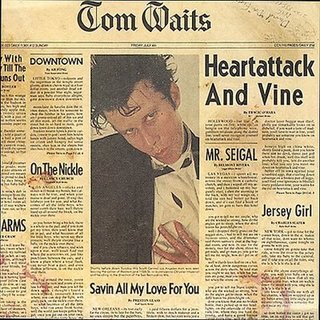 This is the final album Waits made before switching labels and starting over as a new, far more artsy artist. The album cover is crazy, it looks like a newspaper (with all the lyrics to printed like articles on the cover). And there’s a picture of Waits in a tux, hair askew, looking like the most stricken man alive. It’s not a pretty cover, but it sure conveys a lot.
“Heartattack and Vine” is agreat noisy bluesy song. It’s very simple and focuses on Wait’s lyrics and delivery: “I bet she’s still a virgin, but its only 20 after nine”). Oddly, after that great vocal delivery song, we get the instrumental “In Shades.” This has a lot of organ (which is a fairly new instrument in his repertoire) that he shows off his skills on, but it’s nothing that spectacular (and it’s recorded live apparently).
“Saving All My Love for You” is a sloppy kind of ballad (not as nice as most of his ballads), but then judging by the cover image, this is not going to be a sweet album. See also “Downtown,” another rough track like the title song.
Of course, all of the talk of gruff nastiness is rendered false by the beauty of “Jersey Girl.” Most people know the Springsteen version of this song, but (aside from the strings, which may be a bit much) I think this version exudes more real emotion. “Jersey Girl” is a really wonderful song (especially if you’re married to a Jersey girl). But what’s really great about it is that despite all of the sappy emotion (“My little girl gives me everything, I know that some day she’ll wear my ring,” there’s some great reality as well: “I see you on the street and you look so tired, I know that job you got leaves you so uninspired, When I come by to take you out to eat, You’re lyin’ all dressed up on the bed baby fast asleep, Go in the bathroom and put your makeup on, We’re gonna take that little brat of yours and drop her off at your mom’s.”
Sonically the shift from the guitar based blues noise of “‘Til the Money Runs Out” to the string laden ballad “On the Nickel” is pretty jarring. “On the Nickel” is one of Waits’ lullabies that’s not quite a lullaby. But it’s got that mournful permanence that is hard to beat from Waits (he even performed it in the 2009 concert from NPR). “Mr Siegel” is a barsy blues song (although it doesn’t sound like his earlier albums at all) and the album ends with the mournful ballad “Ruby’s Arms,” which Waits sings in his best downtrodden voice.
This album really showcases the breadth of his talents at this stage of his career.
[READ: September 24, 2o11] “The Ring Bin”
Who could even imagine what the title of this story means? It’s weird, and it has so many possibilities. By the time the answer is revealed, the story has gone in so many directions, you almost forget that you cared what the title meant in the first place.
First off, the tone of the story is bizarrely cool. After a brief, confusing introduction (we’re at a celebrity gala of some sort), the story gives us this: “That’s when our heroine’s cellphone rings.” It’s a kind of jarring intrusion by the narrator. But before we can muse on this, the crowd is appalled at her break in etiquette. And the story continues, “If these people knew the whole truth, they’d be more than annoyed.” What is going on here?
And then the narrator gives up any pretense of disinterestedness: “I should step back a moment and describe for you the big picture.” By now, as a reader you are reeling from all oft he broken rules.
And then we find that this wonderful setting, this gala, is attended only by white people (which makes them all a little uncomfortable) but that the people onstage are a veritable United Nations and that the topic of the gala is tolerance. Well, who knows what to think.
The narrator then reveals that our heroine is not embarrassed so much by the cell phone ringing, but by her ring tone, a military march composed in 1936 by Wolfgang Schimmermann–a song she likes which just happens to have been composed as Nazi song (she’s not a Nazi or even a sympathizer–why else would she be at a tolerance gala–she just likes the song). And surely that is why everyone is staring at her and surely that is why the security guard has tapped her on the shoulder and asked her to leave.
But we as readers know that that is completely unlikely, surely the security guard wouldn’t know a Nazi anthem, right? But why is he taking her away?
You see? Do you even care about te title anymore? This was a really wild and very cool story. It’s also my first by Peter Norman, and I’m really curious to see what else he can do.

 I Just Read About That...
Leave a comment