 SOUNDTRACK: JUDAS PRIEST-Sad Wings of Destiny (1976).
 Before Judas Priest were the force behind “Breaking the Law,” they were still pioneers of heavy metal. Except that their metal was tinged with all manner of odd progressive embellishments. Like “Victim of Changes,” an 8 minute (!) multi-sectioned (!) epic. It’s got a great heavy riff and, damn, if Rob Halford’s vocals aren’t the highest-piched in music (I mean, we know he has a powerful voice, but the notes he hits–good grief man!). The middle section is a delicate ballad that mellows out with breathy sighing and with very sixties-era backing vocals until Halford bursts out of that with his piercing wail.
It’s followed by “The Ripper” a classic metal song. The best known version comes from Unleashed in the East, so it’s interesting to hear this earlier version where, for instance, “You’re in for a shock,” is followed by a different person’s scream, not Halford’s wail of the word “shock.” It sounds a little slower but somehow a little more creepy (especially the quiet middle section).
“Dreamer Deceiver” is a creepy quiet song which seems to herald the vocal acrobatics of King Diamond, but this song has a lot more emotion to it, even if it is pretty trippy (like a cooler version of Black Sabbath’s “Planet Caravan,” perhaps). The piano at the end is a really nice touch and leads into the confusingly named “Deceiver,” a very chugga chugga metal song with more great high notes.
“Prelude” opens with more piano (technically this song opened the album when it was on vinyl…the cds all seem to have sides A nd B reversed so now this prelude is in the middle. It’s a dramatic near-orchestral opening (that many bands would imitate much later) to the killer track “Tyrant.” “Tyrant” sounds just as menacing here as it does on the live album except for the backing vocals that sort of slouch through the word “tyyyyyrant”–in the live version Halford crams it all into one breath. It’s followed by “Genocide” a brutal song that has withstood all of these years as an awesome metal track.
Unlike “Epitaph,” which is a completely strange ballad about a dying man. It is all piano, it is quite poetic and is indeed quite sad (especially the final line reveal). But the middle ‘upbeat” section sounds not unlike an Elton John track. It’s quite peculiar, especially when it ends and the chugging riff slowly builds out of the ashes that turns into the stunning “Island of Domination.” This is a disturbing track with really creepy lyrics but with awesome music. The middle section (again with the middle section–did bands just forget about doing cool middle sections in the 80s?) slows the track down with all kinds of echoed vocals.
Although it sounds dated, it still holds up remarkably well as a precursor to later metal albums. It’s one of my favorite Priest releases and one that I come back to time and time again.
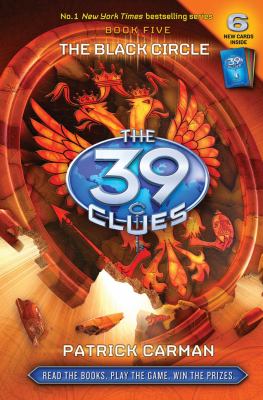
[READ: September 8, 2011] The Black Circle
I haven’t read a 39 Clues book in a couple of months. It’s not that I was losing interest, I just had other things that I wanted to read more. But I will admit that a ten-book series (and now a second series) can be a bit daunting. I’d also never read anything by Patrick Carman before, so I wasn’t chomping at the bit to get into the story again. Well, Patrick Carman has completely revived my interest in the series. The first nice thing was that the book is only 168 pages (sometimes a short book can really pick you up). But aside from that, Carman brings all kinds of cool elements into the story and has more than enough intrigue to keep you guessing and turning pages.
But I was initially concerned about reading this book because Carman reintroduces my least favorite nemeses in the book: the boring and doltish Holt family. They are big, tough, meat- heads with ridiculous political first names like Eisenhower, Hamilton and Reagan. And every time we’ve seen them, they’ve been brutish and mean and not terribly clever (and this series is chock full of cleverness, so these guys really stand out like a sore thumb). But Carman does a wonderful thing with the Holts: he forms a (temporary) alliance between Dan and Amy and the Holt family. And although it is an uneasy alliance, about midway through the book, we see Dan and Hamilton (the Holt’s son) bonding over driving big powerful trucks and flying helicopters. It’s nice to see Dan have a “friend,” however tenuous.
As for the story itself, this book is set in Russia. The beginning is quite funny as they sneak out on their au pair (who I like very much) and she doesn’t appear in the book at all. There are a couple of phone messages with her (and a wonderfully planted suspicion that I hope pays off in some way later on). As in the other books, the country is as much a character as anyone else, and Carman does a wonderful job using landmarks, Russian history and Russian nature (the Holts spend a lot of time in Siberia) to really being depth to this chase.
The most surprising thing about this story, though is that the kids suddenly start receiving information from someone named NRR. They immediately wonder if they should trust NRR, and yet in the initial message, information that they believed only their grandma Grace knew is revealed. Surely this NRR must be a friend, right? But they don’t know anyone in Russia. And how could NRR keep leaving clues for them? And what do NRR’s clues have to do with their quest for the 39 Clues?
This book takes them into Russian buildings with wonderful secret codes and passages. It takes them into theatres and tombs, museums and hotels and each one has a cool aspect that the kids need to figure out. I love that Amy (the book lover of the two kids) finds a Russian guidebook and is able to use it to help with the clues. But even more I love that Carman plays around with history. So, the kids need to find The Amber Room, an actual historical room called the eighth wonder of the world, that was stolen by Nazis (how do you steal a room?) and ultimately lost and never recovered. But in this story, the Amber Room was located by one of the Cahill families and is in their custody. They also travel to the Alexander Palace and the State Kremlin Palace. And since the story made me look into all of these factual locations, it may get other kids to do the same.
But beyond all of the cultural references, this is an exciting story. Who can Amy and Dan trust? In previous books they could trust no one, but in this one, there’s evidence that they can trust people. But how do you hunt for a prize that your friends are hunting for–especially if they seem like they will stop at nothing to win? What does an alliance do in a competition? And just how many rubles does it cost to buy a Kit Kat bar?
The book ends on an optimistic note. There is no indication of where they are headed next, but I’ll be reading about it right away.

 I Just Read About That...
Leave a comment