 SOUNDTRACK: RUSH-“You Can’t Fight It” (1973).
 This is the B-Side of the first single Rush ever released (The A Side: a cover of “Not Fade Away”). It was released briefly but has been long out of print. Thankfully, people on the internets have access to all kinds of things. It’s pretty clearly Rush–Geddy sounds right, and it sounds like an Alex solo, so I think it’s fair to say that this is genuine.
It’s a pretty decent hard rock song from the 70s. It sounds like it could be from any of the second tier bands back then. It’s got some boogie and some swagger and it seems like it’s not about anything important (rock n roll, apparently).
While I’m obviously glad that Rush went on to bigger and better things, it’s fun hearing how confidently they fit into the context of music by their heroes. This song has a cool riff, it’s quite heavy and it shows promise.
For a band that never releases B-sides or rarities or anything like that, I’ve been pretty surprised to see what is in their internet closet.
Enjoy!
(By the way, I’m not advocating the visuals of the video–I haven’t actually “watched” it–just the audio).
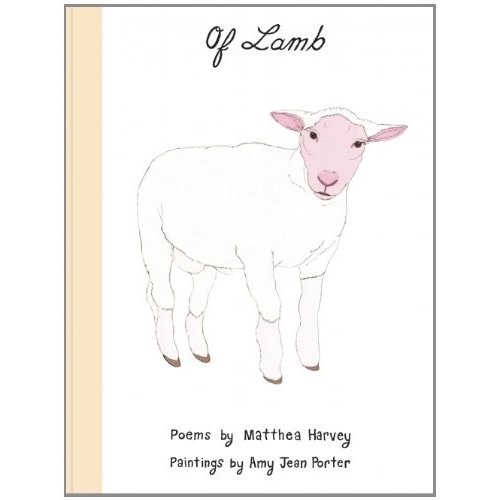
[READ: August 25, 2011] Of Lamb
This book is sort of subtitled: Poems by Matthea Harvey, Painting by Amy Jean Porter.
It’s the “poems” part that I have a hard time with, actually. But let me get to that in a moment.
This book takes a nifty idea (an idea very similar to one that Jonathan Safran Foer is using in Tree of Codes, which, see tomorrow’s post) and fully realizes it. But what’s funny is that she doesn’t tell you what this idea is until the afterword of the book. So while I was reading it I wasn’t really sure what I was seeing. The afterword made me say Oh, I get it now. But I don’t feel that I can review it without explaining what she has done. So, if you don’t want to know anything about the “secret” behind the book, skip the next paragraph.
[Spoiler? Maybe.]
Okay, so essentially what Matthea has done is, she has taken a book at random (literally one she bought for $3 at a used book store), in this case, A Portrait of Charles Lamb, and she has created her poems out of that book. In other words, on every page, she would find the words that she wanted to keep and she whited-out everything else (you can see an example in the book). But rather than presenting the work like that, she had Amy Jean Porter make weird and cool paintings to go with every page’s worth of text (I assume Porter did the lettering as well?). Since the book is about Charles Lamb, it was very convenient that his sister’s name was Mary. So there was a Mary and a Lamb on almost every page. Hence this sort of update of the Mary Had a Little Lamb story.
[end possible spoiler warning]
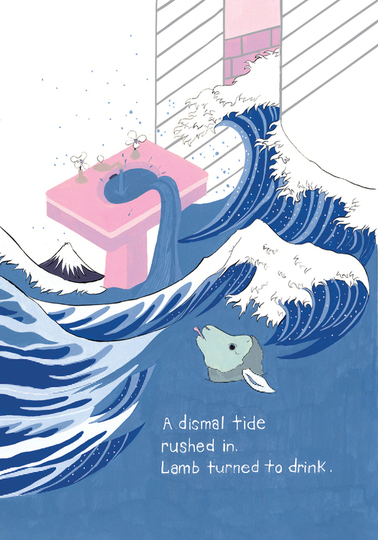 But so this is why I have a hard time with the idea of poems. It seems like one long piece. I mean, as poetry, the individual pages don’t really work . Surely
win-ter
wash-ed
by
doesn’t constitute a poem, does it? Although there are single pages that are quite evocative:
For Lamb,
white-faced,
fettered,
time was full
of time.
That’s very nice.

As a collected singular poem, however, the book is quite interesting. Even though the story doesn’t make “sense” exactly–the plot is forced and unreal for much of the story–it is more of an abstract concept that we’re working with. And the paintings really help to broaden the ideas and make them work for or against each other.
It’s a risky proposition to base your words entirely on the words of others, but sometimes real magic can happen.
As for the “story” itself, I’m not sure that there’s all that much to it. It’s not exactly a spoof of Mary Had a Little Land, nor is it an update of any kind. It ‘s sort of an absurdist extrapolation of the children’s story.
Although for me, this is a book of paintings by Amy Jean Porter that happen to have words attached to them (much like Dave Eggers’ collection of paintings with words, It is Right to Draw Their Fur). I rather like the way the words and the pictures interplay (even when the paintings are slightly off–there is definitely something peculiar about Mary). So, yes, each page is quite cool, even if I can’t see them as individual poems. But the overall story just doesn’t seem to work for me.
That’s okay, I’ve still got the pictures.

 I Just Read About That...
[…] this book follows the exact same logic as Of Lamb. But unlike Harveys’ execution, in which she wrote out the words and made them into her own […]
[…] « Matthea Harvey–Of Lamb (2011) Yosef Hayim Yerushalmi–”Gilgul” (New Yorker, August 15 & 22, 2011) […]